Keeping Gaza Children’s Stories Alive
David Heathfield is a world storyteller, teacher trainer and writer from Exeter, UK. The author of two books – Storytelling with our Students and Spontaneous Speaking (both DELTA) and numerous articles and book chapters, he provides storytelling courses and coaching for teachers worldwide via Zoom.
This article was first published in the May 2026 edition 310 of IATEFL Voices magazine and is republished with kind permission.
On 1 January 2024, Haneen Khaled Jadallah from Gaza was staying with my wife Tammy and me in our home. We were talking about stories told in English by children in Gaza. Out of that conversation came a simple plan: not just to invite people to listen to those stories, but to retell them.
That day Tell a Child in Gaza’s Tale was born.
The invitation was deliberately open. There are no rules about how a story should be retold. You can tell it in English, or in another language, or in several languages. You can share it with your students in a classroom, with family or quietly with one other person. You don’t even need to record it. What matters is respect: honouring the child who chose to share their story and keeping their story alive by passing it on.
Many people do choose to record themselves. Today there are over 400 video recordings: around 130 tales being told by young Palestinians, mostly from Gaza, and more than 380 retellings by people around the world. This volunteer-led project continues to grow, carried by teachers, storytellers, parents, students and listeners who believe that stories matter.
The young Palestinians in Gaza and most storytellers participating worldwide are themselves learners of English and the impact of learning and retelling stories on their confidence and fluency as English users is significant, particularly those who regularly tell stories.
Stories told under impossible conditions
Internet access in Gaza has always been fragile. Since October 2023 it has become extraordinarily difficult. Now in 2026, connection is less reliable and more intermittent than ever making live online link-ups almost impossible. Most of the children whose stories we retell today have survived the genocidal onslaught of the past nearly three years. Others’ circumstances are unknown. Families and teachers have been displaced again and again.
What colleagues and friends in Gaza consistently say is this: keep telling the stories. Whether the child is still with us or not, the stories were chosen. They are part of the child’s culture and identity. Retelling them is an act of responsibility as well as solidarity.
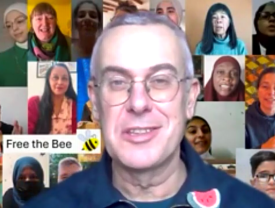
At our recent Free the Bee Zoom event, marking two years of the project Tell a Child in Gaza’s Tale, I lit a candle in a Palestinian candle holder. Most participants were teachers of English around the world and many of them lit candles too.
Some of us retold stories. All of us listened. All of us bore witness.
Hala: stories, medicine and mirrors
Among the most prolific young storytellers in Gaza is Hala. I first met her online at the World Storytelling Café when she was just 13. Young International Storytellers is a regular Zoom event I helped establish during lockdown in 2020 and she has never stopped joining. She continued telling stories as the violence intensified, even when bombs are falling on her neighbourhood. English Teacher, Teacher Trainer and Storyteller Manuela Kelly Calzini in Italy, who coaches Hala, said “Rehearsing with Hala and her sister humbled me and showed me what dignity and hope really are.” Hala’s stories have brought people together around the world.
Now 19, Hala has begun her medical studies. She hopes one day to continue her training outside Gaza, but for now she is studying under conditions most of us can barely imagine. Despite this, she still finds time to write – and to tell stories.
A few days before the Free the Bee event, Hala recorded a brand-new story for us. This was its first public sharing.
The Dog and the Hall of Mirrors
(told by Hala, Gaza)
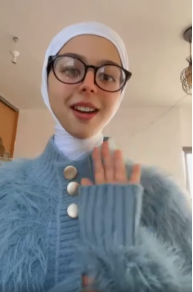
Hi, I’m Hala. I’m 19 years old. I’m from Gaza, Palestine. Today I will tell you a story. The name of my story is The Dog and the Hall of Mirrors.
Once, not twice, not three times, but once upon a time, there was a dog, just an ordinary dog, curious, lively, and full of life. One day, this dog wandered into a museum, but not just any museum. Oh no, this was a museum made of mirrors.
Mirrors on the walls, mirrors on the ceiling, mirrors on the floor, mirrors on every door. Everywhere the dog looked – mirrors. Can you say it with me? Mirrors everywhere. Yes. Mirrors everywhere. Shining, gleaming, dazzling.
The dog took one careful step and stopped. He saw another dog. And another. And another. A whole pack of dogs. The dog growled. He showed his teeth. The dog barked. And guess what? All the other dogs did the same.
He jumped forward – they jumped forward. He leaped back – they leaped back. Round and round he ran, barking, growling, showing his teeth, and everywhere the same angry faces barked back.
The dog barked and barked and barked. He tried to scare them away, but they stayed. He barked louder. They barked louder. All through the night – until there was silence.
In the morning, the museum guard opened the door. And there on the shining mirrored floor lay the poor dog, still and lifeless, surrounded by hundreds of reflections of himself.
No one had harmed him. No one had chased him. He had been angry only with himself.
And that, my friends, is the story of the dog in the hall of mirrors.
What do you see when you look at the world? Because the world – yes, the world – will not bring you good or bad on its own. Everything you see, everything you feel, everything you do is reflected right back to you.
The world is nothing but a great shining mirror. So, when you stand before it, stand carefully, stand kindly, stand wisely.
And remember: what you see is what you bring.
My story did I tell, in your heart let it dwell. Goodbye.
There was a quiet pause after the story ended. As teachers, many of us felt it deeply. Here was a life lesson offered not from a place of safety, but from within catastrophe – and offered with generosity.
There are so many ways to meaningfully include stories told and written by young Palestinian storytellers in our work as educators.
Here is a suggestion which you can easily adapt according to the profile of your students:
- Learn and tell The Dog and the Hall of Mirrors to your students.
- Your students discuss what the story means to them.
- Tell your students an anecdote from your own life experience which the story reminds you of.
- Now outline the context in which Hala, a future doctor from Gaza, told the story on 26 December 2025 and play the video recording. Share the YouTube link.
- Your students can now listen, learn and practice telling the story themselves in preparation for the next class. In the next class they can get into pairs and tell each other The Dog and the Hall of Mirrors. They can tell related anecdotes from their own lives and discuss them.
Later in our Zoom event, Evi Karydi, an English teacher and teacher trainer from Greece, retold The Old Man and the Young man on the Train, another story she had heard from Hala. Evi said “I have to admit Hala is one of my favourite storytellers. This specific story has stayed with me from the moment I heard it. All her stories are wise.”
Two months after Free the Bee in February 2026 Niroda from Aberdeenshire, Scotland and originally from Syria sent me a recording of herself retelling The Dog and the Hall of Mirrors for it to be shared as part of Tell a Child in Gaza’s Tale. She had learned the story from Hala in Gaza and wanted to retell it in solidarity with Hala.
Gaza Girl: writing a future into being
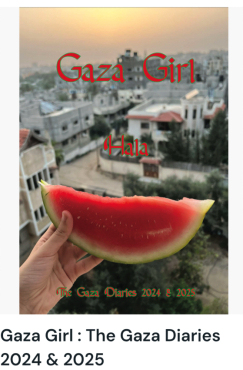
Hala doesn’t only tell stories. In 2025, with the support of a group of us at the World Storytelling Café, she published a beautiful book: Gaza Girl: The Gaza Diaries 2024–2025. All proceeds go directly to Hala and her family. During the event, I read the introduction so listeners could hear her voice on the page.
My given name means the aura of light surrounding the moon. Perhaps it’s my destiny that the moon be my most faithful companion. I hope to reflect her light on my homeland, then on the world.
I often hesitate to write a book. I fear starting something I may not be able to complete. My life is in constant danger at every moment. Something shocking always happens.
A voice pierces my ears. Dust and screams, ending with a child or a girl my age being orphaned. A mother losing her children or her husband. The martyr is carried in his shroud and escorted to a funeral. But today funerals are not held. Burial is in a mass grave.
If your body’s found intact, they might only find a hand or a leg. Or your family might identify you and you might be buried with other remains.
I apologize, reader, but this is just a small part of my life.
I am a young girl. I make mistakes and learn from them. I grow, and then the next shock arrives.
Can I really look towards my dreams?
My dream: to look at the moon, hoping to one day look at it with eyes filled with happiness with the one I love.
To live in a safe, warm house with wide windows that protect me from the noise of the world and allow me to observe it.
To wake up one day with a heart free of pain, a mind free of worries, and eyes free of tears.
To see a sky full of stars undisturbed by warplanes. To feel no confusion between a bomb exploding or a twinkling star.
And to remind myself that everything changes – that the sun will rise, that the clouds will pass, and that life goes on.
For teachers of English, this writing is a reminder: language is not just a system to be mastered, but a lifeline, a form of resistance, and a way of imagining futures that do not yet exist. I recommend this book as a class reader which your learners can read, respond to and be inspired by.
What we learn from our students
As teachers, many of us spend our lives believing we are the ones who teach. Projects like Tell a Child in Gaza’s Tale remind us how much we learn from our students – from their wisdom, their creativity, their moral clarity and their courage.
Storyteller and teacher Veena Hasan from Assam, in northeast India, said during the event, “Every time I tell a child in Gaza’s tale, I develop a bond with all the children – and it makes me feel so happy.”
Mexican storyteller and educator Rebeca Robles said “I feel really proud of being part of this project because for me it is a way of keeping children's voices alive.”
That, ultimately, is what Tell a Child in Gaza’s Tale is about: freeing stories to travel, to be retold, to form bonds across classrooms, cultures, and continents.
As long as these stories are told, the children who chose to share them are still being heard.
References
Free the Bee, marking two years of Tell a Child in Gaza’s Tale https://youtu.be/PShEFrTJ0kU?si=jr9InvpajRrr2P6d
Hala tells The Dog and the Hall of Mirrors https://youtu.be/Y2urAw5wlBc
Niroda from Aberdeenshire, Scotland and originally from Syria retells The Dog and the Hall of Mirrors which she learned from Hala in Gaza https://youtu.be/E8CkoJv3tQI?si=NnjMUrOSj3HJkw9q
Gaza Girl: the Gaza Diaries 2024 & 2025, Navigator Press 2025 all donations go to Hala and her family in Gaza (you can order a single copy but I recommend getting a whole class set) https://ko-fi.com/s/b1db673c55
Here is Hala’s fundraiser https://gofund.me/aea75bf8b
Here is the Tell a Child n Gaza’s Tale index of stories: https://drive.google.com/file/d/1BKu7JPXmONEB6y5cbeGlUW6zWi3SmRAP/view
Here is the ever-growing public playlist 'Tell a Child in Gaza’s Tale' https://youtube.com/playlist?list=PLj-mcWeMmSZw63V5abQ4fw3JIITI_S_kS&si=du47VczUOOkf3dQo
Coming soon! Please check the Pilgrims in Teacher Training courses in 2027 at Pilgrims website
Where have the words gone?
Alan Maley, UKLosing my muse
Rod Bolitho, UKWhat Do You See?
Jamie Keddie, SpainMy Road Unfolds as I Walk
Phuong thi Anh LE, VietnamKeeping Gaza Children’s Stories Alive
David Heathfield, UK