When the Earth Comes as a Guest: A Lesson Outline Based on the Text-Driven Approach
Zerin Koyuncuoğlu is an undergraduate student in the English Language Teaching (ELT) Department at Kahramanmaraş Sütçü İmam University, Türkiye. She is interested in creative thinking and writing, and in designing innovative lesson plans that move beyond traditional, one-size-fits-all lesson structures. Email: zerinkoyuncuoglu@gmail.com
Ufeyra Hopurcuoğlu is an undergraduate student in the English Language Teaching (ELT) Department at Kahramanmaraş Sütçü İmam University, Türkiye. She is interested in research, academic writing, and developing engaging and innovative teaching materials using technology. Email: ufeyrahopurcuoglu@gmail.com
Introduction
The well-known statement “If we teach today’s students as we taught yesterday’s, we rob them of tomorrow”, often ascribed to John Dewey, but possibly not belonging to him (Thayer, 2014), emphasizes the importance of designing lessons that respond to learners’ realities rather than relying on routinized instructional practices. This perspective is especially relevant in foreign language teaching, where sustaining engagement and meaningful interaction is crucial to convert instruction into meaningful experiences for learners by addressing global issues.
Selecting creative and engaging texts plays a central role in this process. They can enrich the materials offered in coursebooks (Rathert & Cabaroğlu, 2022). Thoughtfully chosen texts can stimulate learners’ imagination, foster emotional and cognitive engagement, and provide opportunities for meaningful language use. They also serve as models for grammar, vocabulary, and writing development, while connecting learning to learners’ experiences. The text-driven approach (Tomlinson, 2003) positions texts as the organizing core of the lesson, allowing learners to interact with meaning before focusing on isolated language forms. Following Tomlinson’s (2003) text selection criteria - clarity, relevance, emotional involvement, and meaningful content - supports both effective language learning and personal engagement with the material.
This paper presents a lesson plan illustrating how creative text selection, guided by text-driven principles, can enhance learner motivation, critical thinking, and meaningful classroom interaction.
Text-driven Approach
The lesson presented in this paper follows the text-driven approach (Tomlinson, 2003, pp. 119–121). In this approach, the text functions as the starting point of the lesson and shapes both the content and the language-focused work, rather than being used merely to practise pre-selected grammatical structures. Learners are initially encouraged to engage with the text as a meaningful whole and to respond to it personally before their attention is directed towards specific language forms. A central principle of the text-driven approach is that emotional and cognitive engagement with a text should precede detailed language analysis.
In line with this principle, the lesson is organised into a sequence of five stages that guide learners from preparation to meaningful language use. Readiness activities aim to prepare learners for the topic by activating prior knowledge and creating interest. Experiential activities allow learners to encounter the text holistically, with a primary focus on understanding meaning. During the intake response stage, learners reflect on the text and develop their understanding by expressing personal interpretations. The input response stage draws attention to how meaning is conveyed through language, supporting awareness of form–meaning relationships within the text. Finally, development activities provide opportunities for learners to use language creatively and meaningfully, extending learning beyond the text itself.
Integration of the SDGs into lesson plan
The Sustainable Development Goals (SDGs), developed by the United Nations, provided a conceptual framework for the lesson rather than determining its structure. The lesson focuses on ecological sustainability, addressing themes such as protecting natural resources, reducing pollution, and caring for land and water, corresponding to Life on Land (SDG 15), Life Below Water (SDG 14), and Clean Water and Sanitation (SDG 6) (United Nations, n.d.).
Beyond ecological concerns, the lesson intentionally incorporates cultural and social dimensions to support the transmission of values to younger generations. Highlighting the concept of hospitality, which occupies a central place in Turkish culture, allows learners to connect environmental and social responsibility to familiar practices of care, respect, and shared responsibility. By presenting the Earth as a “guest,” the lesson not only engages learners in meaningful reflection but also encourages a transformative approach to learning, promoting the internalisation and continuation of culturally valued practices in a contemporary context.
Lesson outline
Selection of the Topic, Materials, and the Text
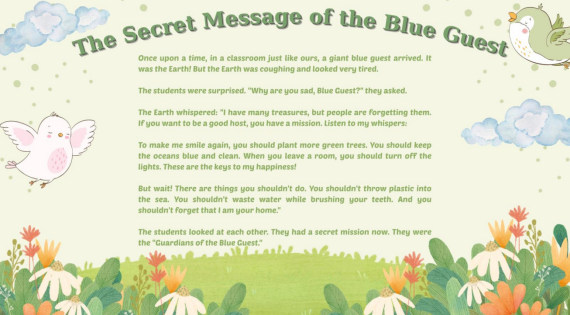
The lesson outline below is based on the text-driven approach (Tomlinson, 2003). It was designed for sixth-grade learners aged 11–12 at A1–A2 level in a Turkish public middle school context, although it can be adapted to comparable educational settings. The main text used in the lesson is a fairy tale entitled “The Secret Message of the Blue Guest”, written specifically for the purposes of this lesson. The authors of this paper composed the text and used AI for language editing purposes. The text focuses on environmental awareness and introduces the idea of caring for the Earth by presenting it metaphorically as a guest.
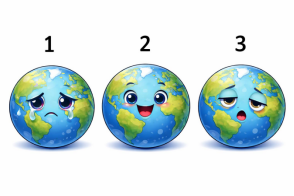
In addition to the written text, the lesson incorporates visual materials, including an Earth model and pictures showing different emotional states of the Earth, as well as listening input through teacher-led storytelling. These materials were selected to support comprehension and to address different learning preferences.
Considering the learners’ age, language level, and cultural background, the topic was chosen because it was expected to be familiar and meaningful for the target learners. The cultural value of welcoming and caring for guests, highlighted in the Turkish as well as in numerous other cultures, is well established among learners and enables them to relate their everyday experiences to the environmental message of the lesson. For this reason, the topic was considered suitable for engaging learners both cognitively and affectively.
Stage 1: Introducing the ‘Secret Guest’ (Readiness)
The teacher enters the classroom holding an Earth model covered with a cloth. Without revealing what it is, the teacher invites learners to guess who the “secret guest” might be. This immediately arouses curiosity and creates a sense of anticipation. Once the object is revealed, the teacher leads a whole-class discussion by asking questions such as:
How do we treat guests at home?
What makes a guest feel happy and comfortable?
Stage 2: Activating Background Knowledge about the Earth (Readiness)
The teacher draws a simple picture of a sad Earth on the board and asks learners why the Earth might be “crying.” Learners brainstorm reasons such as pollution, dirty water, or cutting down trees. The teacher then draws a happy Earth and elicits ideas about what could make the Earth happy, for example planting trees or keeping the environment clean.
Stage 3: Preparing to Experience the Text (Experiential)
The teacher tells learners that they are about to listen to a fairy tale about the Earth. Learners are asked to close their eyes and imagine the Earth as a character. They are encouraged to think about how the Earth looks and feels while listening to the story.
Stage 4: Listening to the Fairy Tale (Experiential)
The teacher reads the fairy tale aloud at a natural pace. Learners listen without interruption. The emphasis is on understanding the overall message and emotional tone rather than individual words or structures.
(Imagery generated using AI.)
Stage 5: Visualizing the Earth (Intake Response)
After listening, learners work in small groups. The teacher shows three pictures of the Earth: one happy, one sad, and one tired. Each group discusses which picture best matches the Earth they imagined while listening to the story and explains their choice to their group members.
(Images generated using AI.)
Stage 6: Discovering the Earth’s ‘Secrets’ (Intake Response)
Learners look again at the ideas written on the board in Stage 2. The teacher then delivers copies of the fairy tale, so that the learners read it in their groups and try to find new “secrets” or rules that can help make the Earth happy but have not been mentioned earlier.
Stage 7: Sharing and Comparing Ideas (Intake Response)
Learners form new groups and share their ideas from Stages 5 and 6. By comparing their interpretations, they realise that different readers may focus on different aspects of the same text.
Stage 8: Focusing on Language for Advice (Input Response)
The teacher asks learners how the Earth gives advice in the story and draws attention to the words should and shouldn’t. Learners reread the text and highlight examples of these structures.
The teacher briefly explains how should and shouldn’t are used to give advice and monitors pair work while learners find examples in the text.
Stage 9: Writing a ‘Secret Letter’ to the Earth (Development)
Learners work in pairs and imagine that they are “Guardians of the Earth.” They write a short secret letter to the Earth, using should and shouldn’t to give simple advice, such as protecting animals, saving water, or planting trees.
Stage 10: Reflecting on the Core Messages (Development)
Learners reread the fairy tale and focus on two key ideas: the Earth’s “treasures” and the sentence “I am your home.” They discuss in groups what these expressions mean. Learners are allowed to use their first language if needed to express deeper ideas.
References
Rathert, S., & Cabaroğlu, N. (2022). Theorising textbook adaptation in English language teaching. CEPS Journal, 12(2), 169-188. https://doi.org/10.25656/01:25227
Tomlinson, B. (2003). Developing principled frameworks for materials development. In B. Tomlinson (Ed.), Developing materials for language teaching (pp. 107–129). Bloomsbury Academic. https://doi.org/10.5040/9781474211826.ch-006
Thayer, T. (2014, August 28). Who said, “If we teach today’s students as we taught yesterday’s, we rob them of tomorrow.”? Education4site. https://www.education4site.org/blog/2014/who-said-if-we-teach-todays-students-as-we-taught-yesterdays-we-rob-them-of-tomorrow/
United Nations. (n.d.). The 17 Goals. Department of Economic and Social Affairs Sustainable Development. https://sdgs.un.org/goals
Coming soon! Please check the Pilgrims in Teacher Training courses in 2027 at Pilgrims website
When the Earth Comes as a Guest: A Lesson Outline Based on the Text-Driven Approach
Zerin Koyuncuoğlu, Türkiye;Ufeyra Hopurcuoğlu, TürkiyeSix Mnemonics for English Teachers: Help Them Remember Stuff
Lindsay Clandfield, UKEnglish as a Medium of Instruction: Print-out Tools to Support EMI and CLIL Programmes, from Oxford University Press