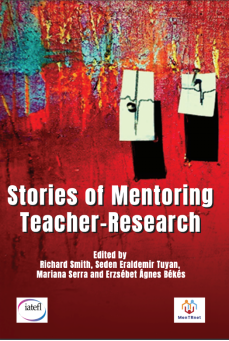
Review of Stories of Mentoring Teacher-Research
Acknowledgement
Many thanks to Erzébet Ágnes Békés is from Hungary for her help.
Title: Stories of Mentoring Teacher-Research
Editors: Richard Smith, Seden Eraldemir Tuyan, Mariana Serra, & Erzsébet Ágnes Békés
Publisher: IATEFL Research Special Interest Group in Association with MenTRnet
Year: 2024
Place of Publication: IATEFL
ISBN: 978-1-912588-50-3
You can download the book here.
The chapters in Stories of Mentoring Teacher-Research aim at presenting how mentors work and support their mentees, namely their teacher-researchers when the latter face classroom issues. The stories provide examples of how problems are identified and how they might be resolved. For this reason, this slim volume can provide food for thought for mentors who facilitate teacher-research using Exploratory Action Research as their approach, but mentors of other kinds of classroom research may also benefit.
After reading the stories of the teacher-research mentors in the book I am reviewing, I felt that it helped me understand my own teaching experience expanding over more than fifteen years, during which I have taught English and mentored new tutors at Savannakhet University, Laos PDR. While delving into this concise collection of reflective stories, I found each page echoing my own daily experiences in the staff room and beyond. Across its engaging chapters, the authors chart how steady, kind guidance can engage both mentors and mentees. The process mirrors every late afternoon I have spent listening to nervous beginning teachers aiming to find their classroom voice.
The editors deserve praise for collecting such a varied set of voices without leaning on jargon or theoretical models. Instead, they steer us toward lived moments that feel immediate and true. Most contributors come from countries in the Global South, so their stories expand the global conversation about teacher development and remind us that effective mentoring wears many cultural costumes. Every chapter weaves together small struggles, quick decisions, and honest pause-for-thought into a bright cloth we can see and touch, rather than an academic article we have to digest diligently. Whether a mentoring meeting was formally scheduled or was a casual chat over coffee, each vignette contains a lesson worth sharing.
As these many strands cross, the different shapes of the teacher-researcher mentoring phenomenon slowly unravel, showing how context, trust, and curiosity overlap in diverse classrooms around the world. Stories of Mentoring Teacher-Research really digs into what mentoring looks like for teacher-researchers and their mentors, and how it plays out in all sorts of different settings. In places where life is tough, such as in Iraq, mentoring can be a lifesaver. Meanwhile, in Cameroon, technology is helping teachers connect and grow, even when they are hundreds of miles apart.
The book consists of interwoven narratives that highlight varying types of mentoring relationships. All chapters describe the processes through which mentors and mentees evolve together, defined by trust, imagination, and collaboration. I was particularly interested in this book because these stories demonstrate that mentoring does not have to be systematic; more often than not, it relies on compassionate and attuned presence. This book illustrates that a productive teacher-researcher is born from deep personal bonds rather than flawless methodologies while letting everyone share what they have faced, and how they solved a given issue.
The variety of voices and experiences adds depth and highlights empathy and community building while pushing back against the usual ideas of professional development. I've seen that some of the best mentoring moments can come from unexpected chats, a shared laugh, or a few kind words. Those little moments can lead to big changes, making me a firm believer in the informal side of mentoring, which often doesn't get enough attention.
This book made me think a lot, especially about how mentorship needs to be flexible and understanding. Just like the mentor in Cameroon, Eric Ekembe, whose chapter is titled “Mentoring a large group of teachers in Africa: A journey into myself”, I've learned that true support has to consider the feelings and situations of the teacher-researchers whose work we want to help. This realization has reignited my passion for mentoring and reminds me of having to be more present and purposeful in my approach. Though impactful, I wish there was a bit of an introduction for those new to Exploratory Action Research EAR, and perhaps a final chapter to tie together the main points and lessons from the different stories could have added more coherence. Also, while the narratives are rich with learning, I think a little more critical look at the ups and downs of various mentoring styles could have been useful. However, the good points of this book far outweigh the gaps or omissions. It invites us to think and adapt when it comes to developing teachers. It's a meaningful and timely contribution to the field, offering a wealth of insights that resonate with us.
In a space often filled with Western ideas, this book does a great job of highlighting voices from other regions, such as those in the Global South. It fills a huge gap in the literature on mentoring through Exploratory Action Research, giving readers practical as well as emotionally charged insights grounded in real-life experiences. One of the best parts is how it presents flexible mentoring models that can really last, even in resource-poor settings; a mentor, who has never given up, tried to use many ways to help their mentee, such as using regular phone calls and WhatsApp messages to support a novice teacher. Such examples challenge the belief that effective professional development has to come with a big budget or some official backing. Instead, it’s all about showing up, caring, and having ongoing conversations. The stories are powerful reminders of how mentoring can transform teaching and lives, whether in war-torn cities, rural schools, or busy urban universities. This book celebrates resilience and innovation, motivating educators to rethink how they develop professionally and help their communities.
My own views on mentorship and education have shifted a lot, thanks to this book. It goes beyond just sharing stories; it ties together common educational experiences, challenges, and successes that hit home for anyone involved in teaching or learning. It encourages us to foster environments where growth can happen by being open and vulnerable. The insights are crucially important for trainers, educators, and policymakers, especially in places facing social inequalities. This book offers hope by guiding those involved toward kinder, better ways of learning. It reminds us to appreciate every interaction, since each one has the power to change lives and communities.
Altogether, this isn’t just another education book; it aims to create a space where different voices come together by sharing knowledge and collaborating. The message is straightforward: teacher-researchers, whether they are seasoned practitioners or just starting out on their journey to carry out EAR, can benefit from crucial connections established during mentoring on the path to mutual understanding, and this book encourages them to do just that.
For another review of the book in HLT look here.
Please check the Pilgrims in Segovia Teacher Training courses 2026 at Pilgrims website
Short Book Reviews
Hanna Kryszewska, PolandReview of Stories of Mentoring Teacher-Research
reviewed by Khanthanaly Panvilaysone, PDR LaosThe Art of Sensitivity in Awareness: an Extract from "Is AI making our kids stupid?”
Roy J Andersen, UKNews from DELTA Publishing
Message from Oxford University Press