Visual Impact in Teaching Materials
In my workshop at IATEFL Brighton 2026, I asked my audience to try out a number of activities exploring the use of visuals including photos, diagrams, and drawings. The following article is a summary of that session with a few of the activities we tried out.
Talking about visuals
The present-day teacher takes the appearance of visuals in teaching materials and their lessons for granted. When you open a coursebook, you’ll see photos. If you walk into a lesson, you’ll see a doodle or a diagram on the board. Or you might see students preparing a set of visual slides to accompany a classroom presentation.
However, in the history of language teaching, visuals are relatively new. One of the first coursebooks to contain photographs was published only a hundred years ago in 1918. Similarly, books with simple line drawings and diagrams to present new language only become commonplace in the early part of the twentieth century. Notably, a book for learners called ‘English Through Pictures’ was published in 1945. And – as it says on the cover – the entire book is a collection of black and white drawings with words below each picture.
Talking with visuals
For the most part, all the visuals in these early materials are used to present and explain language. The learner is expected to say the word being shown and describe what they can see. This is finally questioned for the first time in 1966 when Pit Corder writes a methodology title for teachers on the subject of visuals. In ‘The visual element in language teaching’, Corder makes the distinction between talking ‘about’ images and talking ‘with’ images. He argues that as well as using images simply for description, a teacher can also use images more imaginatively. That pictures can also grab our learners’ attention, encourage them to speculate, help them to predict, personalize, think critically and to create.
Questioning with visuals
To illustrate this difference between ‘talking about’ and ‘talking with’, let’s take a typical photo that we might use at the beginning of a lesson. This one comes from the website Unsplash which is a site I subscribe to because it offers an excellent range of images. You could imagine showing it to students at the beginning of a lesson on the topic of ‘Sport’ or ‘Adventure’.

(Photo by Kamil Pietrzak on Unsplash)
Typically, we’d ask our students to talk about the photo by asking: What can you see? Where are the people? What are they doing? These are the type of questions we might ask learners with low level English and it’s a way to check they have the necessary vocabulary. But if we want the image to have greater impact, then our questioning needs to encourage some higher order thinking. For example, students could speculate when they answer questions such as How do they each feel? What do you think might happen next? And if we want to introduce elements of creativity, then we could set more involved tasks. For example, we could ask learners to imagine the photo is from an advert. Ask What is it advertising? What is the slogan? Or another option is to choose a person in the photo and write three questions to ask them.
Student-generated visuals
A third way to add visual impact to your lessons is to have students generate their own images. This could be as simple as asking them to take their own photo with their phone. For example, if you had used the earlier photo on the theme of ‘Adventure’, then students could take their own photo on the same topic and bring it into the next lesson and present it.
But visuals aren’t just photos. Drawings are also fun to do and a really useful technique for remembering language. Show students the example of a sketch note page like the example below. It visually summarises all the language that has appeared in a unit of a course books on the topic of ‘Learning’. Ask students to identify the different visual ways the learner uses to summarize the language. These include doodles, a mind map, timelines, thought and speech bubbles, a Venn diagram, symbols and signs. Next, you ask students to choose a different unit from the coursebook that they have completed and to create a similar visual summary page. It makes their notes more engaging and will improve memorization of the new language.
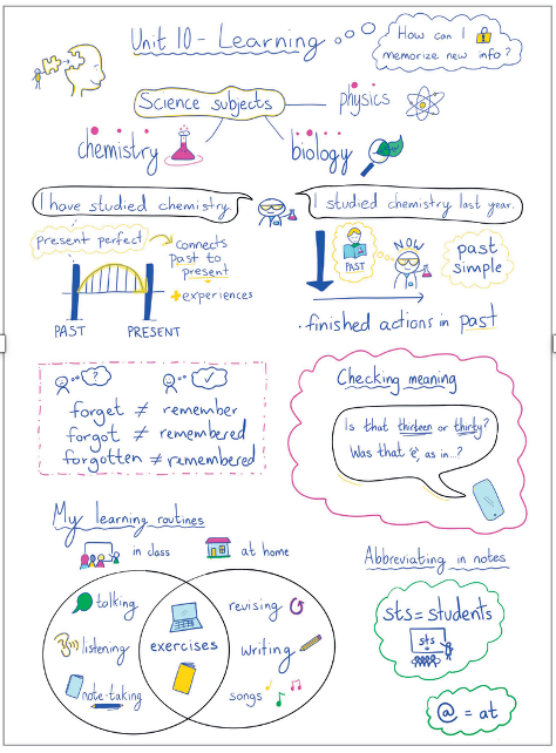
(This image was created by Emily Bryson for the third edition of the coursebook Life Elementary Unit 10, National Geographic Learning.)
How do you use visuals?
To end this summary article, I’ll leave you with two questions to consider that I asked my audience at IATEFL.
- What “visuals” have you looked at in the last 24 hours?
- What “visuals” have you used in your lessons in the last few days?
What you might notice is that your answer to the first question is different to the second. With question one, perhaps you listed a wide range of visuals including road signs, social media images, symbols, icons, as well as photos and diagrams. With question two, was your response more limited? If so, consider that another way towards greater visual impact in our lessons and materials is to make full use of all the different types of images out there in the real world. (For more on this, read Jade Blue’s article on Visual Literacy on the National Geographic Learning website. See the link below.)
References
Richards, I.A. & Gibson C.M. 1945 English Through Pictures Longmans
Corder, P. 1966 The visual element in language teaching Longmans
Hughes, J. Dummett, P. and Stephenson, H. 2025. Life Elementary Third Edition National Geographic Learning
Further reading with ideas for using visuals
Bilsborough, K & Hughes, J. 2025. The A to Z of Writing Language Learning Materials Wemsday Publishing
Clandfield, L. & Hughes, J 2018 ETpedia Writing Materials Pavilion ELT
https://infocus.eltngl.com/2024/06/18/developing-students-visual-literacy-skills/)
Coming soon! Please check the Pilgrims in Teacher Training courses in 2027 at Pilgrims website
The Festive Season in the English Classroom: Holiday Food as a Gateway to Language Learning
Joanna Patyk-Taous, PolandMaking Reading Fun and Easy: 6 Classroom Reading Strategies You Can Count On
Saman Hassan, PakistanVisual Impact in Teaching Materials
John Hughes, UKFrom Swift to Shift: Turning Lyric Videos into Elegant ELT Materials
Puvana Gnanasagaran, MalaysiaUnlocking Language Learning Through Escape Rooms: Innovative Pedagogy in Practice at The Courtauld Gallery
Sarah Amadio France/UK, Angélique Arts, Germany/ UK;Eloi Dotto, Brazil/UK;Abraham Hernandez Cubo, Spain/UKVirtual Tours in English Lessons: Connecting Language and Culture
Mariya Shramenko, KazakhstanThe Use of Audio Podcasts in EFL Lessons
Arelis Tamayo Verdecia, CubaPoetry in the Classroom
John Liddy, Ireland and SpainSupporting Learners in Giving Positive and Constructive Feedback
Mikiko Kawano, Australia