- Home
- Lesson Ideas
- Unlocking Language Learning Through Escape Rooms: Innovative Pedagogy in Practice at The Courtauld Gallery
Unlocking Language Learning Through Escape Rooms: Innovative Pedagogy in Practice at The Courtauld Gallery
Sarah Amadio is a Lecturer in French Education at the King’s College London Language Centre. She specialises in French for professional contexts and developed a French programme for medical and humanitarian professionals. Her interests include gamification and AI in language learning, with a focus on creative and intercultural approaches. https://www.kcl.ac.uk/people/sarah-amadio, Email: sarah.amadio@kcl.ac.uk
Angélique Arts is a Lecturer in German Language Education at King’s College London. She is interested in innovative teaching methods and uses games, VR and improvisation theatre to support learning. She is interested in assessment and feedback innovation and is currently working on mediation based assessment. https://www.kcl.ac.uk/people/angelique-arts
Email: angelique.arts@kcl.ac.uk
Eloi Dotto is a Lecturer in Portuguese Language Education at King’s College London, where he is also Academic Lead for Digital Learning.
His main interest lies in the variables that can potentially accelerate language learning in structured courses. https://www.kcl.ac.uk/people/eloi-dotto, Email: eloi.dotto@kcl.ac.uk
Abraham Hernández Cubo, PhD, is a Lecturer in Spanish Language Education at King’s College London, where he teaches a wide range of Spanish language modules. His research in Applied Linguistics focuses on the study of standard language ideology and the recognition of dialectal diversity in the language classroom. He also conducts research on Spanish cinema. https://www.kcl.ac.uk/people/abraham-hernandez-cubo, E-mail: abraham.hernandez_cubo@kcl.ac.uk
The background
"We have the number!" exclaimed a student in French.
"Let’s try the lock," said another.
Bending over the box together, they opened it with a satisfying click.
"Ah!" they exclaimed in unison.
These are some of the exciting exchanges we overheard from our language students as they were taking part in an Educational Escape Room (EER) set at The Courtauld Gallery in London. In that moment, students were fully immersed in an interactive activity and communication felt alive, dynamic, and playful. Surrounded by centuries of European art, learners were not merely practising a foreign language; they were decoding, reasoning, and applying their linguistic skills in context. Our reflection on this experience highlighted how the gallery environment intensified curiosity, engagement, and creativity, and it prompted us to embark on a project to explore the potential of such immersive approaches to enhance language acquisition in four target languages: French, German, Portuguese, and Spanish.
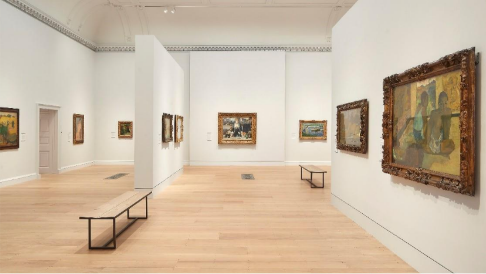
Courtauld Gallery London, photo A. Arts
Our motivation
In everyday teaching, a recurring challenge is capturing learners’ attention in a world overflowing with distractions. As language teachers, we believe that an immersive, interactive experience could overcome this, enabling participants to engage in all four communicative skills while exploring meaningful content. After all, it’s not every day you see students simultaneously practising listening, speaking, reading, and writing while cracking clues and navigating an art gallery.
This desire to create a more immersive learning experience was influenced by principles of communicative and task-based language teaching, where the task becomes a means for communication (Ellis, 2003), as well as sociocultural perspectives on learning, which highlight the importance of social interaction in the construction of knowledge (Vygotsky, 1978). As the intended task was a game-based learning experience, we also considered how games can create environments in which learners actively solve problems, make decisions, and construct knowledge through meaningful experiences (Gee, 2003; Plass, Homer, & Kinzer, 2015). These perspectives, along with additional academic literature on escape rooms, informed our design of an EER in which language was not simply the object of practice, but the means through which students investigated, communicated, and succeeded together.
We also recognised from the outset that the project would provide an opportunity to reflect on our own teaching practices, experiment with collaborative design across multiple languages, and gain insights into how students approach problem-solving in an interdisciplinary setting.
Collaborative work within the scholarship of teaching and learning
All participating teachers are language lecturers at a higher education institution in the UK and formed a professional learning community across languages, aiming to investigate how research-informed, collaborative practices can deepen student understanding. Developing an EER offered a way to explore this, as the activity fosters problem-solving, collaboration, and authentic language use in a motivating context.
Working in a professional learning community was both rewarding and demanding. We were able to build on the German team's earlier experience with an escape room, while also contributing new ideas shaped by our perspectives as teachers of French, Portuguese, and Spanish, as well as by our own preferences for teaching tools and materials - from physical props to digital quizzes and audio-based clues. This cross-language exchange was time-intensive, but it produced a more versatile activity than any one language team would likely have designed alone - a concrete illustration of how professional learning communities can translate collegial exchange into curriculum innovation (Stoll, 2006).
As a result, we produced a more versatile activity than any one language team would likely have designed alone - a concrete illustration of how professional learning communities can translate collegial exchange into curriculum innovation (Stoll, 2006).
From entertainment to education: What are escape rooms?
Escape rooms, originally conceived as recreational team challenges, require participants to solve puzzles collaboratively under time constraints (Nicholson, 2015). Educational Escape Rooms (EERs) adapt this format by embedding learning objectives into gameplay, as participants must apply their knowledge to progress through the puzzles, thereby transforming passive learning into an active and collaborative experience.
The popularity of EERs spans multiple disciplines—from healthcare and STEM to teacher training and language education (López Pernas, 2024; Veldkamp et al., 2020). López Pernas (2024) reports strong learning gains in this kind of activity, primarily due to EERs' alignment with active learning principles such as peer interaction, immediate feedback, and the application of knowledge.
Why escape rooms work for language learning
Building on this pedagogical foundation, EERs offer unique advantages for language acquisition. Students engage in contextualised vocabulary use, authentic communication, and collaborative problem-solving—all within a gamified, motivating framework. Studies by Fotaris and Mastoras (2019), Veldkamp et al. (2020), and the speakER Project (2021) highlight the strong potential of EERs to enhance engagement and knowledge retention. Our experience is consistent with these findings: EERs appear to support linguistic competence while also cultivating curiosity, cooperation, and confidence in using the target language. Importantly, they open up new spaces for learning, both literally and conceptually.
Taking the escape room into the art gallery
To extend this approach beyond the classroom, we designed an EER set in The Courtauld Gallery in London, enabling students to interact with European art from the medieval period to Impressionism. Participants navigated the space while solving thematic puzzles that prompted reflection on representations of gender, the body, and the language of art description and historical narratives — all through the lens of the target language. By choosing this stimulating setting, we aimed to nurture cultural learning and visual literacy in an informal yet structured environment (Garcia Cano, 2025), making language learning both functional and interpretive.
To bring the EER to life, we collaboratively created a master plan in English, which was then translated into multiple chosen languages. The activity targeted students with at least B1/B2 proficiency and centred around a plot in which a fictional thief planned to steal an artwork. Acting as investigators, students worked together to uncover the thief’s identity. On the day, they received instructions and a floor plan, then followed three thematic itineraries — revolving on gender, history, and aesthetics — while working in separate groups simultaneously. Along each route, students received props and clues to solve riddles related to specific artworks, ultimately revealing six letters (two per route) that spelled out the thief’s name.
The materials supporting each thematic itinerary were diverse. One team created their track by following a haptic approach, placing written instructions on and inside envelopes that students could open after solving a riddle or finding a clue. Another team used a Microsoft Forms quiz, which students could access via a QR code. The third team created audio recordings linked to QR codes, which students could access by following instructions that led them to the correct QR code. Students then identified the correct answers in a document based on the audio recordings and received a code that allowed them to open a money box containing the next clues.
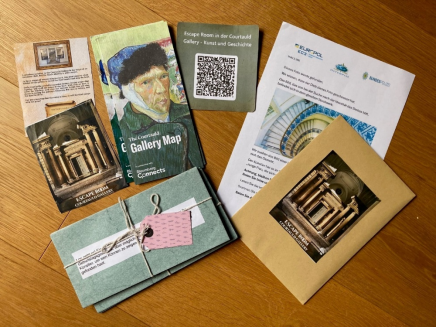
Some of the materials for the escape room in German, photo A. Arts
While the process to create these materials was time-intensive, the diversity of approaches enriched the design of our escape room, making the final activity more engaging for students. This design ensured that participants deepened their cultural understanding while practising reading, writing, speaking, and listening skills in context.
Impact and reflection
We trialled the EER with B1/B2-level students in French, German, Portuguese, and Spanish during the 2025/2026 academic year.
Lecturers found that the activity appeared to generate high levels of engagement among students and provided an opportunity to learn both language and art concepts in a fresh and engaging context, illustrating how leaving the classroom can channel high motivation into meaningful learning outcomes.
Integrating the EER into our teaching required adaptations to existing syllabi. Approaches varied across colleagues. Some positioned the activity as a rewarding end-of-term experience, while others embedded it within units where art already formed part of the curriculum. For one teacher, the project represented an enhancement of the syllabus, allowing greater emphasis on art and culture through a sequence of preparatory and follow-up activities. Another found it more challenging to incorporate within an already dense curriculum and viewed it as requiring a significant investment of teaching time. A further adaptation involved embedding the EER within a business-focused module, where it was used to facilitate discussion of event monetisation, corporate team-building activities, and cultural engagement. Irrespective of these different approaches, most teachers viewed the activity as highly enriching, providing students with an immersive opportunity to learn and communicate in the target language. The variation in implementation highlights both the flexibility of the EER and the challenges involved in introducing innovative pedagogies into existing curricula. While some teachers were able to integrate the activity seamlessly, others perceived it as competing with established syllabus demands.
The consistently high levels of engagement observed across language groups suggest that the escape-room format may provide a transferable framework for motivating learners regardless of the target language, as the activity prompts students to get actively involved in discussions about art, become motivated to solve the puzzles and challenges, and demonstrate sustained participation throughout the activity.
The EER was designed around themes of art, art history, and gender representation, with the linguistic content adapted to the B1/B2 proficiency level of our students. Its primary purpose was not explicit language instruction but rather the creation of an immersive environment in which students could apply their existing language skills in an authentic context outside the traditional classroom.
Transferring the escape room concept across languages and cultures
To enhance its language-learning potential, preparatory activities were developed for Portuguese to introduce relevant vocabulary and expressions, enabling students to discuss paintings and artistic concepts with greater confidence and sophistication. Designed as a pre-task, these activities equipped students with the linguistic resources needed to engage with the EER while also establishing meaningful connections with the cultural contexts of the target language. Although the artworks selected from the gallery offered rich connections with France, Italy, and the Netherlands/Flanders, incorporating art from the Lusophone world helped make the activity more culturally relevant to the learners.
In the lessons leading up to the activity, learners explored selected artworks from the Lusophone world and were introduced to key vocabulary that they would later encounter during the challenge. Working in pairs and using a template, they described the artworks and expressed their opinions about them. For homework, they then completed an online escape room designed to reinforce the language introduced in class while also setting the scene for the main activity at the Courtauld Gallery. The online escape room was created using Genially and embedded in the institution's Learning Management System, Moodle.
The cultural connection was further reinforced on the day of the activity through the storyline itself. Students discovered that the fictitious thief had stolen a well-known Brazilian painting from a museum in Argentina. This additional element extended the narrative beyond the artworks present in the gallery and provided a connection to the cultural context of the target language.
Integrating cultural references into both the pre-task and the narrative demonstrated how the EER could be adapted to different language contexts, even when the target language and its culture are not directly represented in the gallery's collection.
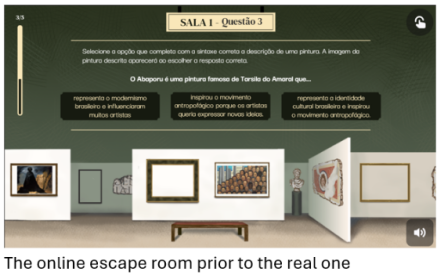
photo E. Dotto
Final considerations
Our observations suggest that the pedagogical impact of the Educational Escape Room (EER) depends not only on the activity itself but also on how it is scaffolded. While the escape room encouraged authentic communication and collaborative problem-solving in the target language, the addition of preparatory vocabulary activities appeared to support more sophisticated discussion of artistic concepts and enhanced learners' ability to engage with the tasks.
Implementing the EER within an art gallery provided a rich and motivating learning environment, although it also introduced practical challenges. Because some gallery spaces host rotating exhibitions, tasks referencing specific artworks required adaptation when those works were no longer on display. Future iterations of the project should therefore verify the continued availability of selected artworks or design tasks that can be more easily adapted. Despite this limitation, the gallery setting emerged as a significant pedagogical asset. Moving language learning beyond the classroom appeared to increase student engagement and encouraged learners to interact with language in ways that were closely connected to observation, interpretation, and collaboration. The findings suggest that informal learning spaces may not only motivate learners but also influence the quality and nature of their language use.
Beyond its impact on student learning, the project demonstrated the value of collaborative inquiry among language educators. Participation in the professional learning community strengthened collegial relationships, fostered professional learning, and generated valuable insights into cross-linguistic teaching practices. The project also showed that the EER format could be meaningfully adapted across languages and cultural contexts: incorporating culturally relevant artworks and narratives, as in the Lusophone version, helped learners engage even where the target culture was not directly represented in the gallery's own collection.
More broadly, this activity highlights the potential of Educational Escape Rooms to bring language, art, and intercultural learning together in a single, motivating experience - and points to the value of collaborative, evidence-informed design in bringing such interdisciplinary approaches to life.
References and further reading
Batlle Rodríguez, J. & Vicenta González Argüello, M. (2023). Gamification and learning Spanish as a modern language: student perceptions in the university context. Language Learning in Higher Education, 13(1), 89-103. https://doi.org/10.1515/cercles-2023-2016
Cruz, Mário. (2019). 'Escapando de la clase tradicional': the escape rooms methodology within the spanish as foreign language classroom. Revista Lusófona de Educação. 46. 117-137. 10.24140/issn.1645-7250.rle46.08.
Ellis, R. (2003). Task-based language learning and teaching. Oxford University Press.
Fotaris, P., Mastoras, G. (2019). Escape rooms for learning: A systematic review. International Journal of Emerging Technologies in Learning, 14(21), 4–22.
García Cano, M., Gil-Ruiz, P. & Martínez-Vérez, V. (2025). Visual arts museums as learning environments in the undergraduate and postgraduate programmes of the Faculty of Education at the Complutense University of Madrid. Int Rev Educ 71, 109–134 (2025). https://doi.org/10.1007/s11159-024-10100-x
Gee, J. P. (2003). What video games have to teach us about learning and literacy. Palgrave Macmillan.
López-Pernas, S. (2024). Educational Escape Rooms Are Effective Learning Activities Across Educational Levels and Contexts: A Meta-Analysis. IEEE Transactions on Learning Technologies, vol. 17, pp. 711-724, 2024, doi: 10.1109/TLT.2023.3328913
Nicholson, S. (2015). Peeking behind the locked door: A survey of escape room facilities [White paper]. https://scottnicholson.com/pubs/erfacwhite.pdf
Plass, J. L., Homer, B. D., & Kinzer, C. K. (2015). Foundations of game-based learning. Educational Psychologist, 50(4), 258–283. https://doi.org/10.1080/00461520.2015.1122533
speakER Project. (2021). Escape rooms and languages, a perfect match: Guide for secondary education. Erasmus+. EN_Guide.pdf
Stoll, L., Bolam, R., McMahon, A. et al. (2006). Professional Learning Communities: A Review of the Literature. J Educ Change 7, 221–258, 2006. https://doi.org/10.1007/s10833-006-0001-8
Veldkamp, A., Van De Grint, L., Knippels, M. C. P., & Van Joolingen, W. R. (2020). Escape education: A systematic review on escape rooms in education. Educational Research Review, 31, 100364.
Vygotsky, L. S. (1978). Mind in society: The development of higher psychological processes. Harvard University Press.
Westbroek, H., de Vries, B., Walraven, A., Handelzalts, A., & McKenney, S. (2019). Teachers as Co-designers: Scientific and Colloquial Evidence on Teacher Professional Development and Curriculum Innovation. In J. Pieters, J. Voogt, & N. Pareja Roblin (Eds.), Collaborative Curriculum Design for Sustainable Innovation and Teacher Learning (1st edition., pp. 35–54). https://doi.org/10.1007/978-3-030-20062-6
Coming soon! Please check the Pilgrims in Teacher Training courses in 2027 at Pilgrims website.
The Festive Season in the English Classroom: Holiday Food as a Gateway to Language Learning
Joanna Patyk-Taous, PolandMaking Reading Fun and Easy: 6 Classroom Reading Strategies You Can Count On
Saman Hassan, PakistanVisual Impact in Teaching Materials
John Hughes, UKFrom Swift to Shift: Turning Lyric Videos into Elegant ELT Materials
Puvana Gnanasagaran, MalaysiaUnlocking Language Learning Through Escape Rooms: Innovative Pedagogy in Practice at The Courtauld Gallery
Sarah Amadio France/UK, Angélique Arts, Germany/ UK;Eloi Dotto, Brazil/UK;Abraham Hernandez Cubo, Spain/UKVirtual Tours in English Lessons: Connecting Language and Culture
Mariya Shramenko, KazakhstanThe Use of Audio Podcasts in EFL Lessons
Arelis Tamayo Verdecia, CubaPoetry in the Classroom
John Liddy, Ireland and SpainSupporting Learners in Giving Positive and Constructive Feedback
Mikiko Kawano, Australia