Poetry in the Classroom
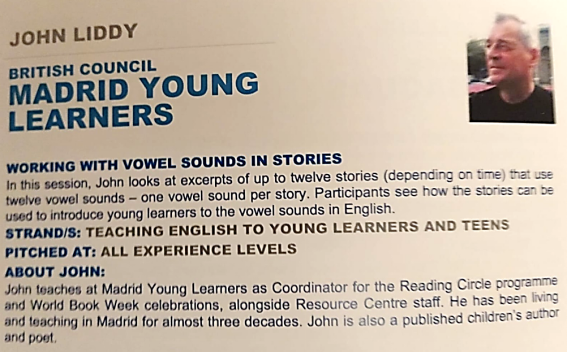
John Liddy is a retired teacher-librarian from the British Council Young Learners’ Centre in Madrid. He has published fourteen books of poetry, including stories for children and translated from and into Irish, English and Spanish. He has lectured at universities and schools in China, England, France, Ireland, old Yugoslavia, North America, Spain and Vietnam. With Jim Burke, he founded The Stony Thursday Book (1975-) and is on the Advisory Board of The Hong Kong Review.
Introduction
Most of these poems have been shared with my classroom students and members of the library Reading and Writing Circles during my forty years as a teacher and a librarian. For the R&W circles the selection of suitable material, not always by me, was based on the learners’ ages and language abilities although I sometimes pushed the boundaries. Working with both Junior and Senior cycles (A1 to C2) ranging in ages from ten to seventeen years old, I introduced students to my own work.
Some of the poems were written as responses to terrible events, which I encouraged my students to do in their own individual ways, by first sharing my poem with them. I rarely asked students to write on a particular topic without my providing an example. Sometimes I introduced a poem such as ‘Freedom’ by asking a simple question: What animal is being discussed in the poem? Some students thought it was a horse, but, in fact, it is a Cheetah I once saw in a zoo with my sons. One response from a ten-year-old to a question I set the students after a lesson dedicated to story writing and the sharing of my poem ‘Tall Story, Short Journey’, both thrilled and surprised me. In answer to the question What is a story? I received the following: A story is a river of words thrown up into the sky and falls.
Now, if that isn’t an example of imagination and inspiration, I don’t know what is.
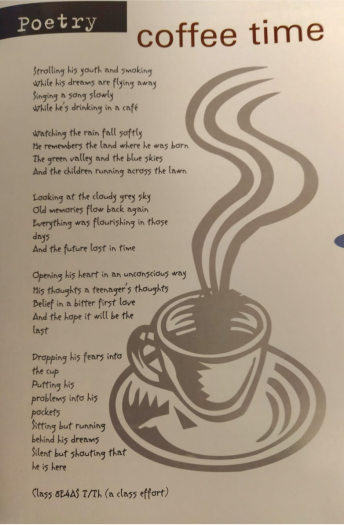
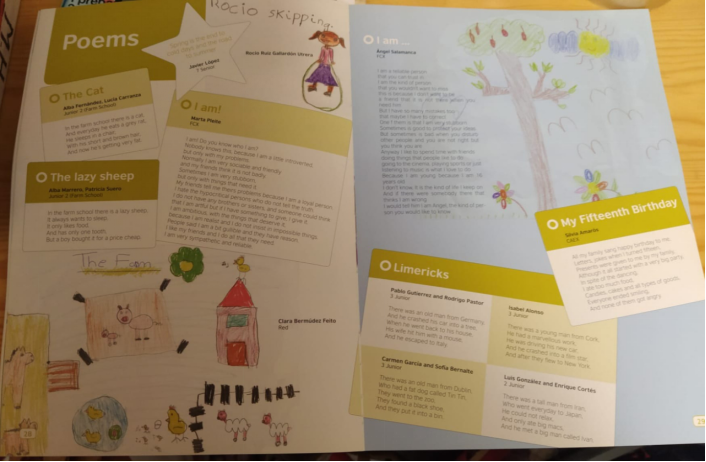
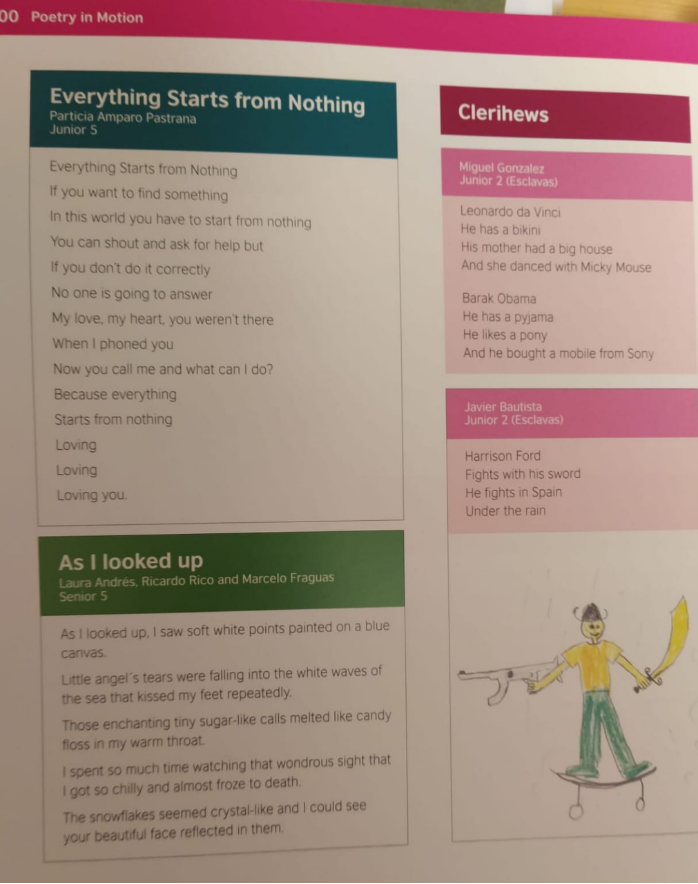
Below are some samples of students’ work taken from various Year Books and the poems I used with members of the Writing Circle and classroom students over the years.
The Poems
RAINBOW ROAD
for Nora McNamara
Among Sharp fragments
Of dangerous delta glass,
Milk streams turned a grey complexion,
Rush hour dust shifted
From footpath into gutter
Into any crack.
Seven-year-old tears fell on pale stone,
Embarrassment conceived a childish crime
Out of such an innocent act.
Another shade of confusion
Crept across the wet
Illuminated road home.
Older, cuter, yet seemingly
Disinterested in adult theory,
Personal preoccupation slackened:
A leather sandal on a rubber sole,
A stocking below an ankle –
As the lazy beat of greasy rain
Built its own ice rink
And like ink blobs on white paper
Paraffin oil crudely kissed
The original skin of cloud water.
More than seven colours
Fashioned the pattern of Rainbow Road.
SCARECROW
I have heard the egg crack
In a wren’s nest. The wind snap
At the thistle tip of every sting.
Once there were two spiders
On a quilt of toasted leaves,
Each with its own blueprint
For its own invisible web.
One hunter I knew could kill
A fox before his gun dog sniffed
The scent. I have seen a river
Doll tug free from those stones
Born on river beds and challenge
The battering course of another
Journey. I have cheered the walk
And tumble of a foal in her
Mother’s blood, cursed those boots
That crushed the ripe stalks
Of my pride. I am a scarecrow
Nailed to old wood, eaten
By worms, paralysed by rust.
SNOW
for Maite Campo
A child is tossed
in the schoolyard wind,
she is blinded by snow.
The older students
gather by the window
to reach for the flakes
of their first fall.
Their tanned hands
fill with the wonder
of white nuggets.
On each face the child
dazzled, in each hand
a loss. Snow
like childhood melts.
SPARE ME
My small body
cannot stop the war.
I am deceived
by your booby-trapped flags.
Your nuclear dreams
frighten me.
My knees bleed
in your concrete gardens,
a black sand
sticks to my feet,
rivers and seas desert,
the air chokes.
I have not yet lived
spare me.
WORDS FOR SAMUEL BECKETT
I read on.
Understanding less.
Yet, I could not leave you.
Each word brought
Me to the next.
Then days of brooding,
Of difficulty,
Until little by little
I saw the word complete.
Felt as my own heartbeat.
I read on.
The same problem,
But always the word
Keeping me in touch.
Out of such ignorance
I learned much.
THUNDER
Whenever I hear thunder
I think of Joyce,
Hiding under the big bed
Of his father’s Dublin house,
Or forsaking the next drink
In the bars of Paris and Zurich,
To run for dear life
Into Nora’s arms.
I think of Fionn before
And Fionn again,
And how all the rivering
Waters run,
Leafy as the Liffey
In the hearts of Molly and Bloom,
The dark mutinous Shannon
Calling me home,
The dead reawakening
Like love outside the room.
And I think of his words
Outweathering the storm,
Still thundering from under
The big wide bed of his world.
from The Angling Cot (1991)
POEM
for my brother Liam
Inside the poem
The faint tormented rumblings of the loft,
Thoughts and images of permanent dark,
Butterflies struggling towards spring.
Ignorance, some truth, fallibility,
Until finally a beginning to rid
The poem of what doesn’t sing.
Inside the poem
The sea-shell echo of love
Keening in your ear, dreams of famine
Devouring the flesh of faces pure,
Eyes that scream explosion;
Gulls among fields of crow
Waiting for the storm to blow,
Caged birds spurning what binds them.
Inside the poem
Places where the mind delights –
Birth of river, bend of mill-road,
Black strand of washed-up shark bone,
Lake, City, Sierra, places nowhere,
Paths across invisible stone,
Depths within reach of the poem.
TALL STORY, SHORT JOURNEY
The road you travel is a dirt path
Through the jungle, an unforgettable
Sunday outing, the ordinary made magical.
Suddenly the car swerves
To avoid the jaguar and the llama,
A mirage of pink flamingos.
On the horizon clouds of dust,
Elephant herd stampeding, the anaconda
And the alligator in the stream
The guanaco feeding behind a bush,
The blue shark returning to the sea
Where you will swim and build
Great pools to house their young.
Soon you are almost there and already
The waves reach in, as you struggle
To keep the car from sinking.
THE CORNER STONE
for Puy
Chipped by centuries of safe homecoming
Along tight streets where no lamp shone
That polished granite-resting place
Steadfast, tenacious, almost forgotten.
The cart wheel worn to a mouldering blade,
Pulverised among the weeds in a backyard
Old halos of thunder and spark
Flaked by much more than mere stone.
A beginning, like the first book
In a library for young minds
Guiding them out of a corner
Towards the open spaces of their lives.
WHAT DALI WANTED TO KNOW
The day after you died
you lived again in the supple-
mented pages of the press, along-
side news of a South American
bloodbath, Russian earthquakes.
But the stage was yours
shared by the first to mourn
a genius in disguise, while one
hinted at darker times,
another threw a stone.
The day after you lived
in the grip of the expert
you were entombed in your own
museum, not buried with Gala.
Figueres flew its flag
and there was talk of a divided
will and testament between
Spain and Cataluña.
In Port-Lligat and Cadaqués
the water licked the shore.
Its last drop inland dried
like slow death on the sand.
The very molecules roared.
from Wine and Hope/Vino y Esperanza (1999)
CHASING THE PIGEONS
for Marcus and Seán
I marvelled at you in springtime.
Tirelessly racing across hazardous
Cobbles to plunge into the wrought
Of an old lady’s mound of crumbs,
Her annoyance banished to another
Bench where she continued to feed
Before the Plaza erupted again.
But you were only after the white one,
The one you wanted to touch
And dream of when sleep brought
That bird of peace within arm’s reach.
What was it the old lady chased
When young and could not catch?
May her crumbs nourish my children,
May they grasp it in their lifetime.
LIP-READING
Languishing
On the spine
We await the voice
To release the inaudible
Struggle of the word for air,
Calm the shiver of paper
Within the blank
Coldness of the room.
We are seasoned
Performers in our prime,
Medleys of meaning
Chosen to convey
Precise meaning,
Gleaned from tomes
Of definition –
Custodians of language
Under the resounding
Roof of the poem
We are here to be spoken,
Chanted or sung,
Pierce indifference,
Identify a common pain,
Traverse the inner ear,
Change routine water
Into Rioja wine,
Unlick a dormant cell
At the back of the hall.
Should all go well
One of us
Might be
Taken
Home.
ALTRUISTIC VOICE
The void slowly fills with ordinary
Conversation about whether to buy
Small or large fruit bowls, a gooooool
Scored on the radio, snatches of laughter
Along indecently strollable streets
In late summer here, early fall there,
Where a woman on a mobile
From a plane on its way to oblivion,
Pleads “What can I do?” as her husband
Sees a tower explode and crumble.
This page should be forever blank
As the colour of pain or Picasso’s dove
Guiding us to an indomitable tree in winter
Snow, alive with dignified response,
Wind-prayer for these inadequate words.
But the need for language to express
Defies the emptiness, replenishes the space
With spoken or solemnly read messages,
Tender as the flame of a night-light −
A warm tear for the living and the dead.
from Cast-A-Net/Almadraba (2003).
ANOTHER ELEVENTH IN THE LIBRARY
for my students
Today I went to work
with the weight of death and mutilation
in my shoulder bag; incalculable loss
like sinking stones in my pockets,
the pens and pencils rattling
to the sound of severed bones
across the floor of a bombed train,
the books and papers
smeared with destiny's blood
stopped in its tracks.
Opening the library door
I saw everything in its place
except myself –
the tidied shelves and shiny plants,
hoovered carpet and clean glass-reflection.
But my chair was no longer mine
beside a desk that pined
for somebody else,
the in-tray for the reach
of another hand.
Then duty slowly called
me to my station
in the face of a child
who needed a book
about animals
in danger of extinction.
IN THE LIBRARY OF THE MIND
There will always be streets full of hope.
Public places held together by strings of goodwill.
Handsome men and women out for evening strolls,
The day's chores done, peace in dreams,
The echo of bird song in sleep.
Children will climb into big books
Where ferocious animals protect them at night,
The drip of evergreen forests slake their thirst
And each page a tactile discovery of worlds,
Escape mechanisms, pleasure in curiosity.
But sometimes doors to knowledge are shut,
Information restricted, data manipulated.
Truth lives in solitary confinement,
Memory betrays thought and effort
Is pain, blank, pointless.
We become other shades of the self,
Grow forgetful; surrender to change,
The wind's whim, the circle's imprisonment;
Survive somewhere between blindness
At birth and old age, the first and last spoonful.
For the fortunate who have found plenty
In bare necessity and see beyond walls,
Love glows in dark corners, shines eternally.
What is made is reaped between the bloom
And death of seeds, a stone's ripple.
from The Well: New and Selected Poems (2007)
THE ORAL TRADITION
My two-year-old son
drew my attention
with his finger
to a scene
on a street corner
in my barrio
and announced:
Man talking,
talking man.
A TREE HOUSE IN JAÉN
for Rubén
I like to imagine it intact,
defiant after all those years
despite time and what winter
does to everything in its path.
A den for children in summer,
high above the din of fields
ablaze in a furnace of crickets,
a shade in the afternoon sun
descending on a day's adventure,
the cold black drone of the Sierra
de Segura in their dreams.
Perhaps it shelters washed-up
immigrants or wounded hawks,
incommunicado hill walkers, a shrine
for those who believe it to be holy,
where miracles happen on days
when the Romería lays out its picnic,
contemplates the apparition.
I like to think the knots as tight
as moored boats in a storm,
the log-walls and floor snug
in the crotch of the old holm-oak,
knifed with initials proclaiming
the existence of a hedge school
That once echoed with laughter
and the silence of leaves on faces
grown to be their own trees
in the thick of cities
where everything can seem
splintered and disposable.
SOROLLA’S GARDEN
Sapped by Madrid’s manic haste
I found my retreat from the noise
and the heat in a painter’s
garden where I could imagine
longed-for-places, thick-ferned
and mossed like fertile groves,
the fountain in the centre a cool
spray fanning me with sea breeze.
Sometimes I was the Moro
who sold oranges nobody bought
or a Valentian guitarist wooing
a woman with love songs.
I could step into any canvass –
be a fisherman’s son with a toy boat
breasting the wavelets, observe
the ladies strolling by the tide’s hem.
I was part of the décor in this haven,
made of it a vital ingredient
to teach my students all the better.
I could apply techniques learned
from others who taught with tools
hewn from hill-palettes of colour,
impart with a painter’s luminosity
lessons clear as light on water.
from Gleanings from the Margins (2010)
FREEDOM
As we neared the compound
she fixed us with a challenge,
ready to test her ground.
I urged the boys to canter,
then to break into a run
around the perimeter.
She jaunted beside them
as though they were a leap
out on a day’s hunting.
When they made a sudden
bolt for it she upped a gear,
looked back as if to warn
Against playing with fire
inside, the fun they’d have
outside, running beside her.
BOY DIVER
The morning he did not show
our teacher led us in prayer
for the repose of his soul.
From then until holiday his pen
idled in the groove of his desk
beside the brimming inkwell.
Half a century later the name
may not mean much to many now,
but this twelve-year-old, natural
All-rounder, good at sport
but no book-lover, was found
when the tide went out.
So, I write this dirge down
because I long to rest
the spirit of Eddie Mullane
To leave my dream of a diver
diving into a mud bank
of a local Limerick river.
WHAT YOU KNOW
for Caroline, my niece
To make the jump you must trust
In cord and harness, overcome
That initial fear of falling
To your doom, but once done,
The world you walk in
Rises to your confident step,
Familiar as child’s play
Because you met it halfway.
This you already know.
Flying in tandem over paradise,
As you glide like a dream-bird
In the current, a swift asleep
On the wing, before landing
Firmly on your feet to take up
Other challenges, adrenalin
Flowing through your vein
As when you skipped the rope’s
Intricacies like a slender stalk
On the green outside your door,
A sheaf of corn in a summer’s
Breeze, girl growing into woman,
Carrying a song of happiness
That is your name, one who
Confronts each day anew.
All this you now know.
The meaning of freedom within,
Limits defied, the spreadsheet
Of daily practicality understood,
The gravitas of the Earth’s pull
And how to step outside it,
To plunge and fly in uncertain
Spheres, so much more to learn.
STORYBOARDS
Ran – the Japanese word for chaos and uprising,
orchid and water lily – was set down by Kurosawa
on board after board to show how it should be told.
He made the tale of war his own to pass on,
guided by Shakespeare and Ford,
just as Coppola watched the Seven Samurai
when filming Apocalypse Now.
Out of such mayhem great art is relayed
by masters who leave legacies for others to embellish
in the way Beckett learned from Joyce who studied
Ibsen, influenced the world’s thinking, as did
Einstein’s Relativity, Eliot’s The Wasteland,
Gandhi’s passivity, Luther King’s defiance
and Ali, a floating butterfly in the ring.
So too Cezanne who gave Picasso and Braque
ideas for Cubism before passing the cube to Juan Gris;
its shape restored by Le Corbusier to make art practical
with affordable housing for the Parisian poor.
From there we enter abstraction,
a layman’s mixum-gatherum of the illusory search
for the linear curves of time and motion.
Music strikes a similar note when we consider
the evolution of instruments, development of scales,
imitation of human emotion and nature’s sounds,
from Medieval to Renaissance, Baroque to Classical
to recent times; each a continuation of the progression
like Field’s ‘Nocturne’, Morrison’s Astral Weeks,
that Clancy ballad by Dylan, Cohen in Lisadell.
The same for Medicine, Science, Philosophy
as exemplified in our search for eudemonia
between heart and brain, the longest journey
ever taken by whatever means, fair or foul,
but we are fortunate to have the storyboards
to allow pure light stream through the Jalis,
make what we can of the inner ground.
from Madrid and Other Poems (2018)
Word Gatherers
for Alan Maley
From where I work there are dictionaries
within reach, nuggets for the obstinate
poem that demands more than libraries,
hidden meanings only found in opposite
Entries on the margins of obscure text
I struggle to decipher but am helped
by the poem’s penchant to be perplexed,
its inexhaustible wish to be skelped
And purged of excess ambiguity.
If I have not betrayed myself or read
the mysterious illumination incorrectly,
what lingers in the margins can be fed
To the poet-reapers of words who wait
for gleanings to feed the poem with light.
INSIDE THE WORD
These words stem from near and far, aeons ago,
passed on to make with them what they bestow,
proclamations of hope or peace with an irenic one
or nudged off course by a Norwegian sailor home
from a whaling trip, eye to eye with Moby in a glass
of vodka, fear harpooning the loneliness.
Words are like that, unpredictable, taking you this way
or the other, malleable, musical, whimsical, in disarray,
coming and going, often pleading for a fairer world
beyond human acridity, devastation and hurt rendered
to reader and writer, to those who may have nothing
but words to console the self; black widows stalking
a page, grim reapers of habitations too much to bear,
nature’s revolt and revenge precursors of despair;
examples of how words behave, like peas in a pod,
one after the other, an assembly of plod and thud
in the pot, severed from their roots, an aftertaste
on the tongue of a dead language, all that waste
and loss of words like melting Poles and desert
encroachment, the segmekwe of a dying heart.
All that imperative effort, trying to right a wrong,
defending truth against lie, doing their two-bit song
to plug the leak, a sapling watered in the depths
of souls not enough to pass on, give hope to those
yet to come, inheritors of a sorry mess without air
to breathe or water to drink, victims of laissez-faire
and the modus operandi for the survival of the race
while good words cower amidst dystopian disgrace,
hostages to bombastic tirades and stupidities,
mala leche compounded by slavish conspiracies,
words distorted, bandied about without care,
their altered meanings meant to snare.
Perhaps the word has been idle with lip service
for too long and we need to address its purpose
again, explore its neart istigh as in one who loves
you in return with the simplicity of Picasso’s doves,
the frailties of both ingrained since Sapiens coupled
with Neanderthals and thought found befuddled
expression in the slow development of scription,
not by a knee on a neck or the spread of confusion
devoid of biological certainty, but in what we feel
for each other, how together we mill the wheel
of words, a wholesomeness born out of silence
wherein we find the sword of love as guidance.
Note:
mala leche. Spanish. lit. bad milk; of bad character, bad intention
neart istigh. Irish. inner strength
segmekwe. Potawatomi. mother earth.
from True to Form (2026)
An outline of how students worked with the poems
Many of the poems, as mentioned in the Introduction, were used with student members of the Young Learners' Writing Circle (prose and poetry) overseen by myself and the library staff, Sonia Contreras and Cristina Sanchéz and two volunteer teachers. Each session lasted 15 minutes with five or six students focusing on a particular poem chosen to suit their level of English. Follow up sessions were arranged to complete various tasks. The poetry sessions were referred to as encounters and after five or six encounters the students were in a position to write a decent draft of their own poem on a similar topic or a theme of their own choosing. Drafts were then worked on and finished poems produced. The following link:
https://www.youtube.com/watch?v=rL4XlYBdIpc
explains how the writing circle operated and the section in the video (44:59) deals with the writing of poetry, using the poem Wind by Ted Hughes, as a generic modal for some of the poems included here. My own poems were also introduced to my students in the classroom towards the end of a lesson, to augment a theme or topic in their coursebook. Each student received a copy of the poem, which I would read aloud twice, for sound and then for meaning, asking students to close their eyes and listen for words that describe sight, sound, smell, touch or even taste, before setting them some fairly basic tasks such as underlining key words or phrases, the language of the senses.
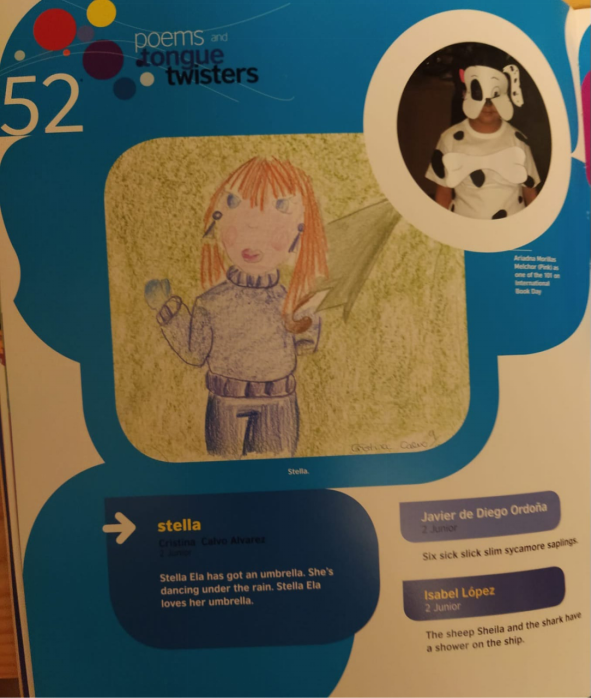
Poems dealt with in the Writing Circle were treated with more in-depth analysis and, depending on the poem and the age and level of the student, the language generated from working with Rainbow Road, for example, consisted of words and phrases concerning the stages of becoming aware of the world, what it means to be young, childhood memories, a certain loss of innocence and growing up. The poem Scarecrow generated nature language, the extraordinary in the ordinary and how something may not be what it seems. Snow, again generated language to do with loss of innocence, occurrences that changed an attitude or opinion. It is dedicated to a student and written after I allowed the class of fourteen years old to go down to the schoolyard, one by one, as we watched from the window. The game, if it can be called that, consisted of each student returning to the classroom with a fistful of snow. For many of these students it was the first time they had seen snow fall in Madrid. Needless to say, they thoroughly enjoyed the task and came back with wet, empty hands. I had looked out the window earlier in the morning and watched a child struggling across the yard with, what I assumed, to be a note for another teacher in her hand. Another Eleventh in the Library and Altruistic Voice were read to them after the horrific train and Twin Towers’ bombings in Atocha train station in Madrid and in New York. I encouraged my students to write about their feelings and finished poems were read out to the class. Another Eleventh in the Library was published, along with poems by members of the writing circle and my own class, in one of the Year Books. The more accessible poems were often introduced to younger, lower-level students and they were encouraged to identify vowel sounds, produce nursery rhymes, limericks and short, four-line poems. Examples of their efforts were published in the Year Book, later edited by teacher David Kavanagh.
To reiterate, my approach to working with poems with students as part of the Writing Circle or in the classroom was as follows: Poems were read as a means to coax my students into tackling topics such as animals, art and artists (What Dali Wanted to Know and Sorolla’s Garden), (Chasing the Pigeons) and (Boy Diver) deal with different kinds of loss, (Spare Me) our relationship with nature (Words for Samuel Beckett and Thunder) writers we admire, (Lip-Reading and The Oral Tradition) language and the use of words, (Scarecrow) imagination and objects, (Poem) the essentials of the poem, (A Tree House in Jaén) adventure, (What You Know) sport, travel and family (Storyboards), story-telling, film-making, (In the Library of the Mind and The Corner Stone) social concerns and the role of libraries, (Word Gatherers and Inside the Word) the joys of learning, listening, reading and teaching. Many of the topics, included as themes in their course books, which we covered, were broadened in line with the approach I have described above.
Some of the poems from Madrid and Other Poems (2018) and the two poems from True to Form (2026) were never shared with my classroom or library students. By the time of their composition and publication I had retired as a teacher/librarian. Yet, I am always gratified to see some of my former students keeping in touch and to showing support by attending book launches and readings.
Without the commitment from teachers and library staff, especially Puy Larraz in the early days, and Sonia, who carried on after I had retired in 2016, with the promotion of World Book Week, Culture Week and the workshops for the Reading and Writing Circles, none of this would have been possible. Sadly, the library is no more and the Young Learners’ Centre Madrid is not what it used to be.
I like to think that one or two poems included here might be introduced to teachers who may be interested in sharing them with their students, should the lesson be open to such work and the age and language ability of their students justify inclusion.
References
Liddy, J. (1991) The Angling Cot. Dublin: Beaver Row Press.
Liddy, J. (1999) Wine and Hope/Vino y Esperanza. Madrid: Archione Editorial.
Liddy, J. (2003) Cast-A-Net/Almadraba. Madrid: Archione Editorial.
Liddy, J. (2007) The Well: New and Selected Poems. Limerick: Revival Press.
Liddy, J. (2010) Gleanings. Limerick: Revival Press.
Liddy, J. (2018) Madrid and Other Poems. Limerick: Revival Press.
Liddy, J. (2026) True to Form. Limerick: Revival Press.
Coming soon! Please check the Pilgrims in Teacher Training courses in 2027 at Pilgrims website
The Festive Season in the English Classroom: Holiday Food as a Gateway to Language Learning
Joanna Patyk-Taous, PolandMaking Reading Fun and Easy: 6 Classroom Reading Strategies You Can Count On
Saman Hassan, PakistanVisual Impact in Teaching Materials
John Hughes, UKFrom Swift to Shift: Turning Lyric Videos into Elegant ELT Materials
Puvana Gnanasagaran, MalaysiaUnlocking Language Learning Through Escape Rooms: Innovative Pedagogy in Practice at The Courtauld Gallery
Sarah Amadio France/UK, Angélique Arts, Germany/ UK;Eloi Dotto, Brazil/UK;Abraham Hernandez Cubo, Spain/UKVirtual Tours in English Lessons: Connecting Language and Culture
Mariya Shramenko, KazakhstanThe Use of Audio Podcasts in EFL Lessons
Arelis Tamayo Verdecia, CubaPoetry in the Classroom
John Liddy, Ireland and SpainSupporting Learners in Giving Positive and Constructive Feedback
Mikiko Kawano, Australia