What Are the 4M’s? Puzzle Solved
Hanna Kryszewska is a teacher, teacher trainer, trainer of trainers. She was a senior lecturer at the University of Gdańsk, Poland. She is co-author of resource books: Learner Based Teaching, OUP, Towards Teaching, Heinemann, The Standby Book, CUP, Language Activities for Teenagers, CUP, The Company Words Keep, DELTA Publishing, and a course book series for secondary schools: ForMat, Macmillan. She is also co-author of a video-based teacher training course: Observing English Lessons, and online course for Orient Black Swan on 21st Century Skills and Teaching the whole person: Humanising language teaching. Hania is a Pilgrims trainer, OTA trainer and editor of HLT Magazine.
Email: hania.kryszewska@pilgrimsteachertrainig.eu
Background
For a while I have been puzzled by the 4M’s. I keep bumping into them … An Old classic boomerang.
So, I started wondering how we can use it for language teaching and language classes…
Online
The term "the 4M" most commonly refers to the 4M Method (Man, Machine, Material, Method), a foundational problem-solving and root-cause analysis framework used in manufacturing, lean management, and safety audits (HSSE)
The 4M Framework:
- Man (Manpower): Evaluates human factors, including skills, training, qualifications, fatigue, behavior, and physical or mental readiness.
- Machine: Examines the tools, equipment, machinery, and technology used, focusing on maintenance, performance, and reliability.
- Material: Looks at the raw materials, components, and substances handled or processed, including storage and labeling.
- Method: Analyzes the operational procedures, standard operating instructions, schedules, and processes followed.
It can improve manufacturing operations. Not sure how I could use it,,, only in ESP classes.
On www.medium.com to be found here
When I read the text here it gets more interesting. More humanistic. It could be a good activity in class on values and priorities.
Discussion 1
In the intricate web of life, we often find ourselves navigating through the interplay of four powerful forces: Mind, Mouth, Mood, and Money. These "4 M’s" are the unseen threads that shape our existence, and understanding their influence can be the key to unlocking a fulfilling life.
Work on pairs and look at the images. Decide how important these are in your life.
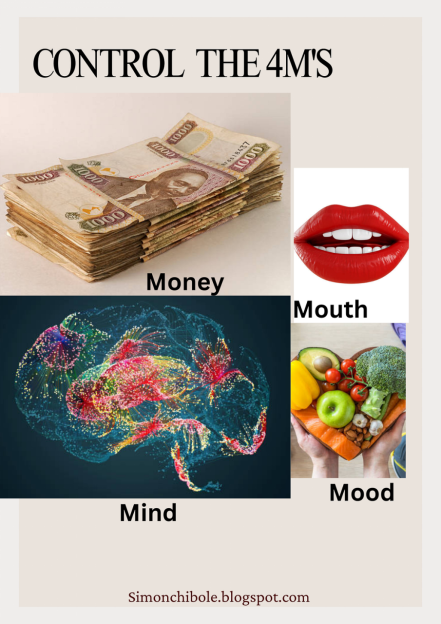
Photos: Unsplash
Design: Simon Chibole
Source: Mastering the 4 'M’s: Mind, Mouth, Mood, and Money | by Simon Peter Chibole | Medium
Reading activity
- Give out these texts to 4 groups.
- Each group gets a different text.
- Read discuss what you have predicted or not.
- Then regroup and feed the information across.
- Discuss your priorities.
Original version
|
Mind: What Controls Your Mind Controls You The mind, that enigmatic powerhouse nestled within our skulls, holds the reins of our actions and emotions. What we feed it, be it positive thoughts, knowledge, or negativity, reflects in our behavior and decisions. It’s a silent dictator, shaping our character and defining our path. By nurturing a positive mindset and embracing growth, we can harness the power of our minds to drive us towards success.
|
|
Mouth: Words from Your Mouth Can Bless or Curse Words are like seeds, and our mouths the fertile ground. What we speak has a profound impact, not only on ourselves but also on those around us. Words of encouragement can uplift spirits, while harsh words can inflict deep wounds. To wield the power of the tongue responsibly, we must choose our words wisely, promoting harmony and understanding in our relationships. |
|
Mood: The Elusive Puppeteer of Emotions Our mood is a silent puppeteer, pulling the strings of our emotions. It’s a force that can either connect us or isolate us from others. When we allow our mood to control us, we risk losing touch with loved ones. Learning to manage and master our moods through mindfulness and self-awareness can lead to healthier relationships and a more balanced life.
|
|
Money: The Alchemist of Character Money, though just paper or digits, possesses the incredible ability to transform individuals. Some people's true character only emerges when money enters the equation. A modest sum can reveal either humility or arrogance, generosity or greed. Understanding the impact of money on ourselves and others allows us to maintain our authenticity and integrity.
|
Or for lower-level groups use AI to simplify the text e.g. https://app.magicschool.ai/tools/teacher/rewriter
|
Your mind controls what you do and how you feel. What you think about matters. If you think good thoughts, you make good choices. If you think bad thoughts, you make bad choices. Your mind is like a helper inside your head. It helps you decide who you want to be. When you think happy thoughts and learn new things, your mind helps you do great things. |
|
Words are powerful. They can help people or hurt people. Kind words make people feel good. Mean words can hurt people's feelings. What you say affects you and everyone around you. You should think before you speak. Choose words that are kind and helpful. This makes people feel happy and helps everyone get along.
|
|
Your mood is how you feel. It can make you happy or sad. Your mood affects how you treat other people. When you're in a good mood, you want to be with friends. When you're in a bad mood, you might want to be alone. You can learn to control your mood. You can use deep breathing and think about your feelings. When you manage your mood, you have better friendships and feel happier.
|
|
Money is just paper and numbers. But it can show what kind of person you are. When someone has money, you can see if they are kind or mean. You can see if they share or keep everything for themselves. Money can change how people act. It's important to know how money affects you. Stay true to yourself. Be honest and kind, whether you have a lot of money or a little. That's what really matters.
|
On LinkedIn
Here comes a writing activity around the 4 M’s. I found a great image here. Make 4 posters with the class, each one is devoted to one of the M’s. You can copy the images from the poster below or let the students create their own.
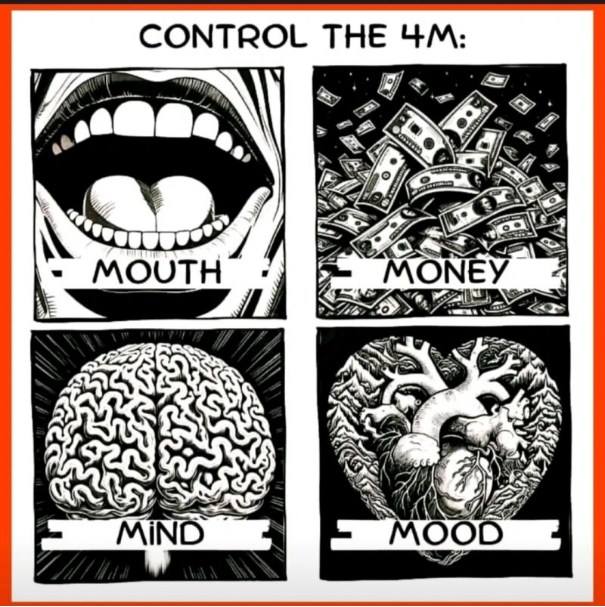
- Give each student 4 Post-it’s or more.
- Students write on each one a recommendation for each category.
- They stick their Do’s and Don’t’s on the posters where they belong.
- Everyone has to stick at least 4 but let them read what other people have written and add more.
- Divide the class into 4 groups. Each group writes a summary of ideas for their M.
- They have to include each idea.
- Make an exhibition of the posters next to the summaries.
- Everyone mills around and looks for or at ways their contributions have been included.
Enjoy the 4 M’s repackaged!
Coming soon! Please check the Pilgrims in Teacher Training courses in 2027 at Pilgrims website.
What Are the 4M’s? Puzzle Solved
Hanna Kryszewska, Poland