Project-based learning: Cultivating creativity in the language classroom
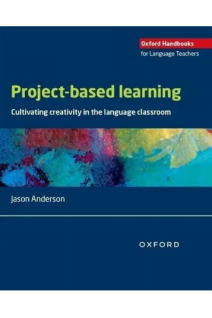
Jason Anderson. Oxford: Oxford University Press, 2026.
263 pages.
ISBN 978 0 19417581 4
This is a welcome return to issues of relevance in English language teaching. In his Introduction, Anderson reminds us both of the long history of projects and of their current relevance. Contemporary language learning increasingly highlights the key role of creative problem-solving, involving life-skills and emotional intelligence as opposed to programmes of study unrelated to learners’ real interests and needs. He ‘… recommends seeking out problems that stimulate one’s motivation, examining them from multiple viewpoints, exploring potential pathways to solutions, and implementing such solutions flexibly.’ (p 3). He is careful to define his subject matter: ‘a project is defined as an activity in which learners work individually or collaboratively … for an extended period of time to develop a product or products, (eg. texts, artefacts, solutions or events) that fulfil pre-specified outcomes or criteria …’ (p 13).
He presents a useful background to project work and its development over time. He then leads teachers through the whole project cycle, showing how projects can be developed from ideas and planning through to the final product of the project. But he acknowledges the variety of settings, so offers a highly flexible set of frameworks for designing, setting up, implementing and assessing projects in diverse settings. He goes on to review ways of dealing with specific types of classroom, offering a large variety of examples of projects successfully implemented in different settings worldwide.
He deals in detail with the issue of AI in the context of project-based learning. The jury is still out on the ultimate value of IA, and on its potential dangers. The views of 100 teachers in 20 countries across the world are reviewed regarding the extent to which AI serves as a useful learning tool and whether it can help as a useful learning tool in its own right and asking if it can be of use in helping develop tools for AI literacy. For the moment it would appear from the views of experts such as Vicky Hockey, that language teaching ‘can be shaped by but not led by AI.’
The issue of trans-languaging is reviewed in a refreshingly undogmatic way, as is the use of the mother tongue as an inevitable part of project implementation. Trans-languaging is bound to be a part of any project-centred programme, especially given that the teacher will not always be present at every stage.
The book will be of value to teacher trainers who are keen on enlarging the field of language teaching and also serve as a practical guide to teachers who are contemplating the incorporation of project work in varying degrees. It is well-researched and practically presented.
Project work can clearly make a major contribution to harnessing student and teacher creativity. It can also reinforce the idea of relocating language teaching within a framework of communal action in real-world settings, which extends beyond mere language learning into thinking skills, life skills and learning in general. This broadening of the focus of language learning is to be welcomed. However, Anderson is by no means a doctrinaire advocate and concedes that various degrees of commitment to the incorporation of project work in the many global different contexts of use will need a variety of flexible approaches.
Coming soon! Please check the Pilgrims in Teacher Training courses in 2027 at Pilgrims website.
Project-based learning: Cultivating creativity in the language classroom
reviewed by Alan Maley, UKNew Titles from Crown House Publishing
Empowering Students in Their Learning Journey with the “Buddies System”
Nina Lauder, Spain;Cristina Quincy, SpainIntroducing TeachAnyClass.org
Chris Sowton, UK