Empowering Students in Their Learning Journey with the “Buddies System”

Cristina and Nina are co-authors of the new Primary series Buddies by ELi publishing and have recently presented at the IATEFL conference in Brighton (2026).
Nina Lauder is a certified Oxford University teacher trainer and an ELT and CLIL specialist and author with three decades of experience worldwide. Email: info@ninalauder.com
Cristina Quincy has over 30 years of teaching experience in Spain and has authored numerous materials for primary and secondary classrooms. Email: cristina.quincy@gmail.com
Introduction
A buddy-system is an arrangement in which individuals are paired or teamed together to monitor, support, and help one another, ensuring each other’s welfare and safety. Originally a safety concept from the 1940s, it is now applied in a variety of scenarios, such as in sports like scuba diving or in the workplace for new hires or lone workers, or even in the classroom to help integrate new students or those with special needs.
By applying this concept specifically to the English classroom, we establish a cooperative environment that offers students a feeling of well-being and connection that promotes and reinforces learner agency. Through structured routines, collaborative roles, and meaningful tasks, a buddy-system activates the learning process for primary school-aged students while developing independence and communication skills in a supportive way.
The “Buddies System” is an approach that is incorporated throughout Buddies, the new 6-level book series by ELi publishing that incorporates engagement and reflection via SEL topics, learner-centered tasks and routines.
Benefits of the Buddies System
Most teachers already use many of the techniques used in the Buddies System but perhaps never considered the effects these techniques have on classroom dynamics and overall student well-being. It is vital in reinforcing five key elements that contribute to a nurturing classroom environment: general social integration, improved future skills in communication, social and emotional learning (SEL) in context, better classroom management and strengthened well-being.
1 Reinforcing social integration
Whether it is offering new students the help of a classmate who speaks their home language or having classmates support struggling students, working in pairs or small groups allows all children the opportunity to interact with one another. By rotating partners or work teams, you ensure these students have the opportunity to work with a variety of classmates and provide the chance for each to offer support and aid in the areas they excel in most. In the English classroom, for example, a student that is good at speaking might not be as good in grammar, whereas another may be too shy to speak in English but can help explain the proper grammar to his/her partner. Over time, every student interacts with many classmates, which normalizes talking to different peers and prevents cliques from forming that can create social isolation.
2 Building future communicative skills through teamwork & leadership
When people think of future skills, they often only consider digital competencies. But in the 21st century, employers look for candidates that also have the ability to communicate, collaborate, create and innovate; all of which are skills that are reinforced through the Buddies System. This can be created through team activities in which each student in the group carries out a specific role. In a group project or experiment (as seen in this STEAM activity for Buddies 4), we have a facilitator that collects all of the materials, recorders to carry out and keep track of each phase of the experiment and a presenter to explain their results to the class.
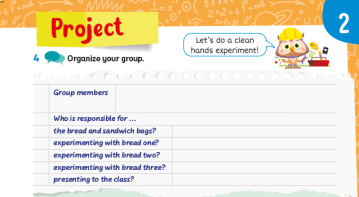
© Buddies 4, ELi Publishing, 2026
When practicing leadership in manageable ways, students learn accountability, communication, and delegation which are skills that are directly transferable to future work environments.
3 Promoting social and emotional learning (SEL)
The Buddies System and social and emotional learning go hand in hand in the English classroom. They both encourage empathy, active listening and respectful disagreement. It creates a safe place for students to learn and improve their English skills. In the Buddies series, SEL is not only tied directly to classroom management and dynamics, but reinforced in the stories that appear throughout the series. Each story recreates a real dilemma confronted by the book characters in which they demonstrate the appropriate SEL behavior. Then, students are asked to reflect on this behavior and even compare it to their own in similar situations. These examples from Buddies 1 and Buddies 5 show how we, as teachers, can promote student reflection based on student age and English level:
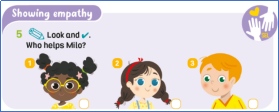
© Buddies 2, ELi Publishing, 2026
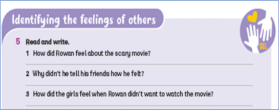
© Buddies 5, ELi Publishing, 2026
By incorporating SEL in the classroom in a real context, not only does it make SEL more meaningful to students, but it reinforces that feeling of personal and emotional safety which is inherent to a Buddies System.
4 Improving classroom management
When students are engaged and accountable to peers, off-task behavior drops because they are actively participating in the learning process. The Buddies System requires collaborating with classmates and staying focused on the academic task, which makes learning more relevant and engaging and reduces misbehavior. It allows teachers to shift from the central figure in a lesson and disciplinarian to a facilitator of content and emotional learning.
5 Strengthening student well-being
Above all, the Buddies System fosters a sense of belonging and emotional safety, both of which are closely linked to student well-being and readiness to learn. According to Maslow’s hierarchy of needs, these basic social and emotional needs must be met before students can fully engage in higher-level functions such as learning, curiosity or creativity. When students feel that they are part of a supportive classroom, they are more likely to participate actively in group activities and take initiative in their language learning.
The Buddies series and its methodology
Buddies is a 6-level series for primary school English learners. It has a flexible, adaptable framework centered around the Buddies System that focuses on connection and curiosity and offers opportunities to develop learner agency.
The series features characters who model the Buddies System in relatable, age-appropriate real-world contexts. By mirroring the daily lives of the students' own peer group, the characters demonstrate how supporting family, friends, and classmates can be easily integrated into the students’ own behavior. Throughout the journey, the mascot Ollie the owl serves as a reliable and supportive guide for students.

© Ollie the owl, Buddies, ELi Publishing, 2026
Another way the series encourages students to work together and recognize their personal strengths is through STEAM projects. STEAM is an approach that integrates Science, Technology, Engineering, Arts, and Math. The STEAM projects found in each level succeed where other groupwork activities sometimes fail because they allow students to provide mutual support in various ways. For instance, a student who excels in English may struggle with math; conversely, those who lack confidence in their foreign language skills might still shine in technical or creative roles. Moreover, by presenting collaborative projects with clear steps, defined roles, and reflection tasks, the series fosters real-world skill-building within a meaningful context.
Incorporating a Buddies System approach in the English classroom
English teachers can encourage buddy-systems and collaborative routines in their classrooms that foster inclusion and mutual support. For example, with younger learners, assigning buddies for lining up at the door or bus or for doing classwork encourages them to look out for one another through guidance and positive reinforcement. To make these relationships meaningful, teachers should provide clear expectations for being a supportive buddy and encourage reciprocity so that all students both give and receive support in different ways. This is why it is important to rotate partners regularly; so children can build new friendships and develop a variety of social roles. A variety of buddy system models, such as collaborative projects, turn-taking games, and SEL activities, can easily be incorporated in the English curriculum which will further strengthen classroom relationships and create a sense of belonging and emotional safety. Sometimes a simple change in routines at the beginning or end of class are the easiest ways for students to practice empathy and active listening. For example, allow time for short “peer-support check-ins” where volunteers can share how they are feeling and discuss successes or challenges from the week.
Conclusion
The Buddies System approach offers a flexible and inclusive framework that supports language acquisition in young learners. It fosters creativity, critical thinking, and communication which are essential skills for today’s diverse primary classrooms. It is more than simply pairwork or groupwork but rather about creating a classroom environment where students learn with and from each other, developing independence and interpersonal skills in a safe, supportive space.
“A journey is best measured in friends, not miles.”
Tim Cahill
References
Finley, T. (2026, Jan 16). 12 Buddy Systems That Support Learning and Student Well-Being, Edutopia. Available at: https://www.edutopia.org/article/using-buddy-systems-support-learning/
Lauder, N. and Quincy, C. (2026) Buddies series, ELI Publishing. Available at: https://www.elipublishing.com/p/buddies
McLeod, S. (2026) Maslow’s hierarchy of needs, Simply Psychology. Available at: https://www.simplypsychology.org/maslow.html
For more information on other English teaching materials by Eli Publishing, visit:
https://www.elipublishing.com/

Coming soon! Please check the Pilgrims in Teacher Training courses in 2027 at Pilgrims website
Project-based learning: Cultivating creativity in the language classroom
reviewed by Alan Maley, UKNew Titles from Crown House Publishing
Empowering Students in Their Learning Journey with the “Buddies System”
Nina Lauder, Spain;Cristina Quincy, SpainIntroducing TeachAnyClass.org
Chris Sowton, UK