More Than Rested: Restoring the Self Behind the Teacher
Effie Kyrikaki, MSc in Applied Psychology, is a teacher trainer, mentor and edupreneur who founded the NeuroLearningPower® framework, which trains and certifies teachers as student-thriving coaches rather than content deliverers. Her work centres on Whole School Wellbeing and Humane Intelligence, and she speaks and writes internationally on teacher wellbeing, and the role of language and coaching psychology in education. Email: effie@metamathesis.edu.gr

Introduction
She woke with a jolt, heart pounding, disoriented, a sharp pain pulsing through her temples. Why am I still in bed? I’m late. I should already be at school. Her hand reached instinctively for the phone on the bedside table, and then realisation came rushing in: it was an August Monday. She closed her eyes and waited for relief. It didn’t come. Her body had already decided it was a school-week Monday.
Perhaps you recognise this. Perhaps you have woken in the night mentally writing tomorrow’s lesson plan, replaying a difficult conversation with a parent, or wondering whether a quiet student was simply tired or silently struggling. Perhaps you have arrived at school already exhausted, not because the day had begun, but because your mind had never truly stopped working.
The hidden cost of caring
For many educators, this is not an occasional experience but a way of living. Teaching has always required intellectual preparation and emotional investment, yet today’s educators carry something heavier than workload alone: emotional load, the invisible responsibility of constantly reading the room, regulating their own emotions while responding to those of thirty learners, managing parents’ expectations, supporting colleagues, adapting to continual change, and somehow remaining calm, encouraging and compassionate throughout it all.
For many women in education, this load extends far beyond the classroom walls. The school day rarely marks the end of caregiving; it simply signals a transition to another set of responsibilities – teacher, mentor, colleague, mother, daughter, partner, organiser, emotional anchor. Each role may be deeply meaningful, yet together they create a quiet accumulation of demands that rarely announces itself dramatically. Instead, it settles gently upon the shoulders, day after day, until carrying it begins to feel normal.
Emotional demand is not necessarily the problem; it is part of what makes teaching profoundly human. We celebrate the teacher who notices the child sitting quietly at the back of the classroom, who senses when a lesson is losing momentum, who encourages the hesitant learner with just the right word at the right moment. These are acts of emotional attunement, requiring presence, empathy and a remarkable capacity to respond to the constantly shifting emotional landscape of the classroom.
The challenge begins when this emotional responsiveness is never switched off. Unlike many professions, teaching does not end when the last student leaves the room: the difficult conversation with a parent replays on the drive home, the child who seemed withdrawn lingers in the teacher’s thoughts through the evening, tomorrow’s lesson is mentally rewritten while preparing dinner. Even moments of rest become colonised by unfinished responsibilities – the body may be sitting on the sofa, but the mind is still taking attendance.
Researchers call this emotional labour: the ongoing process of managing one’s own emotions while simultaneously responding to the emotions and expectations of others. Every smile offered despite exhaustion, every calm response delivered under pressure, every encouraging word spoken when one’s own reserves are running low requires energy. Together, these small efforts create what many educators recognise as emotional load – the cumulative weight of carrying not only our own experiences but fragments of everyone else’s as well.
The effects of this continual adaptation are often subtle long before burnout becomes visible: struggling to remember simple things, waking repeatedly during the night, catching every seasonal virus, finding patience increasingly difficult to access, noticing that joy – once abundant in the classroom – has quietly faded into efficiency. Yet perhaps the deepest cost receives far less attention: chronic emotional load does not only affect how we feel; over time, it can begin to reshape who we believe ourselves to be.
“Chronic emotional load does not only affect how we feel.
Over time, it can begin to reshape who we believe ourselves to be.”
Perhaps this is why conversations about teacher wellbeing so often revolve around one elusive promise: I just need some rest – a free weekend, the next holiday, one uninterrupted night’s sleep. And certainly, rest matters: sleep repairs tissues, regulates hormones, consolidates memory and allows the brain to recover from the cognitive demands of the day. Without adequate rest, neither body nor mind can function optimally. Yet many teachers discover a puzzling truth. They return from a holiday having slept more than they have in months, only to find that beneath the physical fatigue something deeper remains untouched. They are rested, but they are not renewed.
From rest to restoration
This is because rest and restoration, although often used interchangeably, are not the same. Recent work on wellbeing reminds us that human beings require more than sleep alone – physical rest, certainly, but also mental quiet, emotional honesty, sensory relief, creative inspiration, nourishing relationships and a renewed sense of meaning. When these different forms of rest are neglected, exhaustion can persist even after a full night’s sleep.
Yet even this is not the whole story. Imagine an educator who finally reaches the long summer holiday after an exhausting year. Determined to recover, she does almost everything wellbeing experts recommend: she sleeps without an alarm, spends long afternoons by the sea, switches off work emails, reconnects with friends, paints for pleasure, reads novels simply because she enjoys them, and finds moments of stillness that remind her why life feels meaningful. Little by little, the tension leaves her body, her thoughts become clearer, she laughs more easily. By every measure, she is well rested.
Then September arrives. Within weeks she is once again staying late to prepare lessons, replying to emails long after dinner, apologising whenever she leaves school on time, and quietly believing that saying “no” would make her a less committed teacher. The physical and emotional benefits of the summer begin to fade – not because the holiday failed, but because the beliefs guiding her life remained unchanged.
Now imagine another teacher. She too enjoys the restorative gifts of summer, but something deeper happens. Somewhere between the long walks, the conversations with old friends and the return to activities she loved long before she entered the classroom, she begins to remember herself beyond her professional role. She realises that her worth has never depended upon being endlessly available, and returns to school still deeply committed to her students, but no longer believing she must carry every burden alone.
Both teachers rested. Only one experienced restoration. Rest replenishes depleted resources; restoration reconnects us with the person those resources are meant to sustain. Rest asks, What do I need in order to recover? Restoration asks a deeper question: Who am I beneath everything I carry?
“Rest replenishes depleted resources.
Restoration reconnects us with the person those resources are meant to sustain.”
Modern neuroscience offers a clue to why this distinction matters. Human beings are remarkably adaptive: faced with challenge, the brain mobilises an intricate network of physiological responses that help us cope with immediate demands. This process, known as allostasis, is essential for survival. Problems arise, however, when adaptation becomes our permanent state – when the body is repeatedly required to adjust without sufficient opportunity to recover, the cumulative wear and tear begins to leave its mark. Bruce McEwen described this phenomenon as allostatic load: the hidden biological cost of chronic stress.
Perhaps emotional load functions in much the same way. Rarely overwhelming us through one dramatic event, it accumulates quietly through thousands of small adaptations – one more difficult meeting, one more child whose sadness we absorb, one more evening answering emails instead of watching the sunset, one more day in which everyone else’s needs seem to arrive before our own. Like drops of water slowly hollowing a stone, these moments gradually shape not only how tired we feel, but who we believe ourselves to be. This is where restoration becomes far more than a wellbeing strategy: it becomes an act of remembering – not what we have to do next, but who we were before our identity became almost entirely defined by the roles we perform for others.
When what we do becomes who we are
One of the central principles of NeuroLearningPower® (NLPower) is that there is a profound difference between what we do and who we believe ourselves to be. Behaviours exist at one level, identity at another. We may choose to help, nurture, organise, support or solve problems, but over time these behaviours can become fused with our sense of self. We cease simply to teach; we become the one who must always know the answer. We cease simply to care; we become the one who must always hold everyone together. Without realising it, professional roles slowly evolve into identity statements.
For many women, this process is intensified by powerful cultural narratives that extend far beyond schools. From an early age, many are praised for being dependable, accommodating and self-sacrificing; success is often measured not by how well they care for themselves but by how effortlessly they care for everyone else. Teaching, a profession built upon service and relationships, can unintentionally reinforce these beliefs, producing a quiet internal dialogue that sounds deceptively virtuous: “I should be able to cope.” “I can’t let anyone down.” “They need me more than I need a break.”
I was reminded of this during a conversation with a volunteer following a conference presentation I gave on Humane Intelligence. As we spoke about family life, he remarked almost casually, “I don’t help around the house. We simply share the daily load.” I found that distinction refreshing – increasingly, many men are embracing an equal share of domestic responsibilities. So I asked another question: “And how does your wife respond?” He smiled. “She’s happy that we share everything. It’s just that she still carries the worrying. She still wants to check that everything has been done.”
His answer captures something many educators, and many women more broadly, recognise immediately. Responsibilities can be shared; mental load often is not. Long after the practical tasks have been divided, the internal responsibility frequently remains with the person whose identity has become organised around caring.
Restoration begins with identity
This is why identity beliefs are remarkably resistant to change. We can schedule a holiday, practise mindfulness or enjoy a weekend away, yet if our deepest belief remains that our value depends upon constantly giving to others, we will often recreate the very conditions that depleted us in the first place. Like elastic stretched for too long, we return to the familiar shape of over-responsibility because it feels consistent with who we think we are.
This is also why restoration cannot be reduced to self-care, nor achieved simply by finding more hours in the day. Restoration invites us to examine not only our habits but also the stories we have come to believe about ourselves, gently asking questions many educators rarely have time to consider: Who am I when I am not teaching? What parts of myself have quietly disappeared beneath years of caring for everyone else? Which beliefs continue to serve me, and which have become too heavy to carry? These are not indulgent questions; they are essential ones.
When identity becomes organised entirely around responsibility, productivity and service, even rest can begin to feel uncomfortable – we may pause physically while remaining psychologically on duty.
“True restoration begins when we give ourselves permission to reclaim forgotten
parts of who we are, not in opposition to becoming excellent educators, but
precisely because flourishing teachers bring far more of themselves
to their classrooms than exhausted ones ever can.”
Restoration in practice: The humane intelligence of EMBR.ACE
If restoration is the journey back to ourselves, the next question is both practical and deeply personal: how do we remain connected to ourselves while continuing to care so deeply for others? Teachers cannot simply stop caring, nor would most of them wish to; compassion is one of the profession’s greatest strengths. The challenge is learning how to care without gradually disappearing beneath the caring.
This is where the concept of Humane Intelligence offers a broader framework for understanding wellbeing in education. For decades, professional formation has focused primarily on knowledge, pedagogical competence, and performance. More recently, emotional intelligence has expanded this perspective by highlighting the capacity to recognise, understand, and regulate emotions. Humane Intelligence builds on these traditions while shifting the emphasis from competence alone to the quality of human functioning within demanding relational environments. It is organised around three interdependent capacities: Centre, the ability to regulate one’s internal state and maintain psychological stability under pressure; Connection, the capacity to participate in co-regulation through attuned, responsive, and trustworthy relationships; and Choice, the ability to preserve agency, discern alternatives, and act intentionally rather than react automatically. In this sense, Humane Intelligence is concerned not only with how teachers perform, but with how they remain present, relationally available, and agentic while performing their role. It asks not simply, “How can I become a better teacher?” but, “How can I remain fully human while teaching?”
“Humane Intelligence begins when we stop asking
how to become better teachers and start asking how to
remain fully human while teaching.”
This distinction is consequential. When educators understand themselves primarily as professionals fulfilling a function, restoration is easily postponed until exhaustion occurs. When they recognise themselves as human beings whose internal regulation, relational connection, and sense of agency are central to their work, restoration becomes an ongoing relationship with the self rather than an emergency response to depletion. Within the EMBR.ACE framework, this relationship develops through three interconnected capacities – Awareness, Change and Exploration – offering a gentle pathway back to ourselves.
Practising restoration: Centre, Connection and Choice
Below are three activities from the 'Rest to Restoration' workshop I run every summer for women in education from around the world, which I am delighted to share as a visual, created with the assistance of ChatGPT. I would be happy to read – and share – your thoughts on how effective you found them, in an email.
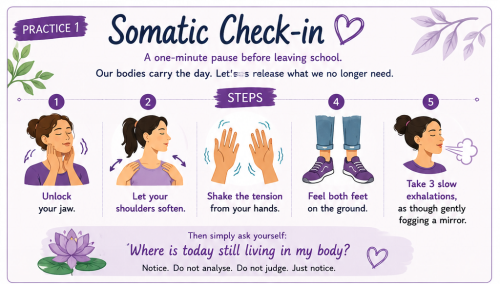
Practice 1: Awareness within Centre
Develop the capacity to listen to the body, notice early somatic signs of tension, and recognise recurring patterns before they intensify into automatic reactions or exhaustion.
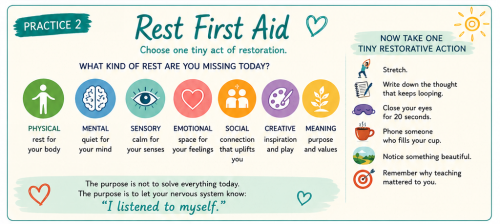
Practice 2: Change through Restorative Choice
Focus on small, sustainable restorative actions rather than unrealistic expectations or dramatic change. Lasting change is built through repeated, manageable choices that gradually create the conditions for deeper restoration.
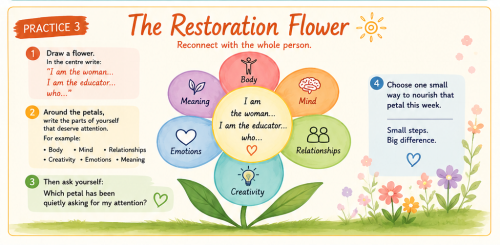
Practice 3: Exploration and Identity
Pause to examine who you are beyond your professional role. Reconnect with the whole person through small, intentional acts that restore neglected parts of the self, one step at a time.
Coming home
Teaching has always been one of the most profoundly human professions. Every day, educators carry knowledge, relationships, emotions, hopes and responsibilities that cannot be measured by lesson plans or examination results alone. It is hardly surprising that so many believe they simply need more rest – and they do. But perhaps what they need even more is restoration: not merely the replenishment of energy, but the recovery of identity; not simply time away from school, but moments that gently remind them who they are beyond the roles they perform.
This, perhaps, is the quiet promise of Humane Intelligence: that flourishing begins not with doing more, but with remembering that before we are teachers, mentors, leaders or caregivers, we are first human beings. That is the invitation of EMBR.ACE – not another initiative or expectation, but simply a way of returning to ourselves through Awareness, growing through Change, and remaining open to Exploration.
Because when teachers come home to themselves, something remarkable happens: their presence changes, their relationships deepen, their classrooms become places where students learn one of life’s most important lessons – that it is possible to care deeply for others without losing ourselves in the process.
Wishing you a holiday that restores you as deeply as it rests you.
Ready to come home to yourself? Join the new, fully sponsored EmpowerED Beginnings cohort - four free weeks of wellbeing training for women educators ready to reclaim who they are beneath the roles they carry.
References
Dalton-Smith, S. (2017). Sacred rest: Recover your life, renew your energy, restore your sanity. FaithWords.
Isenbarger, L. and Zembylas, M. (2006) 'The emotional labour of caring in teaching', Teaching and Teacher Education, 22(1), pp. 120–134.
Kyrikaki, E. (2025) 'Reclaiming the Inner Compass: A Humanising NLP Journey for Teacher Wellbeing', Humanising Language Teaching, August 2025.
McEwen, B.S. and Stellar, E. (1993) 'Stress and the individual: mechanisms leading to disease', Archives of Internal Medicine, 153(18), pp. 2093–2101.
Mercer, S. and Gregersen, T. (2020) Teacher Wellbeing. Oxford: Oxford University Press.
Coming soon! Please check the Pilgrims in Teacher Training courses in 2027 at Pilgrims website.
More Than Rested: Restoring the Self Behind the Teacher
Effie Kyrikaki, Greece