Communicating Research in Social Media: A Teaching Plan for Tertiary Education
Karen Passmore is a teacher and teacher trainer, with 30 years’ experience in English language teaching and an MA in TESOL from the University of Nottingham. Her previous experience includes teaching in Egypt, where she completed my RSA TEFL in 1991, Edinburgh, her hometown and Germany, where she lives. In 2006 She completed a two-year transactional analysis (TA) coaching course and since then she has undertaken teacher training workshops, focused on developing classroom management skills. In her free time, she endeavors to work towards her PhD in TESOL and she is always grateful for thoughts and feedback on her research and writing thus far. Email: karen.passmore@hs-bochum.de
Background
This article presents a structured teaching plan designed to support tertiary-level students in communicating academic research through social media platforms. Developed within the field of Engineering, the plan emphasizes cooperative writing, digital literacy, and the opportunity of using artificial intelligence wisely to enhance learning outcomes. This approach also develops students’ vocabulary in their field of study, giving participants the opportunity to discover and develop their own vocabulary learning strategies. Although contextualized in engineering education, the framework is adaptable across disciplines.
Course design
The program is structured as an extensive 15-week course, consisting of a 90-minute introductory session, weekly check-ins, and a final review session. Students are expected to invest an additional 15–20 hours in self-directed project work where group work is emphasized through cooperative writing and peer feedback. The project accounts for 30% of a 2.5-credit module.
Methodology
The teaching plan follows a step-by-step process:
- Task Setup – Assignment orientation, grading criteria, and feedback procedure.
- Reading Academic Papers – Developing critical reading and summarizing skills.
- Team Formation – Collaborative selection of research papers and cooperative writing tasks.
- Recording Oral Summaries – Enhancing vocabulary acquisition, pronunciation and intonation through oral work.
- Peer Feedback – Benchmarking progress by reviewing peers recorded summaries.
- Writing a Blog – Producing content for non-specialist audiences, with AI tools permitted.
- Formative Feedback – Draft submission for constructive feedback.
- Final Submission – Blogs are fact checked by academic staff.
- Publication – Blogs are shared publicly, providing students with authentic audiences. Please read a sample of two student blogs below.
Learning outcomes
The course develops multiple competencies. Students gain confidence in their ability to disseminate academic work in their field of study. Through cooperative writing, the ability to communicate in written English is developed. Importantly, by publishing blogs, students engage with authentic readership, which increases their motivation and effort. Lastly, the program promotes responsible AI use in academic communication.
Conclusion
This teaching plan demonstrates how integrating social media into higher education enhances research literacy and digital communication skills. While developed within Geo Engineering, the framework’s adaptability makes it relevant across disciplines. By bridging the gap between academic research and public engagement, the project contributes to more accessible and impactful knowledge dissemination.
|
Eyes in the Sky: Working with Drones When mining stops, the land that’s left behind can have a lot of problems. The ground might sink, water can get polluted, and plants may struggle to grow. Normally, checking all this takes loads of time, money, and effort. But drones—small flying machines with no pilot onboard—make it way easier and cheaper to keep an eye on things. A good example of this is the Prosper-Haniel coal mine in Germany. Prosper-Haniel used to be a huge coal mine, but now that it’s closed, the area faces serious issues. The land is sinking in some places, water might be contaminated, and the environment is unstable. Keeping track of all these changes is important, but sending people into dangerous or hard-to-reach areas isn’t always safe. That’s where drones come in.
Drones can fly over large areas and take detailed photos and videos using special cameras. They can spot changes in plants, check water quality, and notice patterns that humans might miss. For example, if plants look unhealthy in the drone images, it could mean the soil or water is polluted. If the water shows strange colors or unusual temperatures, that could be an early warning of contamination. Even though buying drones and software costs money at first, it’s still cheaper in the long run. Traditional surveys need more people and heavy equipment, while drones just need a pilot and the right gear. Plus, the information they collect is super accurate, which makes it easier to make good decisions about fixing problems. The process usually starts with drones collecting “baseline” data—basically a starting picture of what the area looks like right now. Then they fly at regular times to see how things change. Computers analyze all this data to find unusual patterns, which are then shared in reports so everyone can understand what’s happening and decide what to do next. At Prosper-Haniel, drones discovered areas where the ground was sinking and helped show the reasons behind it. They also spotted possible water pollution and gave scientists a clear view of how plants in the area were doing. Overall, drones are a game-changer for checking old mining sites. They’re fast, safe, and cost-effective, and they give us the kind of detailed info we need to keep the land safe and healthy. As technology keeps improving, drones will become even more important for protecting the environment after mining ends. Please support our mission. Just like everyone, you rely on raw materials that come from mining. This gives you the power to be part of the solution. Your help matters—let's work together and make a difference! Written by Christian Vogelsang ;Javier Palacio-Gomez; Niclas Original articles available at: Franken ;Jonas Perenboom Bachelor in Mineral Resource Engineering and Sustainable Resource Management Towards a Long-Term Unmanned Aerial Vehicle (UAV)Monitoring Framework for Post-Mining Effects: Prosper-Haniel Case Marcin Pawlik;Benjamin Haske;Hernan Flores;Bodo Bernsdorf ;Tobias Rudolph https://doi.org/10.3390/mining4020013aleq Darkazali https://fzn.thga.de/forschung/publikationen/ |

|
Are you a Rockstar? Why Rocks, Water and Science Might Be the Coolest Thing You’ve Never Thought About. Exploring the Emscher Formation: Science, Sustainability and the Future Beneath Our Feet Science might sound like something for lab coats and dusty books. But what if we told you that right now, in the ground beneath one of Germany’s most famous industrial areas, a team of researchers is doing something that might just help save our drinking water, protect the environment and shape the future of our cities?
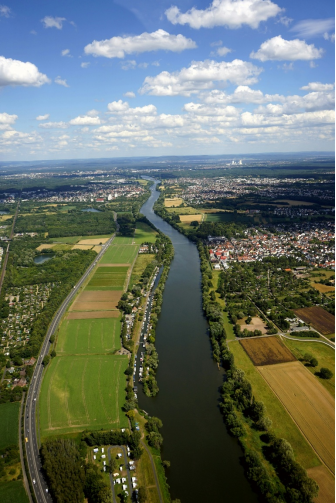
Here’s the story of the Emscher Formation and why it should be on your radar. Figure 1 Clean Water in the Ruhr-Area The Problem: What Happens after Coal Mining? The Ruhr District is one of Germany’s historical powerhouses, literally. For decades, it was the heart of coal mining. Since the end of 2018, mining has officially ceased. The shafts are closed, the machines are silent—but underground, something is still on the move: mine water.” See, when mines were active, they constantly pumped out mine water to keep tunnels dry. Now, with the pumps slowing or stopping, the mine water is beginning to rise again—a process known as mine water rebound, which can be seen as the Earth's way of resetting itself. This rise is occurring in a controlled and carefully managed manner to prevent it carrying nasty stuff, like metals, into freshwater courses which we and the surrounding nature depend on.
So how do we prevent this from happening?
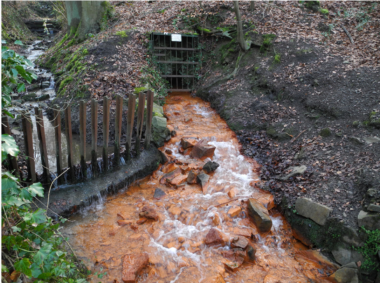
Figure 2 https://www.gd.nrw.de/gw_be_grundwasserschutz-nachbergbau.htm Grubenwasserauslauf aus einem Entwässerungsstollen im südlichen Ruhrtal Enter the Emscher Formation: Nature’s Underground Shield. This is where geology becomes the hero. Beneath the surface lies a massive layer of rock called the Emscher Formation. Think of it as a natural wall made of clay-rich marls, capable of blocking water and gas. If this formation is tight enough, meaning water can’t easily flow through it, it could protect our clean water above from the mine water below.
But how do we know if it’s up to the job?
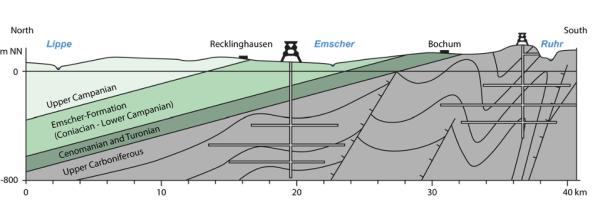
Figure 3 Hydrogeological section (north-south) of the Ruhr, including Emscher Formation The Science Bit: Drilling Deep to Understand More A group of researchers from the Research centre of Post-Mining at Technische Hochschule Georg Agricola in Bochum took on the challenge. Their mission: Oversee the drilling, deep into the Earth (over 1000 meters!) and take samples to understand if the Emscher Formation is really the perfect underground barrier. They didn’t just look at the rocks—they put them through an interrogation. With tools like X-ray diffraction, electron microscopes, and ultra-sensitive pressure tests, they uncovered details such as:
Porosity – how much water the rocks can actually store Permeability – how easily fluids can flow through them Mineral composition – including plenty of clay, calcite, and even some freaky little fossils
And the coolest part? They discovered that the deeper you go, the tighter the rock gets. That’s great news if you’re trying to block rising mine water.
So... Why Should You Care?
The Muddy Work Behind Clean Water Let’s be honest: not everyone dreams of working with mud hundreds of meters underground. But if you’re into making a difference by solving real problems and mixing tech with nature, this is exactly where this happens. The research happening in the Ruhr area connects geology, environmental science, engineering and data modelling. The scientists are building 3D digital models of the underground world to predict how water behaves decades into the future. That’s not just science stuff, that’s protecting drinking water for millions of people. That’s designing sustainable cities. That’s climate resilience. And careers in this field? They’re growing fast! Whether you’re into coding, chemistry, drones or digging, there’s a place for you in Earth Science, environmental monitoring or sustainable infrastructure.
The Future Needs Rockstars (literally)
The Emscher Formation might look like just layers of ancient clay and limestone, but it holds the key to safer water and smarter land use. It’s a reminder that sometimes, the answers to our most modern problems are hidden deep in the past, buried beneath our feet. So if you’re thinking about what to do next, maybe give a second thought to the ground below you. There’s more going on there than you think, and it might just be where you make your mark.
By Mikail Dege and Henrik Hartmann
GENTH, T.; ROSE, L.; JASNOWSKI-PETERS, H.; WESTERMANN, S.; MELCHERS, C. (2024): A workflow to evaluate the potential of the Emscher Formation as hydraulic barrier during mine water rebound in the Ruhr District: A holistic approach. In: KLEINMANN, B.; SKOUSEN, J.; WOLKERSDORFER, Ch. (Eds.): Proceedings of the 15th International Mine Water Association Conference & West Virginia Mine Drainage Task Force Symposium. April 21-26, 2024, Morgantown, WV, USA. p. 212-217. Online verfügbar unter: https://www.imwa.info/docs/imwa_2024/IMWA2024_Genth_212.pdf (zuletzt geprüft am 16.07.2024) [peer-reviewed] |
Please check the Pilgrims in Segovia Teacher Training courses 2026 at Pilgrims website
‘Sophie the Lady and Mouse in the House’: Arts and Crafts ELT Project for Young Learners Part III
Sylwia Zabor-Żakowska, PolandSnow White, AI and the 14 Teenagers
Ruth Jones, GermanyTwo Roads, One Voice: Exploring Choices through Poetry and Imagination – a Lesson Plan Based on the Text-driven Approach
Ayşe Yılmaz, TürkiyeBringing Middle-earth into the EFL Classroom: Teaching Descriptive Writing with Tolkien
Aliya Kurmanova, KazakhstanCommunicating Research in Social Media: A Teaching Plan for Tertiary Education
Karen Passmore, GermanyA Way to Encourage Our Students to Speak and Write Up an Interview
Peter Dyer, FranceWeekly Speech-Contest-Style Speaking Tasks as Reflective Practice
Alexander Cameron, Japan