- Home
- Lesson Ideas
- ‘Sophie the Lady and Mouse in the House’: Arts and Crafts ELT Project for Young Learners Part III
‘Sophie the Lady and Mouse in the House’: Arts and Crafts ELT Project for Young Learners Part III
Sylwia Zabor-Żakowska, Poland is an English, Spanish and Art teacher, teacher trainer, creativity pedagogue, material writer, author, poet and painter. She writes and publishes in Polish and in English. The core of her work is developing thinking and creativity in children. She runs a little Art and Language school www.rzezucha.com. Email: poppies@op.pl
Here you can read Part I and Part II.
Introduction
The project ‘Sophie the Lady and Mouse in the House’ is directed to the teachers of young learners who are keen to explore and develop the field of creativity while English teaching. It is based on pieces of a rhyming story for children and the use of Arts and Crafts techniques. Part I - ‘Prologue’ was published in the February issue of HLT and part II – ‘Monday’ was published in the August issue of HLT Each part consists of 4 lessons and contains downloadable worksheets for students.
True creativity always involves thinking out of the box, which in ELT means broadening and going beyond the well known, standard curricula. It might understandably cause unpleasant discomfort of the unknown. ‘Sophie the Lady and Mouse in the House Arts and Crafts project’, however, not only refers to the prevailing and more than welcome children’s need to act creatively but also is set among standardized ELT practices to make it easily approachable. Clear step by step instructions, worksheets and detailed aims are designed to make implementing the project in the curriculum as easy as possible. Arts and crafts activities together with performing tasks will raise learners’ joy, excitement and engagement leading to high effectiveness of English teaching which will reward the teacher’s effort.
The three parts ‘Prologue’, ‘Monday’ and ‘Friday’ are fragments of the book ‘Siedem dni z życia Hrabiny Grabiny’ published in Polish by BoSz, https://bosz.com.pl/sklep/siedem-dni-z-zycia-hrabiny-grabiny/. The text is accompanied by some Basia Trembaczowska’s illustrations that come from the book, too. You can learn more about the book at the bottom of the project.
About ‘Friday’
Students’ age: 10 - 13
Level: A2/B1
Time: 4 45-minute lessons
Creativity and critical thinking skills:
- aims: fostering students’ interest and eagerness to think and create, developing imagination and deductive thinking, enhancing an ability to make predictions, practising fine motor skills
- activities: making puppets, creating insects, moulding cauldrons and fruits or other soup ingredients, performing the language chunks with puppets and plasticine objects, illustrating
Emotional/social/life skills: triggering interest in studying English, building inner motivation for learning, experiencing joy and excitement for learning English, raising interest in reading in general, taking part in discussions, practising presentation/performing skills, strengthening concentration, enhancing long-term memory, playing with the language, deepening understanding of the value of social life and contact with animals
Language focus: revision and consolidation of the previously learnt language (see part I Prologue’, see part II ‘Monday’) the language of ‘Friday’, Present Continuous, be going to
Cognitive focus: pollination process
Skills: describing a picture, practising speaking, writing, listening and reading skills
Materials: puppets of Sophie the Lady and Mouse in the House (teacher’s and students’), a teacher’s puppets of the Wise Man and insects (it’s optional, whether you want to make them before class or not), recorded ‘Friday’ on a smartphone (if you are willing to do it ), worksheets (no. 9, 10, 11, 12, 13) crayons, felt tips, glue, scissors, skewers, string, plasticine, pieces of fabric or coloured paper from used magazines
GI element: No.3 Good health and well-being, No.12 responsible consumption, No.12 Life on land
FRIDAY
On the fifth day Mouse in the House is wakening the Lady with the flavour of fruit tea
and proudly gives her a rolled up burdock leaf so as she can see
what’s up today in the way, as if it were
a telescope to watch another planet’s rock.
She catches a glimpse of the whole neighbourhood, which puts her in a good mood.
So Sophie takes off her blue bathrobe to pull over her long, working robe.
Then, whistling on her fingers she calls out for help, a swarm of bees and other insects.
Comes only a half, it must be enough.
Ladybugs, butterflies and dragonflies arrive as well, they are all keen to help her.
They get down to work, others chirp flying around the orchard, and astonishing birds.
They all load willow baskets with plenty of juicy fruits,
everyone gives it their all, everything they can produce.
So apples, pears, plums, raspberries, cherries, blackberries,
apricots, peaches and nuts fill up the baskets; insects know the Lady has the guts
and is planning something spectacular, no one is going to cry.
There is a giant clay cauldron in Sophie’s vast garden
heated by fire. The biggest fire in the whole shire.
She is cooking fruit soup, it seems it’s for a larger group.
She uses a magnifying glass - all the helpers watch her cook resting on the mossy grass -
to check if every fruit is ripe enough, not rotten, not covered in mould, the soup must be high-end stuff.
The flames go up. ‘Yup, yup’ - she says -‘That is enough’.
‘It’s time for a try, spread the news across the town’ - she asks every creature that can fly.
‘Not only is the soup delicious, but also it’s especially nutritious.
It will do everybody good, so if only you would
like to take a bite, don’t hesitate and come over, you can bring a bunch of clover.
No matter you’re young or old, you’re big or small, the soup is for all.
You can take your dogs and cats, even bats, even rats.
Women with files, men with watering cans, you’re welcome!’
And there they come. Can you see them arrive? In groups, in troops.
They carry their spoons and bowls, up are their souls.
The sun is beating down on Friday afternoon, the feast is starting soon.
In the hustle and bustle of the town there is even a clown.
People are shaking hands listening to performing bands
and tuck into the soup, now and then you can hear them whoop.
No one moans, no one cries, you can see happiness in their eyes.
No one takes life for granted, this Friday afternoon is enchanted.
No one looks forward to better times but appreciates their lives.
The air, the sky, the sun, the birds flying by, nobody will ever defy
the Earth’s beauty. People are off duty,
and are living here and now. It’s time to laugh, it’s time to smile.
It’s time to enjoy life. Look, that man in a green turban is playing the fife.
Just the way children do. How about you?
And again evening comes, Sophie the Lady arrives at home and watches the skies.
Through the leafy telescope she sees the sparkling stars on the magic dome.
Fortunately, none of her friends is in need, nobody asks her to do any good deed.
She is not urged, and can be at peace with the world.
Mouse in the House darns the Lady’s skirt, she’s already served her a delicious dessert.
Looks at the moon, they’re going to go to sleep soon.
The woods around echo a lullaby.
Mouse in the House is waving to us goodnight, goodbye.
Lesson 1
Procedure and timing
Step 1 (10 min): With the puppets of Sophie the Lady and Mouse in the House greet children warmly as usual and tell them they’re going to read the next part of the story and Mouse in the ‘Friday’. Ask children what they think Sophie the Lady is going to do on Friday. Explain the meaning of ‘going to’ and provide some examples e.g. I think (in my opinion) she’s going to visit the Wise Man, and help students use it. Asking questions will be a good idea, e.g. Is she going to invite Alice Gal Pal and Spider the Mate?
Put their ideas on the board. Students copy their ideas in their notebooks.
Step 2 (4 min): With the puppets of Sophie the Lady and Mouse in the House read the following part aloud and ask learners to listen for what Sophie is going to do. Tell them not to worry if they don’t understand everything. Having read that, students say what the Lady is going to do.
FRIDAY
On the fifth day Mouse in the House is wakening the Lady with the flavour of fruit tea
and proudly gives her a rolled up burdock leaf so as she can see
what’s up today in the way as if it were
a telescope to watch another planet’s rock.
She catches a glimpse of the whole neighbourhood, which puts her in a good mood.
So Sophie takes off her blue bathrobe to pull over her long, working robe.
Then whistling on her fingers she calls out for help a swarm of bees and other insects.
Comes only a half, it must be enough.
Ladybugs, butterflies and dragonflies arrive as well, they are keen to help her.
They get down to work, others chirp flying around the orchard and astonishing birds.
They all load willow baskets with plenty of juicy fruits,
everyone gives it their all, everything they can produce.
So apples, pears, plums, raspberries, cherries, blackberries,
apricots, peaches and nuts fill up the baskets; insects know the Lady has the guts
and is planning something spectacular, no one is going to cry.
There is a giant clay cauldron in Sophie’s vast garden
heated by fire. The biggest fire in the whole shire.
She is cooking fruit soup, it seems it’s for a larger group.
She uses a magnifying glass, all the helpers watch her cook resting on the mossy grass,
to check if every fruit is ripe enough, not rotten, not covered in mould, the soup must be high-end stuff.
Step 3 (6 min): Put the following words on the board and read them out loud. Elicit from your learners which words/phrases they already know and teach them the new ones. Then read the whole list together with the class. Repeat it two or three times.
Hint: I recommend writing the words on the board before class starts. It saves precious lesson time and also helps avoid discipline problems that arouse when a teacher is writing a list of vocabulary and students have nothing to do.
On the fifth day
flavour of fruit tea
burdock leaf
what’s up
a telescope
catch(es) a glimpse
neighbourhood
good mood
a swarm of bees and other insects
it must be enough
keen
get down
plenty of
give(s) it their (one’s) all
has the guts
spectacular
clay cauldron
shire
magnifying glass
mossy grass
ripe
rotten
mould
high-end
Step 4 (3 min): Give out worksheets no. 9, read aloud or play the recorded text as children listen and read.
Step 5 (5 min): Ask students what insects and fruits are mentioned in the text. Ask them if they know the correlation between bees and fruits. Talk briefly about the pollination process and if needed make children aware of the fact that bees are a seriously endangered species.
Step 6 (10 min): Read or play the text again and children fill in the gaps with the given words.
Step 7 (4 min): Read the whole text as a class.
Step 8 (3 min): Hand out worksheets no.10 and set homework.
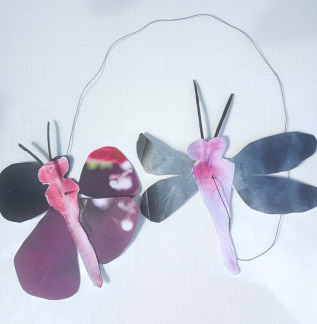
Homework: Children read the text out loud two, three times. If you have recorded the text share it with your learners so that they can first listen and then read. Children cut out the ‘stains’ and adding missing body parts, create insects. They can employ whatever technique – coloured paper, used magazines’ paper, drawing, painting. If they want to, they can also create other insects like bees or bumblebees. (The below photo shows what insects can look like. It’s a good idea to hang them on strings to ‘make them fly’)
You can ask volunteers to learn a piece of the story by heart. I wrote about the value of learning bits
of the text by heart in the ‘Prologue’ part.
Photo: Sylwia Zabor-Żakowska
Lesson 2
Step 1 (10 min): Greet students as usual and start the class listening to and reading the first part of ‘Friday’. Read first as a choir and then ask learners to read the text out loud individually.
© Copyright by BOSZ
Illustrations: Barbara Trembaczowska
Photo: Sylwia Zabor- Żakowska
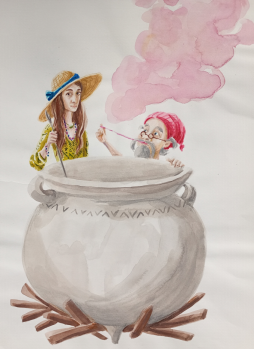
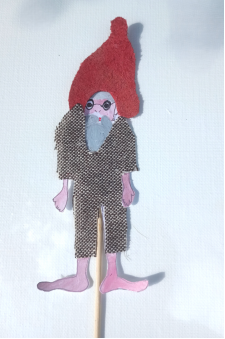
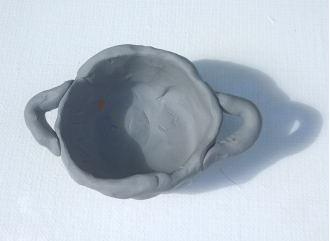
Step 2 (15 min): Show children the illustration of Sophie and the Wise Man standing behind the cauldron and ask them to take the insects they created at home and the puppets of Sophie the Lady and Mouse in the House. Ask learners to guess what Sophie and The Wise Man are going to do and who is going to help them. Tell children they are going to make puppets of the Wise Man and mould cauldrons. Hand out worksheets no. 11 with the Wise Man’s stencils. They can create puppets using crayons, felt-tips, pieces of fabric or coloured paper of used magazines - let them decide. Remind learners of the need to save trees which is the reason for using used magazines’ paper. They will need skewers, scissors and glue. They will also need plasticine to mould cauldrons.
Hint: While children are working remember to give them lots of positive reinforcement and express your enthusiasm about their work. Play the recording of the text a few times or read it out loud. Play the previous parts ‘Prologue’, and ‘Monday’ as well.
Photos: Sylwia Zabor-Żakowska
Step 3 (3 min): Read or say this part performing it with your puppets of Sophie, the Man and insects
The flames go up. ‘Yup, yup’ – she says – ‘That is enough’.
‘It’s time for a try, spread the news across the town’ she asks every creature that can fly.
‘Not only is the soup delicious, but also it’s especially nutritious.
Explain what it means and ask children if it’s really time for a try.
Hint: Don’t hesitate to use your mother tongue.
Step 4 (5 min): Discuss with children what fruits should be added to cook soup. Remind them of ‘should’ and help them say: You should have/add …. and encourage them to ‘add’ other ingredients so that they have the chance to use the language they already know. Mention the importance of consuming fruits and vegetables for good health.
Step 5 (10 min): Children mould fruits and/or other ingredients from plasticine and put them in plasticine cauldrons.
Hint: Play the recording of ‘Prologue’, ‘Monday’ and the first part of ‘Friday’ when they are ‘cooking soup’.
Step 6 (2 min): Set homework and children tidy up the classroom.
Homework: Listen and read ‘Prologue’, ‘Monday’ and the first part of ‘Friday’.
Lesson 3
Step 1 (5 min): Greet children warmly and ask students to take their puppets, plasticine cauldrons and fruits. Ask a volunteer to read the text out loud while the rest of the class is performing the actions with previously made ‘props’. Repeat this activity two or three times.
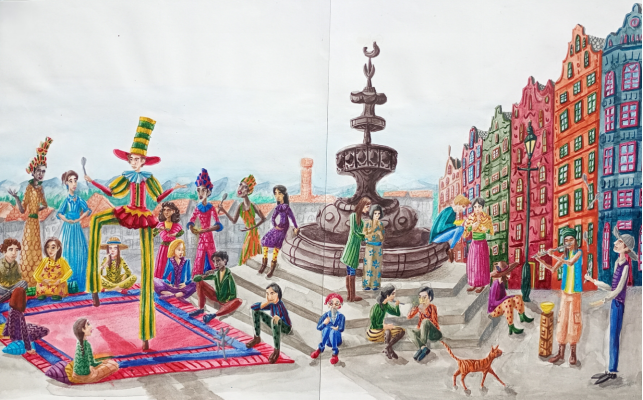
Step 2 (7 min): Show children the below illustration and tell them to describe (orally) the picture. They can use ‘I can see’ and the language they already know. Ask them to detect Sophie the Lady and the Wise Man. Ask children ‘Who are the people?’ ‘Where are they?’ ‘What is happening?’ What are they doing?’ so that they can practice the language as much as possible.
© Copyright by BOSZ
Illustrations: Barbara Trembaczowska
Photo: Sylwia Zabor- Żakowska
Step 3 (2 min): Help children practice the structure ‘going to’ by asking them ‘What is going to happen?’ ‘What are the people going to do?’
Step 4 (8 min): Introduce the below list of words following the usual routine. Elicit words students know, teach the new ones and read the list as a chant two or three times.
Hint: It’s great to use a rattling instrument to beat the rhythm, which enlivens and energizes the activity
up yup yup
try fly
delicious nutritious
good would
over clover
small all
dogs cats bats rats
groups troops
spoons bowls souls
afternoon soon
hustle and bustle
town clown
hands bands
soup whoop
cries eyes
No one takes life for granted, this Friday afternoon is enchanted.
times lives
by defy
beauty duty
life fife
children do how about you?
Step 5 (5 min): Read the below part of the text or play the recording. Ask learners to join you, especially where rhymes turn up. Do this activity twice.
The flames go up. ‘Yup, yup’ – she says – ‘That is enough’.
‘It’s time for a try, spread the news across the town’ she asks every creature that can fly.
‘Not only is the soup delicious, but also it’s especially nutritious.
It will do everybody good, so if only you would
like to take a bite, don’t hesitate, come over, you can bring a bunch of clover.
No matter you’re young or old, you’re big or small, the soup is for all.
You can take your dogs and cats, even bats, even rats.
Women with files, men with watering cans, you’re welcome!’
And there they come. Can you see them arrive? In groups, in troops.
They carry their spoons and bowls, up are their souls.
The sun is beating down on Friday afternoon, the feast is starting soon.
In the hustle and bustle of the town there is even a clown.
People are shaking hands listening to performing bands
and tuck into the soup, now and then you can hear them whoop.
No one moans, no one cries, you can see happiness in their eyes.
No one takes life for granted, this Friday afternoon is enchanted.
No one looks forward to better times but appreciates their lives.
The air, the sky, the sun, the birds flying by, nobody will ever defy
the Earth’s beauty. People are off duty
and are living here and now. It’s time to laugh, it’s time to smile.
It’s time to enjoy life. Look, that man in a green turban is playing the fife.
Just the way children do. How about you?
Step 6 (7 min): Talk with students about what they’ve understood from the text, and what the people are doing on the described Friday afternoon. Compare pre-listening suppositions with what’s in the text. Pay your learners’ attention to how the people are feeling and why, what brings happiness here. Emphasize the value of social life and contact with animals. Look at the illustration once again and talk about what pets are missing there.
Step 7 (8 min): Hand out worksheets no. 12 and follow the usual routine. Children listen, read and fill in the gaps.
Step 8 (2 min): Set homework.
Homework: Children read the text out loud two or three times. If you have made the recording share it with your learners, so that they can first listen and then read. Volunteers learn parts of the story by heart. You can also give optional homework – willing children make puppets of the inhabitants of the town.
Lesson 4
Step 1 (10 min): Greet children friendlily, and ask volunteers to read the text (from worksheet 12) out loud or those who’ve learnt it by heart, to recite it. Listening children use the puppets to perform the action.
Step 2 (5 min): The whole class reads the text using their puppets.
Step 3 (5 min): Hand out worksheets no. 13 and read aloud or play the recorded text. Ask students to pay their attention to the rhymes.
And again evening comes, Sophie the Lady arrives at home and watches the skies.
Through the leafy telescope she sees the sparkling stars on the magic dome.
Fortunately, none of her friends is in need, nobody asks her to do any good deed.
She is not urged, and can be at peace with the world.
Mouse in the House darns the Lady’s skirt, she’s already served her a delicious dessert.
Looks at the moon, they’re going to go to sleep soon.
The woods around echo a lullaby.
Mouse in the House is waving to us goodnight, goodbye.
Step 4 (10 min): Ask the class to find out and read the rhymes aloud. Then elicit what they have understood and teach the new vocabulary items e.g. dome, be in need, deed, urged, be at peace, darn, dessert, lullaby. Children take notes.
Step 5 (5 min): The class reads the last part of Friday two, three times.
Step 6 (15 min): Give children space to illustrate the last part in the way they imagine it. They can work in pairs or individually. Play the recording of ‘Prologue’ ‘Monday’ and ‘Friday’ or read them out loud while they are drawing.
Hint: Eager beavers who know the parts of the story by heart can recite and perform them while others are illustrating. Remember to express your appreciation of your students’ engagement and effort.
No homework this time.
Follow up
Make a display of the illustrations.
About the book
© Copyright by BoSz www.bosz.com.pl
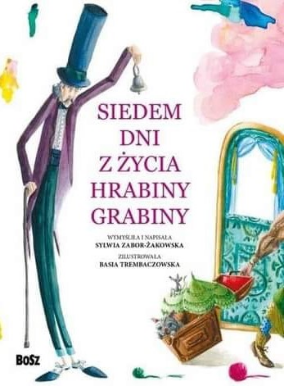
Title in Polish: ‘Siedem dni z życia Hrabiny Grabiny’
Invented and written by: Sylwia Zabor-Żakowska
Illustrated by: Barbara Trembaczowska
Published in Polish by BoSz
Audience: Children 4/5 -12/13
Word count: 4870
Numbers of chapters - 8 ( prologue and 7 chapters)
Key idea
To introduce children into the world of art through a process of creating/designing a book.
To appreciate children’s creative potential and their need to create and give them a chance to experience to a certain degree creating a book.
To invite children to go through a creative process along with the author and the illustrator.
To develop children’s love for reading as well as for creating.
Children/readers are invited to co-create the book with their own ideas, using their own imagination and individual sensitivity so that they become co-authors. They are provided with the creative, artistic ‘assignments’ to explore various artistic techniques (e.g. water paint, soft pastels, collage, pencil, crayons, mixed techniques)
Synopsis
The rhyming story ‘Sophie the Lady and Mouse in the House – Seven Days of Their Lives’, which is a working title, takes young readers for an unprecedented, unexpected and unforgettable adventure that has neither the beginning nor the end and lets children experience the joy of creativity. The reader is the one who is welcome to co-create, design and complete the missing elements with their own imagination, creativity and ideas expressed by a variety of artistic techniques, which helps children practise artistic skills using e.g. soft pastels, water paint, collage etc.
The inspirations coming from Polish, English and Swedish children’s classic literature permeate each other. The whole concept derives from different art branches: imaginary visions that you encounter evoke Marc Chagall’s or Impressionist paintings and the introduction resembles a theatre play (‘Mouse in the House is drawing the curtain to invite you to a joyous and exciting adventure.
Join her, you will be happy. That is for certain.’)
Sophie the Lady and Mouse in the House lead their lives in a mysterious castle surrounded by nature, which has a significant influence on them. Sophie acts as a fairy doing lots of good deeds and helping those in need. Each day brings new adventures and challenges which demand commitment and courage. On Monday she is invited to Alice Gal Pal and Spider the Mate to weave a web. On Tuesday she plants a pearl out of which Treasure Tree will grow. On Wednesday she heals Christopher the Whale with a shell. On Thursday she takes The Cat in the Bag to Trumpeter who lost his creative power and visits Filestra who conducts an orchestra at night. On Friday a swarm of insects help her cook fruit soup for the whole town. On Saturday she blows a hot air balloon out of chewing gum and cherishes the day by the stream. On Sunday she’s over the moon celebrating a family reunion.
Non-material / social/ citizenship/ values like friendship, help, tenderness for each other, love for nature, awareness of a healthy lifestyle, appreciative attitude towards life and joy of life recur in this story of Sophie the Lady, Mouse in the House and their numerous, unique friends who look forward to meeting young readers. The book is also intended to delight adults while reading out loud to children.
If you are interested to get this book published in English, do not hesitate to contact Sylwia or BoSz
You can see the book here: https://bosz.com.pl/sklep/siedem-dni-z-zycia-hrabiny-grabiny/
The publisher’s note
The illustrations are taken from the book "Siedem dni z życia Hrabiny Grabiny" published by the BOSZ Publishing House. The English texts were developed based on the Polish edition of the book.
Original title: ‘Siedem dni z życia Hrabiny Grabiny’
© Copyright by BoSz Coming soon!
© Copyright for text Sylwia Zabor-Żakowska
© Copyright for illustrations Barbara Trembaczowska
The worksheets for the Friday can be downloaded from the links at the bottom of the page.
Please check the Pilgrims in Segovia Teacher Training courses 2026 at Pilgrims website.
‘Sophie the Lady and Mouse in the House’: Arts and Crafts ELT Project for Young Learners Part III
Sylwia Zabor-Żakowska, PolandSnow White, AI and the 14 Teenagers
Ruth Jones, GermanyTwo Roads, One Voice: Exploring Choices through Poetry and Imagination – a Lesson Plan Based on the Text-driven Approach
Ayşe Yılmaz, TürkiyeBringing Middle-earth into the EFL Classroom: Teaching Descriptive Writing with Tolkien
Aliya Kurmanova, KazakhstanCommunicating Research in Social Media: A Teaching Plan for Tertiary Education
Karen Passmore, GermanyA Way to Encourage Our Students to Speak and Write Up an Interview
Peter Dyer, FranceWeekly Speech-Contest-Style Speaking Tasks as Reflective Practice
Alexander Cameron, Japan