- Home
- Various Articles - Social and Emotional Learning
- Reclaiming the Human in Higher Education: A Call for Social and Emotional Learning (SEL) in the Age of AI
Reclaiming the Human in Higher Education: A Call for Social and Emotional Learning (SEL) in the Age of AI
Jokha Al Hosni is a senior instructor in the Centre for Preparatory Studies at Sultan Qaboos University. She holds an MS in Curriculum and Instruction from Purdue University, USA. She has been teaching EAP courses for 15 years. Her research interests include curriculum design, language assessment, generative AI for language learning, and social and emotional learning.
Introduction
Human progress has evolved through distinct phases of skill emphasis. In early societies, physical strength was essential for survival and labor. With the Industrial Revolution, the focus shifted to mental capabilities, such as logic, analysis, and technical knowledge, which became the driving force of innovation and economic growth. Today, however, in an era defined by rapid technological change, social complexity, and artificial intelligence, emotional skills like empathy, self-awareness, and resilience have emerged as critical for thriving in both personal and professional life.
According to the World Economic Forum's 2025 report, at least 50% of the top 10 skills that employers will look for in the next five years are related to social and emotional competence (SEC). These skills include leadership and social influence, resilience, flexibility, agility, self-awareness, and empathy (World Economic Forum, 2025). This raises a critical question: Are we truly equipping our undergraduate students to meet the demands of the modern workplace, and, more importantly, to navigate the broader challenges of life? In the age of AI, coupled with the relentless complexity of social media, human beings face unprecedented challenges that threaten their innate capacities to thrive as individuals within a human society. The constant digital bombardment and rapid information flow risk diminishing our abilities to connect deeply, empathize authentically, and manage emotional complexities. These skills are crucial for fostering meaningful relationships and promoting personal well-being. Yet, these are often sidelined in higher education, where the focus leans toward productivity, efficiency, and innovation through technology.
SEL Frameworks
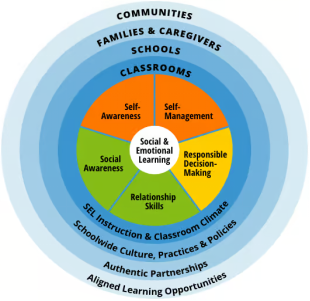
Collaborative for Academic, Social and Emotional Learning (CASEL), a leading non-profit organization focused on advancing social and emotional learning (SEL) in education, defines SEL as “ the process through which all young people and adults acquire and apply the knowledge, skills, and attitudes to develop healthy identities, manage emotions and achieve personal and collective goals, feel and show empathy for others, establish and maintain supportive relationships, and make responsible and caring decisions” (CASEL, n.d., para.1). The CASEL framework known as CASEL Wheel identifies five core social and emotional competencies circled by 4 key settings where students live and grow as illustrated in figure 1. This framework is popular across various educational systems globally due to its clarity, flexibility, and strong evidence base, making it a practical tool for guiding SEL implementation at all levels of education. The Ecological Approaches to Social Emotional Learning (EASEL) Laboratory, led by Dr. Stephanie Jones of the Harvard Graduate School of Education, has developed smart and interactive Framework Profiles for educators to explore CASEL and a wide range of other SEL frameworks with ease and clarity.
Benefits and challenges
Integrating social and emotional learning (SEL) strategies in higher education is a necessity rather than a supplementary approach. SEL can build stress resilience and create more positive engagement in the classroom (Elmi, 2020). It can also enhance student motivation, academic achievement, and overall success by promoting respect for others, appreciation for diverse perspectives, and willingness to help those in need (Simion, 2023). It is also believed that socio-emotional learning in higher education institutions can improve students' mental and physical health, decrease antisocial behavior, and boost academic performance (Palamar et al., 2024). SEL can reduce anxiety and support a positive classroom climate (Bergin et al., 2024; Herrera, 2023; Mahoney et al., 2020; Wicaksono & Saraswati, 2024).
While a substantial body of research exists on SEL, the primary focus has been on school-aged children. SEL in higher education remains underexplored, despite its growing relevance in preparing students for both professional and personal success. SEL programs in higher education are generally provided as an intervention for targeted students rather than a universal program for all students (Conley, 2015). This gap has been attributed to a couple of challenges. First, many universities lack formal SEL policies, resources, or leadership buy-in for SEL programs (Madden-Dent et al., 2021; Williamson, 2021). Second, there is a lack of academics’ preparedness. Faculty often have limited training or experience in SEL, making integration inconsistent (Madden-Dent et al., 2021; Pental, 2025). Third, students may resist SEL activities, viewing them as irrelevant or lacking motivation (Linh, 2020; Pental, 2025). Fourth, there are difficulties in measuring SEL outcomes and integrating them into academic evaluation, as there are no clear, comprehensive frameworks for teaching and assessing social and emotional competencies in higher education (Simion, 2023; Williamson, 2019). Pressure to prioritize academic content is another reason that can overshadow SEL efforts (Pental, 2025).
How to promote SEL
This gap suggests an urgent need for developing a comprehensive framework for teaching and assessing social and emotional competencies in undergraduate courses. English language classes can be a perfect space for promoting SEL in higher education. These classes naturally involve communication, self-expression, and interaction, which make them ideal for nurturing empathy, active listening, and emotional awareness. This offers a valuable opportunity to humanize language teaching by nurturing learners not only as language learners, but also as whole individuals developing the emotional and social skills essential for academic, professional, and personal success.
To effectively promote Social and Emotional Competence (SEC) in higher education, institutions can take several strategic steps. I believe we need, first and foremost, to carefully design a comprehensive framework for teaching and assessing social and emotional learning in undergraduate English courses by adapting or learning from the existing SEL frameworks. The designed framework should be aligned with employability skills to help bridge the gap between academic learning and industry expectations. It is also significant to develop faculty training programs to raise SEC awareness. Educators' own social-emotional competence plays a vital role, as their well-being and classroom relationships directly influence student outcomes. A holistic approach to course design where SEL is woven throughout the curriculum can encourage collaboration, trust, and student engagement. For example, active and blended learning strategies, such as group projects, simulations, and social media integration, can enhance self-awareness and social skills.
It is time for higher education institutions to rethink what it truly means to prepare students for the future. We need to reintegrate SEL frameworks into university programs so that our graduates leave not just with smart minds, but also with wise hearts.
References
Bergin, C., Tsai, C. L., Prewett, S., Jones, E., Bergin, D. A., & Murphy, B. (2024). Effectiveness of a Social-Emotional Learning Program for Both Teachers and Students. AERA Open, 10. https://journals.sagepub.com/doi/full/10.1177/23328584241281284
CASEL. (n.d.). Fundamentals of SEL. https://casel.org/fundamentals-of-sel/
Conley, C. S. (2015). SEL in higher education. In J. A. Durlak, C. E. Domitrovich, R. P. Weissberg, & T. P. Gullotta (Eds.), Handbook of social and emotional learning: Research and practice (pp.197–212). New York: Guilford.
Elmi, C. (2020). Integrating social emotional learning strategies in higher education. European journal of investigation in health, psychology and education, 10(3), 848-858. https://www.mdpi.com/2254-9625/10/3/61
Herrera, L. (2024). Social-emotional learning in ESOL with ninth-grade newcomers. ELT Journal, 78(2), 127-136. https://academic.oup.com/eltj/article-abstract/78/2/127/7382144
Kaspar, K. L., & Massey, S. L. (2023). Implementing social-emotional learning in the elementary classroom. Early Childhood Education Journal, 51(4), 641-650. https://link.springer.com/article/10.1007/s10643-022-01324-3
Linh, L. (2020). ENGLISH LANGUAGE TEACHING INTEGRATED WITH SOCIAL EMOTIONAL LEARNING (SEL) IN RESPONSE TO STRESS EXPOSURE AT HIGHER EDUCATION. Journal of Science, Social Science, 65(5), 93-109. https://vjol.info.vn/index.php/DHSPHN/article/view/57026/47923
Madden-Dent, T., Oliver, D., Stratton, B., Strand, E. A., & Reed, K. (2021). Higher Education Leading with Social, Emotional, and Academic Development: University Case Study on Explicit SEAD Coursework. In Leading Schools with Social, Emotional, and Academic Development (SEAD) (pp. 56-77). IGI Global.
Mahoney, J. L., Weissberg, R. P., Greenberg, M. T., Dusenbury, L., Jagers, R. J., Niemi, K., ... & Yoder, N. (2021). Systemic social and emotional learning: Promoting educational success for all preschool to high school students. American Psychologist, 76(7), 1128. https://psycnet.apa.org/buy/2020-74076-001
Palamar, B., Zhelanova, V., Leontieva, I., Palamar, S., Kosharna, N., Petryk, L., & Mykhailichenko, M. (2024). IMPLEMENTATION OF SOCIO-EMOTIONAL LEARNING IN THE MODERN UNIVERSITY: GOING BEYOND AN ACADEMIC EDUCATION. Clinical and Preventive Medicine,7(37), 95-102. https://elibrary.kubg.edu.ua/id/eprint/50953/
Pental, K. (2025). Bridging Academic Rigor and Emotional Development: Teachers’ Perceptions of Social-Emotional Learning in Indian Higher-Secondary Education. International Journal for Multidisciplinary Research, 7(2). https://www.ijfmr.com/research-paper.php?id=38788
Simion, A. (2023). The impact of socio-emotional learning (SEL) on academic evaluation in higher education. Educatia 21, (24), 109-117. https://www.ceeol.com/search/article-detail?id=1193955
Wicaksono, M., & Saraswati, N. (2024). Social emotional learning in ELT: Opportunities and challenges. Global Expert: Jurnal Bahasa dan Sastra, 12(1), 25-33. https://ejournal.uigm.ac.id/index.php/GE/article/view/4427
Williamson, B. (2021). Psychodata: disassembling the psychological, economic, and statistical infrastructure of ‘social-emotional learning’. Journal of Education Policy, 36(1), 129-154. https://doi.org/10.1080/02680939.2019.1672895
World Economic Forum. (2025). What are the most valuable skills for the jobs of the future. https://www.weforum.org/videos/future-of-jobs-valuable-skills/
Please check the Pilgrims in Segovia Teacher Training courses 2026 at Pilgrims website.
Developing Intercultural Communicative Competence in Early Childhood through Telecollaboration and Storytelling: A Turkey–Nigeria Qualitative Action Research Study
Seda Hava Ak and Henry Dakat, GermanyReclaiming the Human in Higher Education: A Call for Social and Emotional Learning (SEL) in the Age of AI
Jokha Al Hosni, OmanPractical Application of Culturally Responsive Teaching Practices and Universal Design for Learning to Promote Inclusivity
Tichakunda Gabi, ZimbabweFostering Teacher–Student Rapport for Sustainable Benefits: Student Insights
Lara Arafat, Oman