Editorial
Dear HLT Readers,
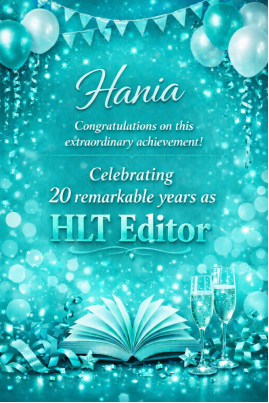
Welcome to the February 2026 issue of HLT magazine. I will start on a personal note. The beginning of 2026 is very special for me – it is 20 years since I took over as the editor-in-chief of HLT mag.
When Mario suggested I should take over, I was concerned that it would be very hard to follow in his footsteps. However, thanks to his initial guidance and feedback, I found my feet. Then I started gradually introducing changes, but nothing would have been possible without you - dear readers, authors, contributors and HLT friends.
Two decades is a long time; I have given the mag a big chunk of my life. But every minute was worth it if you believe HLT has been making a significant contribution to the ELT scene. And so, I will carry on in this spirit.
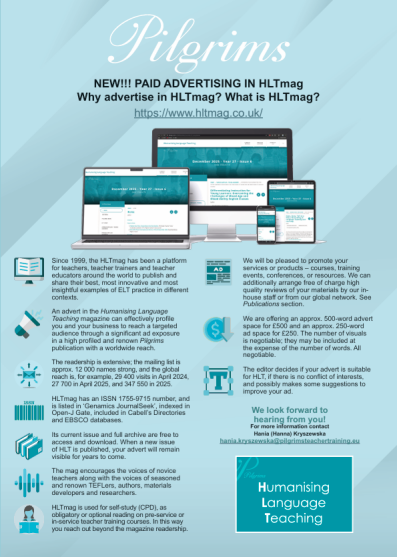
2026 marks a change for HLT and TTJ – from now on HLT will appear 4 times a year (mid February, mid May, mid August and mid November), while TTJ will appear 3 times a year (March, June and October). Also, you can now advertise in TTJ and HLT. Read more in Paid Advertising in HLT and Paid Advertising in TTJ.
We have new Pilgrims initiatives – like The Pilgrims Teacher Trainer Panel Discussion on: Using AI in the Humanistic Language Classroom, Saturday 21st February 2026, a joint HLT and TTJ Pilgrims conference in October, and online Pilgrims courses we are planning throughout the year.
But we don’t lose sight of our signature events – our summer courses. We are now planning for the Pilgrims summer in Segovia so don’t miss this unique opportunity to enjoy and dive into the Pilgrims experience face to face in unforgettable and picturesque setting. You are worth it. As we say:
You’ve worked hard all year…
it’s time to reward yourself!

For more information about forthcoming events and developments read Pilgrims News: Pilgrims on the Move – Initiatives for 2026 by Phil Dexter, Pilgrims Teacher Training coordinator and editor the Teacher Trainer Journal
We would also like to highlight a number of events which we support or are involved in like IATEFL UK, MATSDA/UAEH Conference: The Value of Texts as L2 Language Learning Materials, The Simon Greenall Award 2026, European Mindful & Compassionate ELT Project and Invitation form Chat&Chill Café. Make sure you look us up if you are attending any of the events…
As for the articles in this issue there a couple of main themes. The first one is tertiary education with Triple - A Writing Analysis: Analyzing the Message, the Complexity of Language, and Fluency of Expression by Miriam Semeniuk, EFL Students' Perceptions toward the Use of ChatGPT as Writing Assistance by Tran Thi Thanh Mai and Vo Tran Quynh Thy,, MMO Gaming and Netflix During the COVID-19 Pandemic: The Potential Influence on the Generation of Obsessive-Compulsive Behavioral Patterns within Belgrade University Students by Nebojša Damnjanović.
The second theme is social and emotional learning with Developing Intercultural Communicative Competence in Early Childhood through Telecollaboration and Storytelling: A Turkey–Nigeria Qualitative Action Research Study by Seda Hava Ak and Henry Dakat, Reclaiming the Human in Higher Education: A Call for Social and Emotional Learning (SEL) in the Age of AI by Jokha Al Hosni, Practical Application of Culturally Responsive Teaching Practices and Universal Design for Learning to Promote Inclusivity by Tichakunda Gabi, and Fostering Teacher–Student Rapport for Sustainable Benefits: Student Insights by Lara Arafat.
The third theme being the teaching profession and methods in the broad sense; CPD Continuing Professional Development or Continuing Personal Development? - 10 Steps to Life-long, Life-wide Learning by Anila R. Scott-Monkhouse, Artificial Intelligence (“AI “) and the Humanistic Method by Mike Shreeve, Why Your Content is Better at Creating Clients than Anything AI Can Produce (Sorry ChatGPT!) by Rachel Roberts, and Review of Stories of Mentoring Teacher-Research, reviewed by Khanthanaly Panvilaysone.
And finally, the fourth theme is scattered across the whole issue and there is not prize for guessing …Yes, it is AI. It is referred to in the Articles section, Lesson Ideas section e.g. Snow White, AI and the 14 Teenagers by Ruth Jones, Publications section e.g. The Art of Sensitivity in Awareness: An Extract from "Is AI making our kids stupid?” by Roy J Andersen, and in the To the Editor section – Letter 2 and Letter 3. And, of course, the event: The Pilgrims Teacher Trainer Panel Discussion on: Using AI in the Humanistic Language Classroom, Saturday 21st February 2026
Our regular or almost regular columns are doing well: Eco Issues (Hania Kryszewska), EMBR.ACE (Effie Kyrikaki), NO Project (Judy Boyle), The Creativity Group (Jamie Keddie), Humour -Testing Times (Geoff Tranter) and we welcome a new column Psychology and ELT ( Nick Michelioudakis).
The issue offers many practical ideas for your lessons: ‘Sophie the Lady and Mouse in the House’: Arts and Crafts ELT Project for Young Learners Part III by Sylwia Zabor-Żakowska, Snow White, AI and the 14 Teenagers by Ruth Jones, Two Roads, One Voice: Exploring Choices through Poetry and Imagination – a Lesson Plan Based on the Text-driven Approach by Ayşe Yılmaz, Bringing Middle-earth into the EFL Classroom: Teaching Descriptive Writing with Tolkien, Aliya Kurmanova, Communicating Research in Social Media: A Teaching Plan for Tertiary Education by Karen Passmore, A Way to Encourage Our Students to Speak and Write Up an Interview by Peter Dyer, and Weekly Speech-Contest-Style Speaking Tasks as Reflective Practice by Alexander Cameron.
Enjoy the February issue of HLT and see you in May or at any of the conferences or other ELT events.
Hanna (Hania) Kryszewska
HLT Editor
Email: hania.kryszewska@pilgrimsteachertraining.eu