Christmas through Art with a Bit of Humour: Artists’ Christmas Trees
Hanna Kryszewska is a teacher, teacher trainer, trainer of trainers. She was a senior lecturer at the University of Gdańsk, Poland. She is co-author of resource books: Learner Based Teaching, OUP, Towards Teaching, Heinemann, The Standby Book, CUP, Language Activities for Teenagers, CUP, The Company Words Keep, DELTA Publishing, and a course book series for secondary schools: ForMat, Macmillan. She is also co-author of a video-based teacher training course: Observing English Lessons, and online course for Orient Black Swan on 21st Century Skills and Teaching the whole person: Humanising language teaching. Hania is a Pilgrims trainer, OTA trainer and editor of HLT Magazine.
Email: hania.kryszewska@pilgrimsteachertrainig.eu
Editorial
The visuals were found on Pintrest.
1. Look at the pictures
(Before the class remove the names of artists in whose style the twelve Christmas trees have been drawn. )
Students match the artists with the names: Warhol • Monet • Picasso • Botticelli • Seurat • Dali • Vermeer • O'Keeffe • Mondrian • Van Gogh • Michelangelo • Matisse
They google paintings by chosen painters and match the Christmas trees.
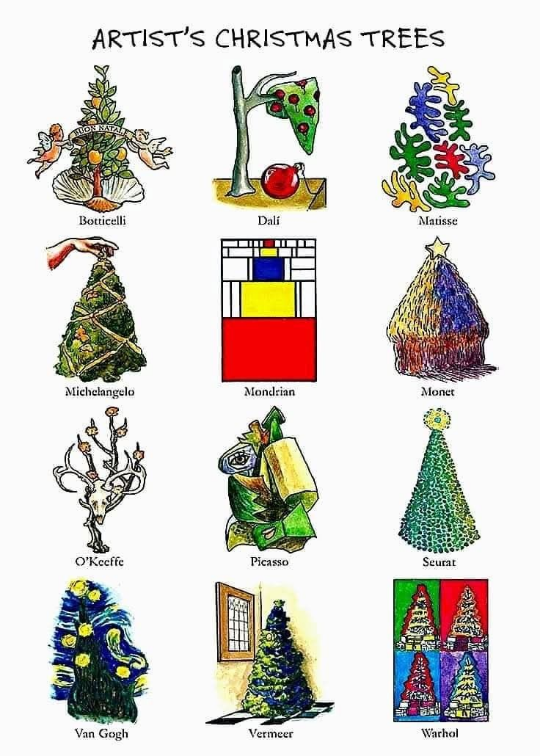
Botticelli • Dali • Matisse • Michelangelo • Mondrian • Monet • O'Keeffe • Picasso • Seurat • Van Gogh • Vermeer • Warhol
2. Which Christmas tree…?
Write the name of the artist to complete the sentence. Make sure they remember about the Saxon Genetive (‘s)
- ___ looks as if it is made of small dots.
- ___ uses geometric shapes and blocks of colour.
- ___ looks as if it is made of four different coloured pictures.
- ___ looks very unusual and surreal.
- ___ looks as if it could be made from flowers or plants.
- ___ looks very colourful and reminds you of Van Gogh's style.
- ___ looks like a traditional Christmas tree decorated with lights.
- ___ looks as if the tree is made from pieces of paper.
- ___ looks like a tree painted with thick, energetic brushstrokes.
- ___ looks like a Renaissance-style religious painting.
- ___ looks as if it has been painted outdoors with soft colours.
- ___ looks as if someone has sculpted a tree from an unusual material.
3. Vocabulary – describing art
Match the words with their meanings.
- abstract
- realistic
- geometric
- colourful
- surreal
- traditional
- detailed
- minimalist
a. using very few elements
b. looking strange or dreamlike
c. showing things as they appear in real life
d. using shapes such as squares, rectangles and circles
e. following established or familiar ideas and forms
f. containing many small elements
g. using bright or many different colours
h. not representing things in a realistic way
(Extra: Decide which Christmas tree is in which style.)
4. Choose your favourite
Look at the picture again and complete the sentences.
My favourite Christmas tree is the one by __________.
I like it because __________________________________________.
It looks _________________________________________________.
The colours are __________________________________________.
I think the artist wanted to show ____________________________.
I would / wouldn't like to have this tree in my home because _____.
5. Speaking – Which one would you choose?
Work in pairs.
Student A: Choose one Christmas tree but don't tell your partner which one it is.
Describe it using at least three clues.
For example:
It's very colourful.
It has geometric shapes.
There is a lot of red and yellow.
It looks modern.
Student B: Guess the artist.
Then change roles.
6. Challenge: The art auction
Imagine that all twelve Christmas trees are being sold at a charity auction. Choose one tree that you would buy.
You have £1,000.
Prepare a short sales pitch:
I'd like to buy __________'s Christmas tree.
I think it is worth £________ because…
The most interesting thing about it is…
It would look great in…
I wouldn't choose __________'s tree because…
Then the class votes on which tree they would most like to buy.
Useful language:
I prefer…
I'm attracted to…
What I like about it is…
It's more interesting than…
It reminds me of…
It's quite unusual / striking / elegant / playful.
I'm not particularly keen on…
In my opinion…
I'd definitely choose…
Answer key
Exercise 1
Botticelli • Dali • Matisse • Michelangelo • Mondrian • Monet • O'Keeffe • Picasso • Seurat • Van Gogh • Vermeer • Warhol
Exercise 2
- Seurat
- Mondrian
- Warhol
- Dali
- Botticelli / O'Keeffe
- Van Gogh
- Vermeer
- Picasso
- Van Gogh
- Michelangelo / Botticelli
- Monet
- Matisse / O'Keeffe
Some answers can reasonably be debated — which is actually useful for the speaking stage.
Exercise 3
1 – h
2 – c
3 – d
4 – g
5 – b
6 – e
7 – f
8 – a
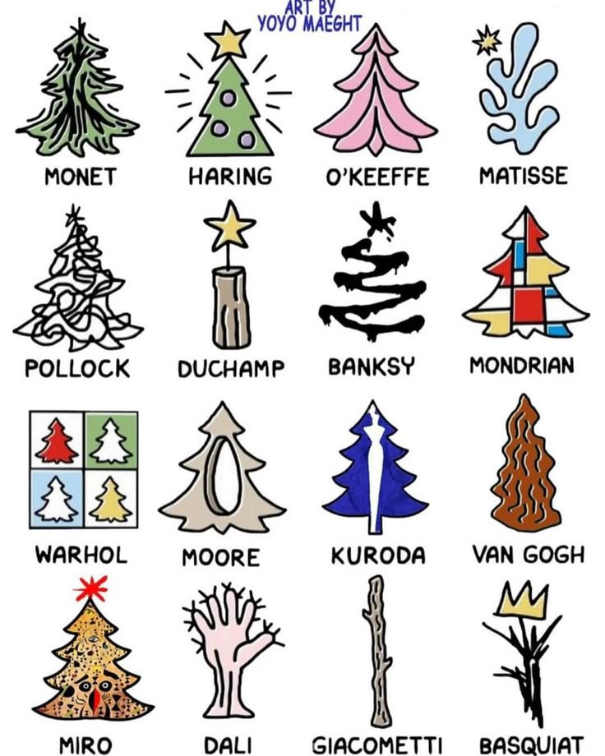
You can use the above lesson plans with the set above or find your own way.
Coming soon! Please check the Pilgrims in Teacher Training courses in 2027 at Pilgrims website
Christmas through Art with a Bit of Humour: Artists’ Christmas Trees
by Hanna Kryszewska, Poland