- Home
- Eco Issues
- Fostering Social Engagement in SLA with Oral Histories: Practical Guidance for Teachers and Teacher Trainers
Fostering Social Engagement in SLA with Oral Histories: Practical Guidance for Teachers and Teacher Trainers
Brent A. Jones is a Professor and Director of Language Programs at the Hirao School of Management (CUBE) at Konan University in Japan. His interests include second-language learning motivation, learner engagement, Content and Language Integrated Learning (CLIL), Project-Based Learning (PBL), team-based learning, instructional technology, and AI integration in education. Email: bjones@konan-u.ac.jp
Editorial
This article is based on a talk given by the presenter at the GILE SIG Forum at Pan-SIG 2025 in Chiba. Reprinted by permission form GLOBAL ISSUES IN LANGUAGE EDUCATION NEWSLETTER, Issue #135 July 2025 Tottori, Japan.
Introduction
Oral history (OH) projects ask students to record, transcribe, and share the lived experiences of real people. When embedded in second-language (L2) classes, they turn abstract grammar and vocabulary lessons into authentic, community-facing tasks that build intercultural empathy, critical thinking, and communicative confidence.
Drawing on 14 years of project-based CLIL experience in a Japanese university, this article distills the what, why and – above all – the how of OH for teachers who want a quick, practical blueprint. Findings from three cohorts (2019, 2022, 2024) are reduced to six student-generated themes to show what works and what to watch out for.
1. What is an oral history?
An oral history is a recorded first-person narrative collected through one or more semi- structured interviews and archived—usually as audio/video plus a verbatim transcript. Unlike impromptu “chatting with locals”, OH projects follow basic scholarly standards:
• Planning – topic focus, background research, informed consent.
• Recording – high-quality audio/video, back-up device.
• Processing – accurate transcription, translation if required, and participant approval.
• Sharing – classroom presentations, podcasts, websites, or community events.
2. Why use OH in SLA / CLIL courses?
The chart below summarizes key OH benefits:
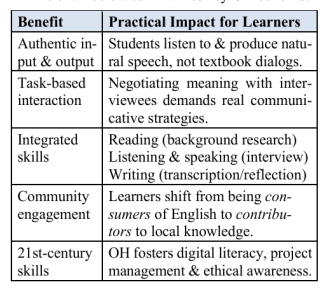
Teacher takeaway: OH ticks the boxes for experi ential learning, task-based lg. teaching and CLIL without needing expensive technology or travel.
3. How to run an OH project: A 6-step roadmap
Step 1 Kick-off and Ethics (Week 1) Brief students on OH purpose, showcase sample projects (Densho, StoryCorps) and cover consent forms, anonymity options, respectful questioning.
Step 2 Topic & interviewee hunt (Week 2) Brainstorm community themes: migration stories, local businesses, wartime memories, sustainability practices, etc. Use a shared spreadsheet for listing up contact leads. Each pair/group needs to secure at least one willing participant.
Step 3 Question design & rehearsal (Weeks 3-4) Teach open vs. closed questions, follow-ups and cultural sensitivity. Run mock interviews in class. Have students record and evaluate themselves to improve clarity, pace and proper body language.
Step 4 Fieldwork (Weeks 5-6) Students conduct 30-60-minute interviews with their subjects, either off-campus or online. Require them to use dual recording devices and have a simple back-up plan (phone hotspot, power bank).
Step 5 Processing & analysis (Weeks 7-9) Use free tools (such as oTranscribe or YouTube auto-captions) for first drafts; then correct while listening at 0.75× speed. Groups tag excerpts under emerging themes (e.g., "resilience", "innovation").
Step 6 Public product / reflection (Weeks 10-12)
Options: poster session, short documentary, podcast episode, bilingual website. Grade with a rubric balancing language accuracy (30%), content depth (30%), teamwork & project management (20%), and reflection (20%). Finish with guided reflection prompts: “What surprised you most about your interviewee’s story? What did this experience teach you about language use?”
4. Student-identified themes – distilled findings
A thematic analysis of 84 student reflections collected from 3 course runs produced six major themes that you can leverage or pre-empt:
1. OH = Hidden knowledge Learners value special access to hearing unique personal stories that aren’t found in textbooks or online.
2. Skill stack growth Students make gains in questioning, summarizing, tech and confidence.
3. Team dynamics matter A clear distribution of student roles helps to boost quality; passive group members need early nudges.
4. Preparation beats panic Extra research and equipment back-ups help to save projects.
5. Perspective-bridging Interviews broaden students’ views on age, culture and professions.
6. Ethics & accuracy Students become protective of the dignity of oral history participants and be come more careful in translation as a result. Tip: You can turn these six themes into pre-task prep discussion topics, for example: (“How will our group avoid problems with Theme #3?”).
5. Quick troubleshooting guide
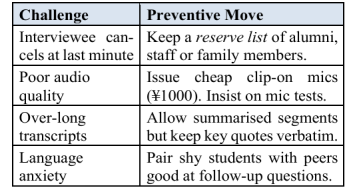
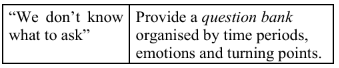
The chart below lists common OH problems with suggested preventive countermeasures:
6. Conclusion and next steps
Oral history projects transform language class rooms into labs of social engagement. With modest resources, teachers can scaffold authentic high-stakes communication that builds empathy and archive community voices that might other wise fade. Start small—one interview per pair— and iterate from there. Your learners will carry both the language and the special memories of these oral history projects far beyond their final grade.
Starter resource list
Oral History Association < oralhistory.org > Go to: Resources à Best Practices • Smithsonian SIA: How to Do Oral History, https://siarchives.si.edu/history/how-do-oral-history Go to: Resources → Best Practices
Densho Project, https://densho.org/, Go to: Collections & Research → Oral History
oTranscribe, https://otranscribe.com/, a free online transcription tool
Coming soon! Please check the Pilgrims in Teacher Training courses in 2027 at Pilgrims website.
The Eco Chapter
Marla Lise, SingaporeFostering Social Engagement in SLA with Oral Histories: Practical Guidance for Teachers and Teacher Trainers
Brent Jones, Japan