Developing AI literacy in Language Teacher Training
Professor Anna Turula is an experienced CALL / EFL teacher and teacher trainer. She is currently based at the English Studies Dept. of the University of Wrocław, Poland. Her research interests include: information and communication technologies as well as artificial intelligence in language learning and teacher training; critical virtual exchange; cognitive and affective factors in CALL; e-classroom dynamics. Anna Turula is professor at University of Wrocław, Poland. Email: anna.turula@uwr.edu.pl

Abstract
The paper looks at whether and how (prospective) teachers of foreign languages can be trained to use artificial intelligence wisely. Defined as a competence conglomerate – a multiliteracy, in fact (Pegrum 2025) – AI literacy was taught as a TEFL university course. The process was subject to action research, the main tool of which was a survey filled in by the participants of the AI class. The results show the importance of the higher level of said competence conglomerate, with special regard to ethical and critical literacies. Both are subject to a very individual perception by the participants / respondents.
Introduction
The onset of the general access to various AI chatbots opened a discussion of how the new technology can be used in education. The underlying assumption in this debate was that such use requires high levels of AI literacy of the students and – quite naturally – the teachers. Consequently, it became critical to incorporate AI literacy in teacher training programmes. This, in turn, required a good understanding of what such literacy is in terms of a well-defined competence framework. It soon became obvious – and argued in a number of publications (Mollick and Mollick 2023; Pegrum 2025) – that such framework needs to accommodate knowledge and skills going beyond the purely technical dexterity or even prompting expertise towards pedagogical prompting as well as higher-order competences and attitudes.
Since writing pedagogical prompts – with their foundation in educational approaches, methods and techniques as well as teacher roles, attitudes and beliefs – is well defined in various publications (cf. Mollick and Mollick 2023), I will concentrate on critical and ethical AI literacies. Emphasising these two literacies in the educational use of AI seems crucial. The importance is motivated by numerous controversies which surround artificial intelligence; controversies which appear to be much stronger than in the case of previous digital technologies. The resistance to AI seems to outpower anything that has ever been expressed towards distance learning and its LMS tools; cloud computing; or mobile learning. These controversies are ethical (concerning copyright violation, threats to privacy, safety and democracy) as well as developmental (the problem of cognitive debt, trust problems, etc.). This is why I want to propose that if the resistance is matched with lower-order technical skills on the one hand and the pedagogical reflection on the other, the result is going to be the teachers’ AI multiliteracy of the multifaceted, multilayered kind I argue for in this paper.
AI literacy
In order to understand the complex character of AI literacy, we need to take a step back and look at the very concept of multiliteracies proposed by Pegrum more almost two decades ago (Pegrum 2009; 2014). Based on his concept, digital dexterity alone or the ability to navigate the virtual world satisfying one’s basic needs (tech-comfy) is only the first step to full digital competence (tech-savvy). Based on this are higher order competences or literacies: search, information and participatory. Let us have at least a cursory look at the three.
Search literacy, layered directly upon the basic digital literacy, goes beyond mere familiarity with different browsers. Pegrum (2009) emphasises the importance of knowing how the algorithms work, how commercialised the top results of the queries are. What is also important is the ability to evaluate the data found in one’s search called information literacy. This ability rests on one’s critical literacy needed to estimate the credibility of the author and source, how up-to-date or complete the publication is as well as familiarising oneself with perspectives alternative to the one obtained in the search. Related to this are filtering literacy or source selection based on its weight; networking literacy requiring a web of social and professional contacts; and hypertext literacy also described as the knowledge of how hyperlinking affects our processing of the online text. Next on the multi-hierarchy is the participatory literacy. Pegrum (2009) argues that it rests on co-creation of content, potentially in a constant clash of ideas which needs the ability to safely disagree with each other. This literacy is also powered by positive factors. Thompson (2013) lists two digital skills important to online participation. One is called tummeling and translates into a non-intrusive, self-less mediating emotional presence with the lens always on the other, empowering and motivating them. The other skill is referred to as ambient awareness and can be described as a kind of digital sixth sense. It makes it possible for those who have it to detect people’s emotional problems based on subtle changes in their online behaviour.
The competence conglomerate Pegrum (2009) writes about is much broader. It includes personal, multimodal, coding, networking and other literacies such as gaming, texting and intercultural. They all interact and reinforce each other. This is why we need to speak of multiliteracy rather than literacy.
Artificial intelligence literacy is subject to similar layering and internal interaction. The purely digital literacy amounting to one’s familiarity with various AI tools as well as a certain prompting dexterity is just the basis of a much more complex set of interacting competences.
To start with the very prompting literacy, Mollick and Mollick (2023) show it as a compound of: the awareness of one’s objectives; the role AI is supposed to play; the ability to form clear and precise instructions – there is a reason Pegrum (2025) compares the latter component to search literacy; and the restrictions we want to impose on the AI agent. The prompting competence conglomerate would not be complete without the knowledge about the different modes the human may interact with artificial intelligence; and the informed decision which mode to choose. Mollick (2023) writes about two such modes: cyborgisation and centaurisation. The former, as the word would imply, means full human/AI integration manifesting itself in, say, chain prompting. The latter amounts to role assignment and co-operation in which both sides bring in their strengths and compensate for each other’s deficiencies. Prompting multiliteracy incorporates the knowledge and skills in this area as well.
Defined in such a way, the basic AI literacy paves the way for ethical and critical literacies. The former, as emphasised by Pegrum (2025) is fueled by various moral dilemmas. They include the trust problem, issues connected with the artificial, dehumanised communication and AI bias as well as various concerns over copyright, actual and potential redundancies, equity, deep fake and other threats to privacy, safety and democracy, enslavement of the Global South and others. Critical literacy, in turn, is needed in the face of cognitive threats such as the growing tendency to outsource thinking and decision making. Being aware of these threats and, equally importantly, of one’s beliefs and attitudes in this area as well as making important decisions to what extent – if at all – one wants to rely on artificial intelligence is a crucial part of AI multiliteracy in education.
AI multiliteracy in teacher training programmes. Course design
If school is to educate students to the AI multiliteracy delineated above, it seems logical that such a competence conglomerate first needs to be found in their teachers. As this paper is written from a teacher training perspective, it will present a sample course of this type. The effectiveness of this course will then be evaluated based on a survey filled in by its participants.
The course on AI multiliteracy for TEFL teachers was written and implemented in 2025. Its competence framework (defined above) and, consequently, its syllabus tackled the following areas, on the basic digital and higher-order levels. Its point of departure were: large and small language models; various types of AI (generative, corrective, predictive; cf. Narayanan and Kapoor 2024), a review of AI chatbots and applications. There was a large component of the course devoted to prompting and creating custom gpts in both modes: cyborgisation and centaurisation. Additionally, numerous classes focused on AI threats (cf. above), student attitudes and beliefs with special regard to forming teacher identity and individual sensitivity. Creating lesson plans based on CLIL methodology: revolving around AI threats and not using AI itself was also an important part of the course.
AI multiliteracy in teacher training programmes. Survey results
As the author of the course I was interested in how effective it was in developing AI multiliteracy as seen from the perspective of the student participants. I was less interested in how digitally literate they had become in the area of AI tools and applications. This literacy was proved in the course of projects carried out in the class. My main focus was on the critical and ethical literacies: if the students were aware of the moral dilemmas; what beliefs and attituded they demonstrated; and how open they were to acknowledging and respecting resistance to artificial intelligence in their own future students.
Consequently, the survey questions were written in such a way so as to show (i) their own boundaries (if any) as regards the use of AI in education; (ii) their individual perceptions of potential AI threats.
There were 21 participants in the study. In the question regarding what educational uses of artificial intelligence are allowed, they chose between the following answer options: [a certain AI use] is ok; I don’t know; and [a certain AI use] is not ok. The answers were weighed and assigned 3, 1 and 0 points, respectively. In question 2, listing potential AI threats, the answer options included (points assigned in brackets): It’s a serious problem (4); It’s a minor problem (2); I don’t know (1); It’s not a problem.
The answers to the first question can be seen in figures 1 and 2.
Figure 1. What can the student ethically use AI for
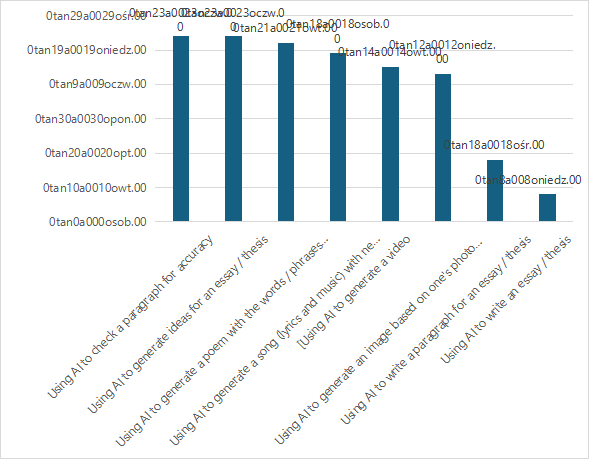
Figure 2. What can the teacher ethically use AI for
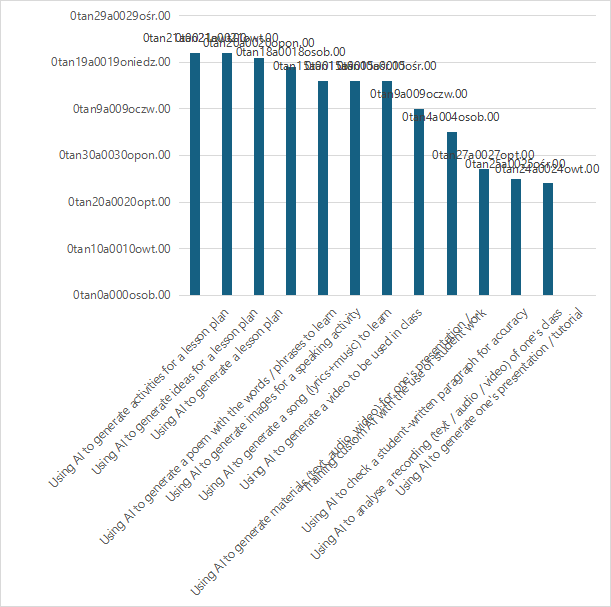
As for data description, it needs to start with an assertion that the answer to this question was given by 18 out of the 21 participants. This was because three respondents declared that using AI in any way is morally reprehensible. This is why they were allowed to skip this question and concentrate on the AI threats alone.
Apart from the three radical outlooks on AI, the remaining 18 respondents were in favour of using artificial intelligence for all preparatory and AI-assisted activities. All or almost all of them (51-54 points) believe that it is acceptable to use AI to generate essay (students) or lesson (teachers) ideas as well as materials and tests or to apply AI in the evaluation process. Justifiable – with a lower score – is also generating multimedia. As regards corrections, students are allowed more (54 points) than teachers (27 points). The list is closed with training AI based on the student work (teachers; 25 points). The lowest it’s-ok score, for both students and teachers, is noted in the case of generating the whole deliverable: an essay / thesis (students) or a presentation (teachers).
When it comes to the perspectives on AI threats, Figure 3 shows the answers.
Figure 3. The weight of various AI threats
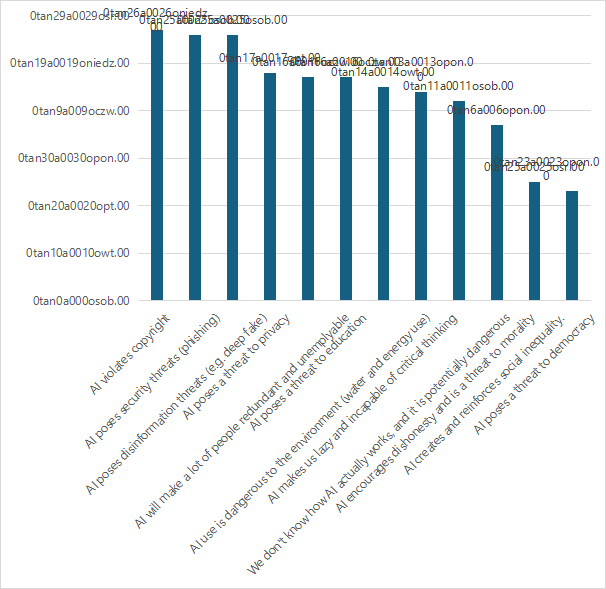
Opening the list of AI-related problems (ranking above 50 points) are: copyright violation, security threats and disinformation. Another group (40+) contains: threats to privacy, redundancies in various jobs, educational and environmental problems, cognitive debt and the so-called black-box issues. (Note. We do not know how exactly prompts are processed and output generated.) . Last on the list are dangers in the area of morality, equity and democracy.
When we reverse the presentation modes and look at how individual students perceive the ethics of AI use and the problems it causes, we see that both are highly individual (Figures 4 and 5).
Figure 4. Individual students about the ethics of AI use
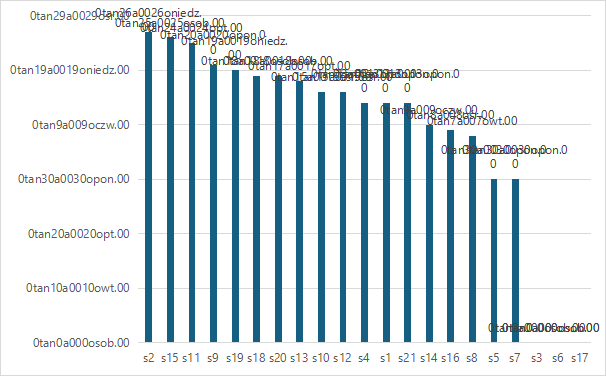
As it can be seen in Figure 4, the group contains students (respondents) ranging between two extremes: from those (s2, s15, s11 and s9) believing all or most uses of AI are ethical through a number of middle-of-the-road approaches to three respondents excluding any use of artificial intelligence as morally reprehensible (s3, s6 i s17).
A similar diversity of beliefs can be observed in the case of AI threats.
Figure 5. Individual students about AI threats
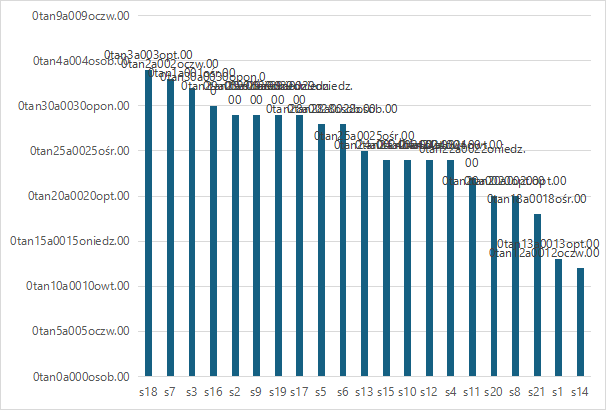
Some students (respondents) see artificial intelligence as a source of all or most of the problems surveyed (s18, s7, s3 i s16). Others see the threats as not really serious (s21, s1, s14), with the majority sensitive to some of the problems.
AI multiliteracy in teacher training. Discussion and conclusions
The discussion of the results of the survey study presented above has to open with a disclaimer. Considering the small number of respondents, the data are of no statistical significance. Nor can they lead to general conclusions. In other words, there is little research value to the results presented.
However, to the teacher trainer, the answers given to individual research questions are good food for thought as regards ways of preparing prospective educators for the wise use of artificial intelligence in their classrooms. Additionally, they can inform the action research undertaken, by giving insights into the effectiveness of the training in developing AI multiliteracy, especially on the higher levels of the hierarchy.
Based on the data gathered, the following observations can be made:
- The course participants show a preference for AI-assistance over AI-replacement
In other words, artificial intelligence applied as ancillary or a source of inspiration is seen as more acceptable than if used as a replacement of a human in their efforts, especially if such a replacement can lead to the cognitive debt (Figures 1 and 2). Yet, when analysed in a broader context, the observation is difficult to sustain: cognitive debt does not rank high among the potential threats (Figure 3). Additionally, in both cases – the assistance and the replacement – there is a higher level of acceptance in the case of students (Figures 1 and 2). This may show that the opinions expressed in the survey may be motivated by the traditional perception of roles in the classroom rather than the concerns about the cognitive debt.
- Tolerance for text generation with AI higher than in the case of multimedia creation
The observation stands for both students and teachers. There are two possible interpretations. The difference can be ascribed either to environmental concerns (image and video generation leads to greater energy consumption) or to copyright violation. Figure 3 shows that it is probably the latter consternation. What may be interesting is that the problems seems the most acute in the case of images (and not text).
- There are differences in the perception of AI threats
If we were to decide the weight of threats based on the survey ranking, copyright issues, disinformation and security concerns would top the list of AI dangers. Are these problems the most serious, objectively? We can respond to this by saying that danger is always perceived subjectively. However, one cannot ignore the fact that AI uses for disinformation and against security (voice cloning, deep fake) are the same that pose a threat to democracy; a threat that is ranked last. This, in turn, may show that the survey ranking is the result of excessive personalisation of threats as well as a potential proximity bias and not an in-depth reflection. In other words, most respondents may know a visual artist made redundant by AI or have come across phishing through AI-generated voice cloning; at the same time threats to democracy may seem too abstract to consider.
- There are considerable individual differences in beliefs and attitudes at the end of the course.
As shown in figures 4 and 5, the participants of the course differ considerable in their beliefs about the ethical use of AI as well as their perception of the AI threats. They can be placed on two continua: from all is allowed to no AI use is ethical; and from artificial intelligence is a serious threats in many areas of life to the AI dangers are not really serious. It can be hypothesised that a strong critical, reflective component of the teacher training allowed each participant to form their unique teacher identity in the area of AI use in education. If so, the expectations expressed in the competence framework delineated at the beginning of the article have been met. At the same time, however, we cannot exclude the possibility that the students enrolled in the course already holding very strong beliefs about AI. Consequently, they filtered all the content presented in class through these beliefs, succumbing to yet another cognitive bias – the one of confirmation.
What does all this mean for a teacher trainer wishing to prepare prospective educators for the ethical, critical use of AI?
I believe that acknowledging the diversity of attitudes and beliefs should always be a point of departure for teacher training. A teacher trainer has to accept that the AI multiliteracy raised in the course of the teacher training may result in the educator deciding not to use artificial intelligence in their classroom at all. Such participants ought to be allowed to stick to their beleifs; and to focus solely on raising the learners’ awareness of the AI threats in their prospective classrooms. This also is demonstrative of the teacher’s AI multiliteracy.
References
Mollick, E. (2023). Centaurs and cyborgs on the jagged frontier. One Useful Thing [Substack]. www.oneusefulthing.org/p/centaurs-and-cyborgs-on-the-jagged.
Mollick, E. R. and Mollick, L. (2023). Assigning AI: Seven Approaches for Students, with Prompts. The Wharton School Research Paper, Available at SSRN: https://ssrn.com/abstract=4475995 or http://dx.doi.org/10.2139/ssrn.4475995.
Narayanan, A., & Kapoor, S. (2024). AI snake oil: What artificial intelligence can do, what it can't, and how to tell the difference. Princeton University Press.
Pegrum, M. 2009. From Blogs to Bombs: The Future of Digital Technologies in Education. N.p.: UWA Pub.
Pegrum, M. 2014. Mobile Learning: Languages, Literacies and Cultures. N.p.: Palgrave Macmillan.
Pegrum M. (2025). From revolution to evolution: What generative AI really means for language learning. Language Teaching. Published online 2025:1-17. doi:10.1017/S0261444825000151.
Thompson, C. (2013). Smarter Than You Think: How Technology is Changing Our Minds for the Better. Penguin.
Coming soon! Please check the Pilgrims in Teacher Training courses in 2027 at Pilgrims website.
In Class Use of Devices Versus Printed Material
Stephanie Ptak, South KoreaDeveloping AI literacy in Language Teacher Training
Anna Turula, Poland