- Home
- Lesson Ideas
- Every Child is an Artist: Visual Representation and Learner Generated Visuals in ELT
Every Child is an Artist: Visual Representation and Learner Generated Visuals in ELT
Chrysa Papalazarou is currently involved in the administrative side of education, but before that she has taught English to students of all ages for more than twenty years alongside writing, presenting and publishing about her endeavours to use art and foster the development of creative thinking in the ELT classroom. She is interested in how the interweaving of the aesthetic and social awareness component of artworks can introduce wider world issues to students, promote values, and contribute to a more thoughtful and creative flow in English language teaching and learning. Chrysa has created Art Least, a site on art, thinking and creativity in ELT. Chrysa is a member of the C Group and the Visual Arts Circle. She is also a member of “Worlds into Words”, an international creative writing group. E-mail: hryspap@yahoo.gr
Introduction
This article reflects on the element of visual representation, a prominent aspect of my classroom practice. Visual representation – a basic component in developing students’ visual literacy – is about conveying information, ideas, or concepts through visual elements. These could be images, drawings, photos, to name a few.
In my classroom, visual representation, mainly through drawing, also becomes a doorway into students’, aged 8 to 11, creative expression. They engage naturally and enthusiastically with drawing, and over the years it has been fascinating to observe how they generate, explore ideas and give them visual form. Through drawing, I have seen their thinking unfold. This process of making and communicating meaning is also mediated by the English language. I find this space where students’ thinking, meaning-making, and innate artistic expression converge with their foreign-language learning, absolutely fascinating and inspiring.
I will present four activities I have implemented in my classes for this purpose. Three of the activities are drawn from the Visible Thinking approach (Harvard, Project Zero) while the fourth is an activity I have developed over time. I will also include examples of students’ work. With the exception of the final case, produced by eight-year-olds, all examples come from eleven-year-old primary school students.
Colour-Symbol-Image (Harvard, Project Zero)
Choose a color that you feel best represents or captures the essence of a key idea.
Choose a symbol that you feel best represents or captures the essence of a key idea.
Choose an image that you feel best represents or captures the essence of a key idea.
Try to explain your choices.
Theme: War/peace
Class organisation: group work
Time: 80 minutes
Context: prior to this activity students had been exposed to:
- a painting (Guernica by Pablo Picasso)
- a 3D video of the painting
- a short animation film (Chromophobia by Raoul Servais)
- a series of visual prompts (drawings, photographs, paintings, illustrations) with the aim to identify how visual language symbolises war or peace.
All the visual input mentioned above was framed with relevant language and thinking activities taking into consideration the needs of the specific groups of students. The theme of war/peace was the focal point. Eight teaching sessions had preceded this activity.
|
|
Colour, symbol, and image are intricately intertwined in this piece of work. The cross on a tomb which holds inside the bones of those who have died, along with a spirit figure and a barren tree, form a metaphor for the bleak landscape of war. This effect is further amplified by the choice of two dominant colors – red and black – symbolising blood and death. |
|
|
A mainly monochromatic unified composition. The choice of black as the dominant color is echoed in the symbol of the black sun, used metaphorically in stark contrast to the conventional association of the sun with light and life. The image of ruins – literally for the buildings and metaphorically for people’s shattered lives – reflects the consequences of war.
|
|
|
This group’s work is organised into three parts. Grey, representing sadness, fear, and destruction, is paired with weaponry as a symbol of aggression, while the image of a radiant sun overshadowed by a war aircraft serves as a metaphor for how war casts a shadow over peace. |
|
|
Green and light blue, representing nature, life, and freedom, frame a landscape of peace. The peace symbol surrounded by flowers, together with the metaphorical image of an imprisoned war – both connected to and contrasted with prisoners of war – compose this group’s work, which is organised into three vertical columns. |
|
|
Another example of a unified composition that explores the concept of peace. Green, the color of trees, plants, and nature, symbolises life and growth, while also referencing the hippie anti-war movement. The smile doodle represents happiness and a positive attitude, and the image of children holding hands serves as a metaphor for cooperation, friendship, and hope for the future. |
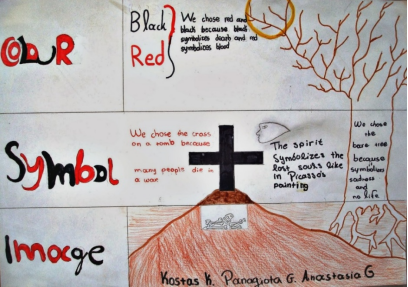
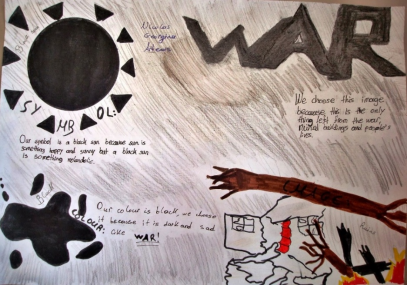
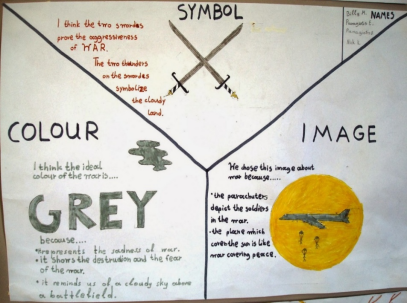
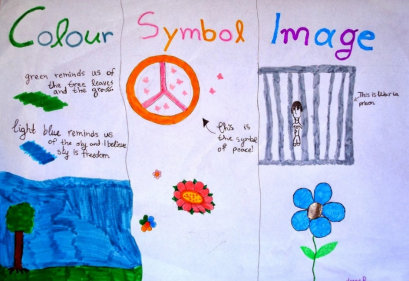
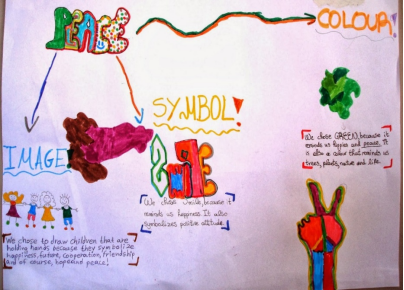
Figure A: student responses to the CSI routine (War/Peace)
The CSI routine encourages students to identify and capture the heart of ideas they have explored through reading, watching or listening to the selected source material. As students make their selections of colours, symbols, images, they are pushed to make connections and think metaphorically. I’m looking at these powerful pieces of work now, nearly ten years after they were made, and I’m still amazed at the intricacy, complexity and creativity it was put into them. Meaning is communicated “not only by what’s depicted, but through structure: the size, shape, placement, and relationship of components – what they’re next to and what they’re not, matters” (Sousanis, 2015, p.66).
Headlines (Harvard, Project Zero)
If you were to write a headline for this topic or issue right now that captured the most important aspect that should be remembered, what would that headline be?
Theme: Bullying
Class organisation: group work
Time: 40 minutes
Context: prior to this activity students had been exposed to:
- paintings (Children's Games by Pieter Bruegel and Bullying by Matt Mahurin)
- a series of photographs to help them identify different forms of bullying
- a short video on bullying from UNICEF
They were all framed with relevant language and thinking activities. The theme of bullying was the focal point. Three teaching sessions had preceded this activity.
|
|
|
Poster-like compositions combine textual and graphic elements, drawing on the visual language of newspaper-style headlines as a vehicle for summarising and capturing the essence of bullying. |
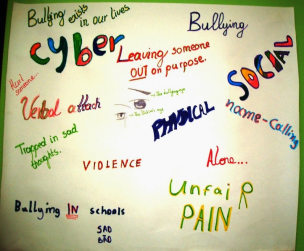
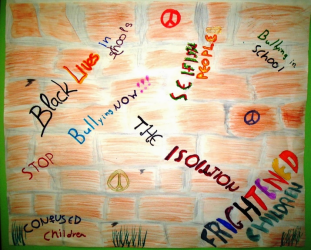
Figure B: student responses to the Headlines routine (Bullying)
***
Theme: Refugees
Class organisation: individual work
Time: set as homework
Context: prior to this activity students had been exposed to:
- an illustration for World Refugee Day 2011 by Hanane Kai
- a short video (People of nowhere by Lior Sperandeo)
- a poem (Here I am by Electra Alexandropoulou)
They had explored these through a series of language and thinking activities. The theme of refugees was the focal point. Seven teaching sessions had preceded this activity.
|
|
|
|
Capturing the essence of the refugee experience through an exploration of trauma and memory as its central elements. |
Capturing the core of the theme of refugees through the lens of empathetic understanding. |
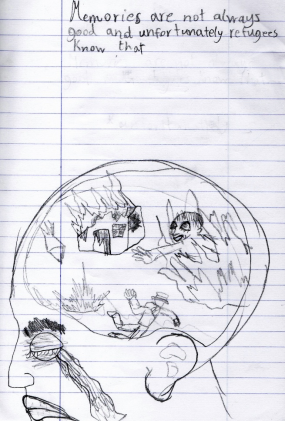
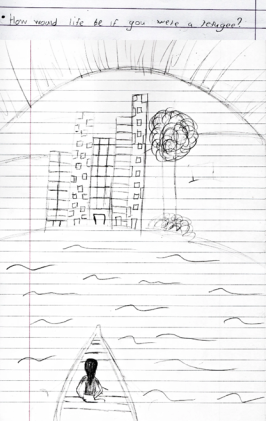
Figure C: student responses to the Headlines routine (Refugees)
The Headlines routine helps students capture the core of the matter being studied or discussed. It can also involve them in summing things up. This routine works especially well at the end of a class discussion or session in which students have explored a topic and gathered a fair amount of information or opinions about it.
Creative Questions (Harvard, Project Zero)
Brainstorm a list of questions about a topic (concept or object)
Choose a question to imaginatively explore by writing a story or essay, drawing a picture, creating a play or dialogue, inventing a scenario, and so on
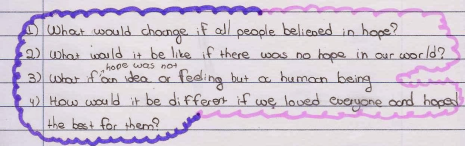
Theme: Hope
Class organisation: individual, pair, group work
Time: 80 minutes
Context: prior to this activity students had been exposed to:
- a poem (“Hope” is the thing with feathers by Emily Dickinson)
- a kinetic typography video rendering of the poem
- a series of photographs, quotes and mixed media works of art all applying to the concept of hope
They had explored these through relevant language and thinking activities. The theme of hope was the focal point. Five teaching sessions had preceded this activity.
 |
|
|
|
|
|
|
|
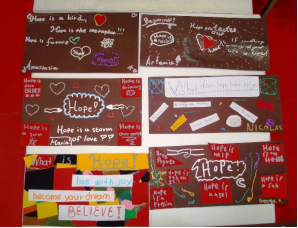
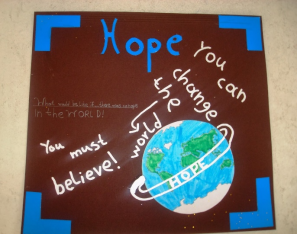
Figure D: student responses to the Creative Questions routine (Hope)
Emily Dickinson’s poem and the mixed media works of art on hope that had been used during this theme had an important impact on the students as echoed in their compositions. Collages were made using paper and paint while there were also a couple of assemblages with found objects. Students chose their preferred mode of work i.e. individually, in pairs or in groups and came up with more than one final products.
My image of…/My photo of…
This is an activity I have developed with the aim to be used at the end of a series of lessons pertaining to a specific theme.
Create an image/take a photo that for you represents (a) key aspect(s) of the theme examined and explain what and why.
Theme: Poverty
Class organisation: individual work
Time: set as homework
Context: prior to this activity students had been exposed to:
- a painting (The Potato Eaters by Vincent Van Gogh) explored through relevant language and thinking activities
The theme of poverty was the focal point. Three teaching sessions had preceded this activity.
|
|
|
|
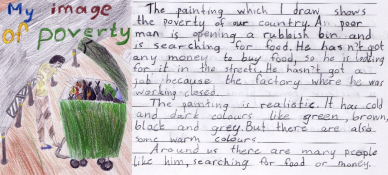
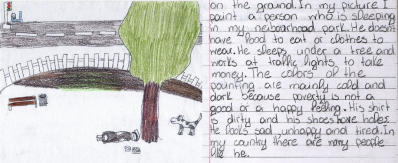
Figure E: student responses to the ‘My image of’ activity (Poverty)
People scavenging food, paper or anything useful from rubbish bins, homelessness, the refugee influx, feelings of helplessness, optimism and determination were among the prominent themes students dealt with in their compositions. These were also prevalent faces of poverty in our surroundings during the Greek debt crisis period and the refugee influx following the Syrian war, a period during which the specific theme was explored. Students expressed themselves in verbal and visual modes, and saw and identified the often unseen and overlooked.
***
Theme: The Diary of Anne Frank
Class organisation: individual work
Time: set as homework
Context: prior to this activity students had been exposed to:
- a screenshot visual from an animation about Anne Frank’s story as well as the animation itself, both explored through relevant language and thinking activities
The theme of Anne Frank’s story was the focal point. Three teaching sessions had preceded this activity.
|
|
The imagery of the animation served as the inspiration for this piece. The student depicts Anne at the moment she is given the diary as a birthday present, emphasising its significance and the lasting impact it would have as a book in the years to follow. |
|
|
A student drew Anne writing in her diary highlighting the importance of what she wrote not only for herself, but also for future generations. |
|
|
A series of four portraits of Anne, also inspired by the animation, correspond to four significant moments in her life. Each portrait reflects her emotional state: birth (free), receiving the diary (happy), hiding and writing in the Annex (angry), and finally being arrested (scared). |
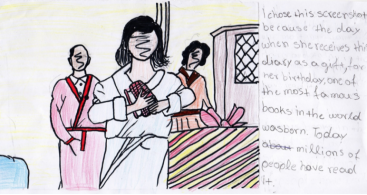
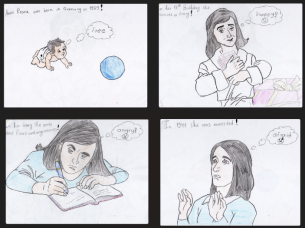
Figure F: student responses to the ‘My image of’ activity (The Anne Frank story)
The multimodal input of the animation intrinsically appealed to the students because of its aesthetic quality (Maley, 2010). The subsequent ‘My Image of’ activity contributed to the creative process and gave students the chance to notice, relate and evaluate content.
***
Theme: Children’s Rights
Class organisation: individual work
Time: set as homework
Context: prior to this activity students had been exposed to:
- a series of UNICEF’s animation spots based on the articles of the Convention of the Rights of the Child
The theme of children’s rights was the focal point. Three teaching sessions had preceded this activity.
|
|
|
|
|
|
|
|
Students chose the right they wanted to work on. They took photos and wrote accompanying texts. Abstract ideas like ‘protection in times of war’, ‘appropriate information’, ‘free expression’, ‘child labour’ were made more concrete as they used the photographic medium to explore and connect them to the theme of children’s rights. |
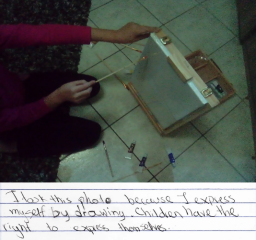
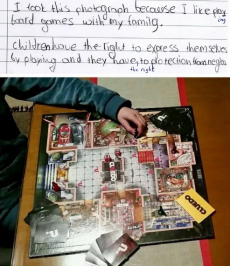
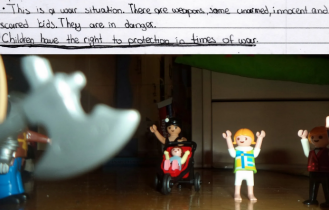
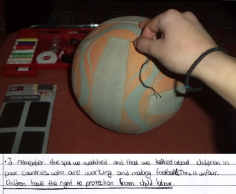
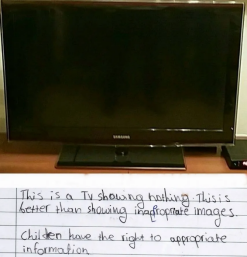
Figure G: student responses to the ‘My photo of’ activity (Children’s rights)
The topic of UNICEF’s spots, timely and universal, spoke holistically and emotionally to students’ personal experience. The ‘My photo of’ activity gave them a feel of ownership and activated their personal schemata to make diverse associations, compare and contrast, and reflect on their rights and other children's rights.
***
Theme: Alphabet
Class organisation: group work
Time: 30 minutes
Context: prior to this activity students had been exposed to:
- a woodcut print (Sky and Water I by M.C. Escher)
- a short animation of the artwork
- images with letter tessellations, word clouds, and a series of images pertaining to logos with a hidden message
Two teaching sessions had preceded this activity.
|
My hidden image-message
|
|
|
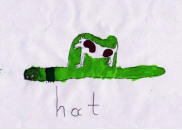
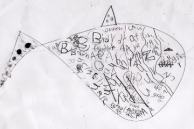
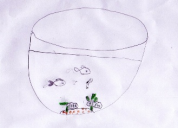
Figure H: student responses to the ‘My image of’ activity (Alphabet)
Very young learners worked on creating their own images with a hidden message. Groups developed an understanding of the meaning behind their images through perception and imagination. They learnt from both words and pictures by building mental representations from each mode.
Final thoughts
When students engage with visual content (icons, diagrams, infographics, videos, photos, animations) they begin to think more critically about multimodal information and to create meaning from what they see. As they draw, they translate the abstract into the tangible, using a visual language that often reaches beyond the limitations of words alone and reflects their inner worlds. Metaphors also play a powerful role in this landscape of visual meaning-making. By associating new concepts with familiar ones, metaphors help learners extend their understanding and recognise how their thinking has changed (Kövecses, 2010).
For this reason, these are not five- or ten-minute activities. The time we devote to a task matters because it signifies values, what is considered to be important (Eisner, 2002, 2003). Students’ ideas and concepts are significant; they thus need processing time during which evaluation, critical thinking, and self-expression take place. Students’ responses showed clear emotional and cognitive engagement. As they created images and wrote about them, they employed their thinking, planning, and connecting skills shifting between verbal and non-verbal modes of expression. This shifting across modes supports creativity, agency, and voice. At the same time, in cases of group work, students make collective decisions about how they will collaborate, which modes to use and in what way, and how they will use language.
Drawing itself contributes significantly to learning. The time spent deciding how to represent an idea visually offers valuable processing time during which students evaluate, question, and think more critically. As their drawing develops, so does their understanding in a cyclical process where one informs the other. Engagement becomes active and personal, leading to more memorable learning—exactly what we aim for in the language classroom.
Part of drawing’s effectiveness stems from the diffuse thinking it encourages. In this relaxed, unfocused mode, the mind wanders freely, forms unexpected connections, and generates insights—the kind of thinking that occurs while cooking, walking, or “sleeping on it.” When students draw, they give ideas the space they need to settle, reorganise, and grow. At the same time, the activities’ requirements offer structure to divergent thinking by amplifying a process of choosing, arranging, observing, and synthesising multiple components in order to reach a final outcome.
The social and semiotic shifts of today’s world profoundly shape how we teach and learn English. Meaning is now made through image, colour, layout, and other multimodal forms (Kress, 2017). Visual representation lies at the heart of this shift. In my classroom, moments where children’s natural artistic expression has intersected with their learning of a foreign language have given rise to a multimodal landscape. This landscape has inspired me and reshaped my understanding of how students make meaning.
References
Eisner, E. W. (2003). The arts and the creation of mind. Language Arts, 80(5), 340–344. http://www.jstor.org/stable/41483337
Eisner, E. W. (2002). What can education learn from the arts about the practice of education? John Dewey Lecture, Stanford University.
http://www.infed.org/biblio/eisner_arts_and_the_practice_of_education.htm
Kövecses, Z. (2010). Metaphor: A practical introduction (2nd ed.). Oxford University Press.
Kress, G. (2017). Making meaning: From teaching language to designing environments for learning in the contemporary world. In K. Donaghy & D. Xerri (Eds.), The Image in English Language Teaching (pp. ix–x). Malta: ELT Council.
https://visualmanifesto.files.wordpress.com/2017/09/the-image-in-english-language-teaching-2017.pdf
Malchiodi, C. A. (1998). Understanding children's drawings. Guilford Press.
Maley, A. (2010). Towards an aesthetics of ELT. Advances in Language and Literary Studies, 1, 4–28. https://journals.aiac.org.au/index.php/alls/article/view/26/23
Papalazarou, C. (2025, April). Sky & Water: Creativity and artful visuals with very young learners. Humanising Language Teaching, 27(2). https://www.hltmag.co.uk/apr25/sky-and-water
Papalazarou, C. (2020). The Diary of Anne Frank: A teacher’s Insight into Creative Pedagogy. In I. Papadopoulos, E. Griva & E. Theodotou (Eds.), International Perspectives on Creativity in the Foreign Language Classrooms (pp. 45–79). Nova Science Publishers.
Sousanis, N. (2015). Unflattening. Harvard University Press.
Resources
Art in the English class project: War/peace theme
Art in the English class project: Bullying theme
Art in the English class project: Hope theme
Please check the Pilgrims in Segovia Teacher Training courses 2026 at Pilgrims website.
Every Child is an Artist: Visual Representation and Learner Generated Visuals in ELT
Chrysa Papalazarou, GreeceFree the Bee – Animated Storytelling with Young Learners in Gaza
Luzan Matar, Palestine;David Heathfield, UKLearning from Freedom
Daniel Costa, InternationalBlogging as a Tool to Develop Written Expression
Gretel Victoria Calderón Ruiz, CubaTeaching Adults in TTC Courses
Narjes Nasrpour, Iran