The Silent Way of Crocheting University
Professor Anna Turula is an experienced CALL / EFL teacher and teacher trainer. She is currently based at the English Studies Dept. of the University of Wrocław, Poland. Her research interests include: information and communication technologies as well as artificial intelligence in language learning and teacher training; critical virtual exchange; cognitive and affective factors in CALL; e-classroom dynamics. Anna Turula is professor at University of Wrocław, Poland. Email: anna.turula@uwr.edu.pl

Do you remember the Silent Way? Proposed by Caleb Gattegno, it is one of the humanistic language teaching methods. There are a number of principles it rests upon: discovery learning based on problem-solving; the teacher remaining silent and giving floor to the student; and, quite importantly, learning being facilitated by accompanying physical objects (cf. Richards and Rogers 1991). The most popular manipulatives used by those implementing the method are Cuisenaire rods (some ideas can be found HERE).
Almost 20 years ago I wrote an article for Humanising Language Teaching in which I showed how Lego blocks can also be used in a similar way. I argued that by manipulating them, we can teach and learn all language skills and sub-skills. I backed the argument by a list of activities designed by my students – prospective teachers of English as a foreign language.
Over the years – and with the Lego set offered as a gift to Ukrainian children fleeing the war in 2022 – I have replaced the blocks with other manipulatives, including buttons, screws, candy and pasta. I would like to recommend the last set as varied, available from your local grocery store and much cheaper than Legos. I have a bagful of pasta at work, for my students to learn to teach grammar, listening comprehension and digital story-telling to their future learners. I also took 60+ photos of the pasta in various configurations and I am sharing the link to it with you (https://tinyurl.com/pastaphotos).
Moving along the same lines – the educational importance of manipulatives or a hands-on activity; and, more importantly, the student-centred, discovery learning - I have just started a new project: Crocheting University.
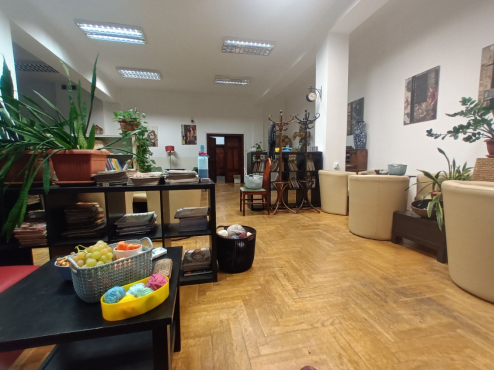
Launched in October 2025, Crocheting University has a double meaning to its name. To start with, it is a university that crochets. We start each class (held weekly) with a craft session: we crochet and learn to; but also knit; and are open to macrame. The other meaning of the name is about what we do in the project: we crochet university in the sense of weaving in our experience, understanding of phenomena and who we are as people into each class. We do this throughout each meeting but, specifically, in the second session, which starts after the craft-practising session, and is devoted to a chosen theme from the area of English Studies (the project is run in said department). So far we have had a poetry-reading class; a class on comics and semiotics; and a class on serious games and researching them. The remaining November class (remaining at the moment of writing the article) are about affect in language learning and civic education. Each such session is facilitated with an expert on topic. Their role is to provide reflection questions before the meeting; to facilitate (but not dominate) the discussion in class; and to sum-up the meeting with recommendations as to where to go next (=what to read to gain a deeper insight into the problem).
We talk about the second-session topics with our hands busy (crocheting, knitting, etc.). There are several reasons for it. One is the community-building factor. As in the old days, with the practice of feather tearing, people meet united by a common goal. Do not let the word goal mislead you: as in the case of feather tearing, our crocheting is mostly about the process not the product. Additionally – and very much in line with the Silent Way – the crocheting has important cognitive and affective functions to fulfil. The hands-on experience is to help process the input. It is also meant for those who would rather listen than talk. With your hands busy, remaining silent in a discussion class does not make you feel awkward – it takes off the pressure to speak until one is ready. Finally, the whole idea keeps the teacher (in our case, the topic expert) silent, allowing the participants to process and discover.
Please check the Pilgrims in Segovia Teacher Training courses 2026 at Pilgrims website.
The Silent Way of Crocheting University
Anna Turula, Poland