Short Book Reviews
Hanna Kryszewska is a teacher, teacher trainer, trainer of trainers. She was a senior lecturer at the University of Gdańsk, Poland. She is co-author of resource books: Learner Based Teaching, OUP, Towards Teaching, Heinemann, The Standby Book, CUP, Language Activities for Teenagers, CUP, The Company Words Keep, DELTA Publishing, and a course book series for secondary schools: ForMat, Macmillan. She is also co-author of a video-based teacher training course: Observing English Lessons, and online course for Orient Black Swan on 21st Century Skills and Teaching the whole person: Humanising language teaching. Hania is a Pilgrims trainer, OTA trainer and editor of HLT Magazine.
Email: hania.kryszewska@pilgrimsteachertrainig.eu
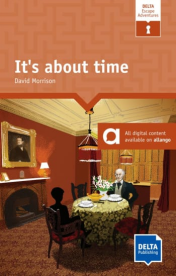
It’s about time. D. Morrison DELTA Publishing.(2024). ISBN 9783125011632, pp.149. In the days of relatively new forms of entertainment among which are escape rooms and board games with interactive apps, the idea of escape adventures in a book is very appealing and fresh. The first thing is that you are the main character in the book, and it is you who is in a situation from which you have to escape. Like in an escape room, you need to read each chapter, then get a grasp of the whole situation, and finally solve a problem or problems. Even if you have to think hard you are aided by some prompts or hints. In this particular ELTA reader ( pitched at Level 7) you find yourself in a Victorian house. Lord William Armstrong is an inventor of a time machine which transports you to the 19th century. Your mission is to save the world from water shortage. In order to do so you have to solve puzzles and as you go along you meet famous people. The question is whether you can achieve your goal. In the book part your read the chapters, then solve the puzzle using the numerous clues, and hopefully escape. Additionally, online you find interactive quizzes which help you to better understand the story and audio clues. The book does not just tell a story; there is also vocabulary work, extra activities, CLIL content, ideas for speaking activities and further content development ideas. Thia graded reader is intended for learners aged 11-15 who can use it in class or self study, but I think older readers will also enjoy it due its novel format.
For another review of a DELTA escape reader in this series go here
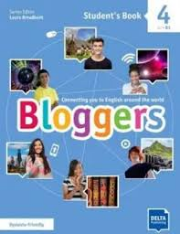
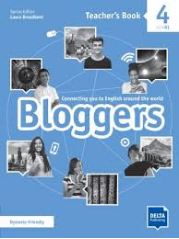
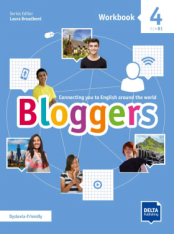
Bloggers. Student’s book 4 B1. Dyslexia friendly. Series editor L. Broadbent. DELTA Publishing (2020). ISBN 97831250112080, pp.140. Bloggers. Workbook 4 B1. Dyslexia friendly. Series editor L. Broadbent. DELTA Publishing (2020). ISBN 97831250112097, pp.128. Bloggers. Teacher’s Book 4 B1. Dyslexia friendly. Series editor L. Broadbent. DELTA Publishing (2020). ISBN 97831250112172, pp.248. Bloggers is a new four-level course ( A2-B1) for lower secondary teens. Blogging as a phenomenon is international and the course is international too. It is already reflected in the number of contributing authors; the names suggest they come from various countries. The course has an international or even cosmopolitan theme. It follows the blogs of the in-house characters - five teenagers from London, New York, Dublin, Los Angeles and Glasgow which introduces learners to age relevant and culturally specific content. Each unit provides students with a challenge or project that at the end of the unit gives them a real sense of achievement. Bloggers has been written by teachers who know what students want and need to learn, and, like I said, the writing team is as international as the course addressees. The topics (in Bloggers 4) are relevant to the interests of the learners (school rules, legends and myths, shopping, world of work, life in US, life in Australia, or a Shakespeare play).
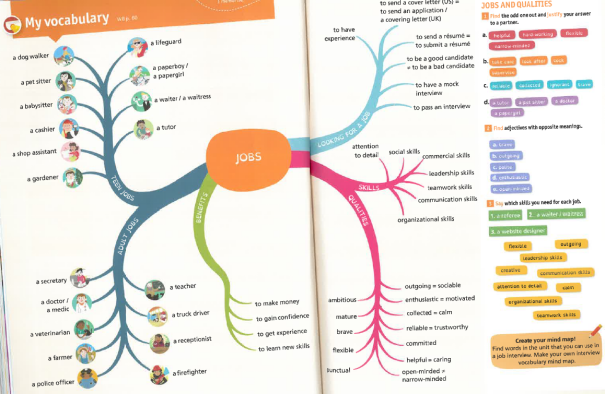
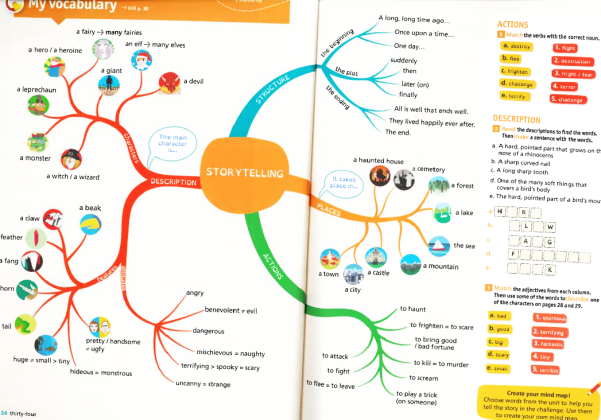
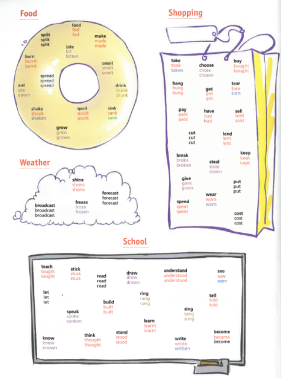
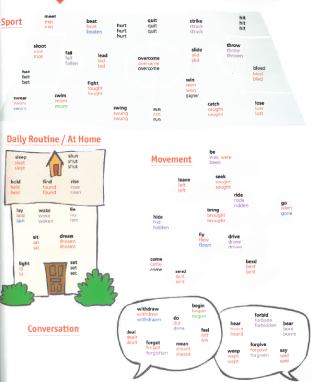
The course has a modern approach as it is project based, takes on board the 5 Cs - critical thinking, creativity, communication, collaboration, and cultural awareness. In the words of the publisher the edition I am looking at is also dyslexia-friendly which is reflected in the following way: “It focuses on modular units, a balanced grammar progression with revision, and a strong emphasis on vocabulary and communication, which are key features of inclusive educational materials that can benefit dyslexic learners.” I would add enhanced print, the font, choice of colours and layout. Personally, I love a number of features, especially the presentations of vocabulary in the form of mindmaps:
a. to teach lexis around the working world
b. to help with writing or telling a story,
c. to help with learning irregular verbs by grouping them thematically instead of putting them in alphabetical order as it is usually done
This is a great book in itself, not to mention the online support, online extras, workbook with an interactive pack and free materials on the DELTA Augmented app. Personally I cannot wait till I can use it with me learners.
More to be found here
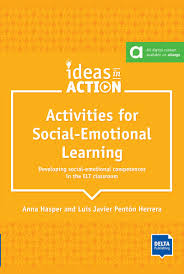
Activities for Social-Emotional Learning. Developing social-emotional competences in the ELT classroom. A. Hasper and L J Penton Herrera. (2024) DELTA Publishing. ISBN-978-3-12-501775-7, pp 175. This book has been published in the DELTA Ideas in Action series. The aim of the series is to build a bridge between theory and practice in language teaching. It looks at how theoretical ideas can be illustrated by practical, motivating and enjoyable ideas for classroom activities. Social-emotional learning (SEL) is one of the ’hot’ topics in conferences, webinars and teacher training. The aim of the SEL concept is to help the learners develop skills which will help them with understand and manage emotions, define milestones in the process of gaining a deeper understanding of emotions, develop empathy and understanding of emotions, and learn to take the right decisions. According to one source “ it involves five core competencies: self-awareness, self-management, social awareness, relationship skills, and responsible decision-making. SEL can be taught at any age to improve well-being and academic success.”
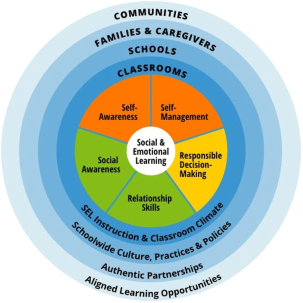
However, unlike what you might expect the book is not divided into five sections which reflect the 5 areas. But before I talk about the activities and the hands-on aspect, first I neet to mention the very informative introduction to social-emotional learning – why SEL matters and how to create the right conditions for SEL in the classroom, which is followed by a section on micro-strategies which give the teachers tools for “compassionate class management, mindful check-in, competence modelling”. The authors call them ‘sprinkling’ activities as they serve to sprinkle SEL onto our lessons. There are 16 of those – short and sweet and … brilliant. Then come the activities divided not into the 5 SEL categories represented above, but instead the authors chose to focus on the age of the learners: primary, secondary and adults. There are between 9 and 12 activities for each age group. The activities are well described, the procedure is easy to follow, where necessary it is accompanied by visual material or diagrams, like the SEL wheel or initial reaction boxes divided into think, say, feel, do. My favourites are the following activities: “Worry monster”, “Introducing positive psychology”, “The art of refusing”. In the world in which people face social and emotional problems, the book is an absolute must.
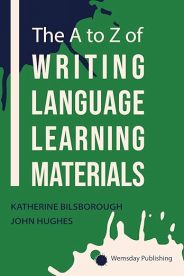
The A to Z of Writing Language Learning Materials. K. Bilsborough and J. Hughes.(2025). Wemsday Publishing. ISBN-13978-1068334313, pp.375. The A-Z format can be misleading. When you pick up the book, do not expect a publication along the lines of Scott Thornbury’s A-Z of ELT or The New A-Z of ELT. Scott’s book is a very useful and informative publication which maps out EFL, its history, trends, various aspects and issues it addresses (for the areas the revised edition covers look here). The book I am looking at it different. It does not just narrow down an area of ELT to writing materials.
Yes, the authors have chosen various aspects of materials writing and cleverly managed to arrange them in the A-Z format. The order seems to be chaotic, but this is not an issue at all. By definition, the book is a dip-in publication, so the order
- A is for Aims goals and objectives
- A is for Answer key
- A is for artwork brief
- A is for Authentic
- etc
seemingly chaotic, is fine as you will find what you need going down the contents page and choosing to read what grabs your fancy. Besides, what is the right order of talking about writing materials? Where do you begin? Where do you go next? But if you want to see all the categories, study the contents page available here.)
But apart from the order in which the various aspects of the writing process are listed and presented; it is important what happens in each entry. Usually there is an element of definition, sometimes a bit of theory, a bit of practice, some tips and ‘words of wisdom’. But it is not fixed; in Q is for Quiz and Questionnaire, needles to say, you have to take a quiz. �� Each ‘entry’ ends with an Ask yourself section, and where it is possible or appropriate with references. Overall the format is not strict, the tone is chatty, and the entry section does not follow a template. As a materials writer myself I can relate to the choices and the areas the authors have chosen e.g. Co-author, Template, sometimes I am surprised how cleverly they have chosen some areas and why e.g. Genre, Find someone who, sometimes I am puzzled by an entry e.g. Zone but when I read it I see this is what I call flow.
Overall, the book is a great resource as the authors, who are experienced and seasoned coursebook writers, materials developers and trainers, generously share they knowledge. They did not get stuck in the rut or put in a straightjacket of a template for each entry so they have kept it fresh, varied and following what they believed was right in each case. It is a great publication that can be used with teachers developing their own materials, on teacher training courses, for self study, in a materials developers’ team and in many other contexts.
You can find out more about writing business materials by John Hughes here.
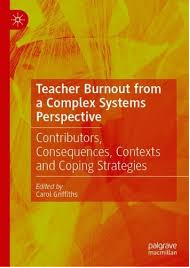
Teacher Burnout from a Complex Systems Perspective. Contributors, Consequences, Contexts and Coping Strategies. Ed. C. Griffiths. Palgrave Macmillan (2025). ISBN 978-3-031-85023-3, pp.312. If you are in the teaching profession, it is enough to look around the staffroom to see burnout. Already in the first sentences of the foreword Daniel J Madigan points out the fact that burnout is more common in the teaching profession than in any other profession – as he puts it: “in this respect the teaching profession eclipses any other professions”. He also points out that when a teacher decides to quit the job it is usually too late; the prolonged stress will have taken its toll when it comes to physical health, mental health and family life just to name a few.
In the Introduction – Carol Griffiths gives her rationale for writing the book. I find this sentence particularly poignant: “A recent quick check of Amazon revealed 31 books which deal with burnout, but of these, only a few related directly to teachers/ educators.” She also states that the 12 books recently published books are of the self-help kind, and none of the books offered any “academic coverage”. The aim of this book is to fill the gap. Actually, the very fact that the collection of articles and research findings has been published by Palgrave, suggests that the publication is serious stuff. And indeed, it is. The research studies presented in the collection try to describe, analyse and understand what 75% of teachers experience. But burnout is not just mathematics, and quantitative research cannon possibly describe or explain this complex phenomenon. The articles present different and varied methodology which has been used to collect the discussed data, which makes the books so valuable and helps to paint a wider picture of the problem. As for ways of looking at burnout, the multiple contributions to this collection investigate burnout, types of burnout and contexts in which it occurs, and it analyses potentially useful coping strategies. There are 13 chapters written by 25 contributors. The details of the chapters and contributing authors can be found here. Reading the available sample to be found on the website, you can judge by yourself how seriously the authors approach the subject and how informative their findings are. I am sure that the book will be invaluable reading for teacher trainers, headmasters and head teachers, educators and decision makers in education.
Please check the Pilgrims in Segovia Teacher Training courses 2026 at Pilgrims website
Short Book Reviews
Hanna (Hania) Kryszewska, Poland