Short Book Reviews
Hanna Kryszewska is a teacher, teacher trainer, trainer of trainers. She was a senior lecturer at the University of Gdańsk, Poland. She is co-author of resource books: Learner Based Teaching, OUP, Towards Teaching, Heinemann, The Standby Book, CUP, Language Activities for Teenagers, CUP, The Company Words Keep, DELTA Publishing, and a course book series for secondary schools: ForMat, Macmillan. She is also co-author of a video-based teacher training course: Observing English Lessons, and online course for Orient Black Swan on 21st Century Skills and Teaching the whole person: Humanising language teaching. Hania is a Pilgrims trainer, OTA trainer and editor of HLT Magazine.
Email: hania.kryszewska@pilgrimsteachertrainig.eu
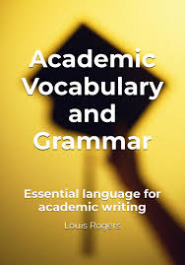
Academic Vocabulary and Grammar. Essential language for academic writing. L. Rogers. (2024). Self-published. ISBN-978346940227, pp.146. There are quite a few books which offer introduction to and work on academic vocabulary and academic grammar. But there are never enough materials in this category. The addressees are obviously tertiary level learners but in my experience secondary learners would benefit from such materials, as when they leave school and go to university they need to be prepared for the eventuality that they will follow academic courses delivered in English. Then it might be a bit too late or quite tricky to start learning academic English.
The book is divided into two parts: Grammar and Vocabulary; each of them has 20 sections. In the vocabulary sections you will find exercises on, for example, academic vocabulary, academic collocations, quantifiers or cohesion; in the grammar sections - revision of tenses, passive, conditionals or defining and non-defining relative clauses. Each section has the same organisation: introduction, key vocabulary, 3-4 practice exercises, extension and example; three pages in all. The exercises are traditional and so straightforward to do, especially on your own. The book will be great for self study as there is a key at the end of the book. The only snag may be the amount of grammar terminology and metalanguage which may be an obstacle for some learners. You can read a sample of the book here.
I understand that so far there are three books in the series and I hope to review them all in the next issues of HLT.
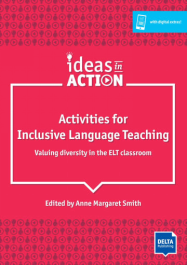
Activities for Inclusive Language Teaching. Valuing diversity in the ELT classroom.
Ed. A. M. Smith. (2010) DELTA Publishing. ISBN-978-3-12-5017399, pp 134. This book has been published in the DELTA Ideas in Action series. The aim of the series is to build a bridge between theory and practice in language teaching. It looks at how theoretical ideas can be illustrated by practical, motivating and enjoyable ideas for classroom activities.
The book is very special as it not only helps the students to learn English; it instils values, shapes characters and builds the group through English. The first chapter is an introduction which looks at various aspects of the inclusive class, the most common terminology, inclusive teaching practices and micro-strategies for the inclusive classroom (e.g. modelling respect, study groups, disagreements). A very interesting angle can be found in two sections in which the physical and the virtual classrooms are juxtaposed in the context of inclusion.
There are over 30 activities in the main body of the book; they fall into five groups: the welcoming classroom (supporting collaboration and supportive working environment), well-being in the classroom (boosting self-esteem and motivation, and overcoming individual barriers), understanding difference-embracing diversity (recognising the benefits of diversity and harnessing these differences), and, finally, reflection on own talents and skills, and choosing the best ways and methods to grow. The procedures are described very clearly and are easy to follow; they offer a rationale, variations, and where necessary are accompanied by visual materials and worksheets. You can also use the free DELTA Augmented app to access more materials and ideas. You can read more about the book here.
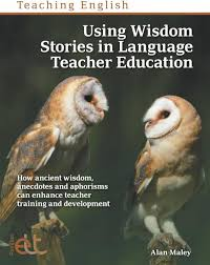
Using Wisdom Stories in Language Teacher Education: How Ancient Wisdom, Anecdotes and Aphorisms Can Enhance Teacher Training and Development. A. Maley ( 2024). Pavillion. ISBN: 978-1803883601, pp.308. Since time immemorial mankind has liked stories of all kinds; we like telling stories, listening to stories and making up stories. Stories help us to understand ourselves, help us to understand others, help us to understand the world around us and help us to communicate sometimes the most complex messages. These are just a few reasons why stories matter to us, mankind as well as individuals. A story can serve as a metaphor, or a vehicle for deep thoughts; it may be an illustration of a point or a springboard for discussion or silent reflection. Stories make us human; stories are found in all religions across the globe. They help us to remember, and they help us to forget.
Alan sees stories of all kinds and other shorter text forms as perfect tools and triggers for teacher development (TD) and continuous professional development (CPD). A story well chosen and well told can be a perfect springboard for reflection, discussions, and even sometimes action when it comes to your teaching profession with regard to personal development and growth.
Part 1 of the book is devoted to wisdom stories, stories that may on the surface seem paradoxical, ambiguous or puzzling, but which lead to reflection, sometimes very deep reflection. There are many sources Alan draws upon, among others, Zen stories, Sufi stories, Jewish stories, stories form the African continent, ancient mythologies, legends, fables and fairy tales by the classic authors of the genre, contemporary texts like mini sagas etc.. Part 2 of the book contains poems, personal anecdotes, metaphors and quotations. The wealth of materials and cultural background knowledge found in the book are impressive.
The way to use the texts is suggested in the introduction to each of the two parts of the book, and individually after each text in the so called ‘Possible discussion prompts’. You must see it to believe what a treasure trove this book is. Having read it I feel a bit sad that there will never be enough TD sessions to work through the contents of the book. But there will be always moments of quiet time in which to read and reflect on your own.
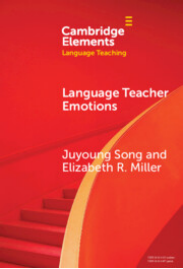
Language Teacher Emotions. Juyoung Song Murray and E. Miller. (2025). Cambridge University Press. ISBN: 9781009594134, pp.146. The book appeared in the Cambridge Elements series which is devoted to various aspects of language teaching such as education, applied linguistics, psychology, changing pedagogies and globalisation of education. The aim of the series is to bridge the widening gap between research and the practice of language teaching. Teachers do not have easy access to research-based publications and may find it difficult to relate them to their day-to-day teaching. And conversely, day-to-day teaching is not often subject of serious academic research. The series does what the educational scene needs – it bridges the gaps between theory and practice or academia and classroom practice by giving us “research-informed pedagogy, and pedagogy-informed research”.
The title under review, affect being one of the “Elements” addressed in the series, is devoted to language teacher emotions (LTE). It presents an overview of major approaches and research findings on teacher emotions combined with relevant underpinning pedagogy. The central focus of the book is affect and its rising importance in education. In the book affect is presented from various LTE aspects and schools of psychology against a wider backdrop. The various perspectives lead to a better understanding of emotions. This in turn leads to better teacher education, wider teacher development and deeper critical enquiry into emotions experienced by teachers as well as addressing related ethical issues.
The chapters include: Language Teacher Emotions and the Affective Turn, Psycho-cognitive Approaches to Emotions, Critical Approaches to Emotions, Pedagogical Approaches, and Ethical Considerations and Future Directions. This academic book which is on the heavy side is interwoven with ‘lighter’ personal narratives, dialogues, personal reflections and reflection questions.
The book is an excellent backup reading and inspiration for trainers, mentors and educators who, I am sure, will be able to sift through the text and make it more accessible to practising teachers. But this does not mean that a teacher could not pick up this book. The bottom line is that now we are not only talking about language teacher emotions but that the subject has been thoroughly researched and now will be brought to those in the teaching profession.
Please check the Pilgrims in Segovia Teacher Training courses 2026 at Pilgrims website
Short Book Reviews
Hanna (Hania) Kryszewska, PolandPavilion ELT
New From DELTA Publishing