Wellbeing Literacy: The Missing Language of Teaching in ELT (and not only)
Effie Kyrikaki, MSc in Applied Psychology, a seasoned edupreneur, teacher trainer, and mentor, is the founder of the NeuroLearningPower® framework and methodology that empowers and certifies teachers in their enriched roles - from content carriers to student thriving coaches. Her work focuses on Whole School Wellbeing and Humane Intelligence. She keynotes and writes on teacher wellbeing and the role of language, coaching psychology and NLP in shaping flourishing learning environments.
Email: effie@metamathesis.edu.gr

From survival to awareness, change, and exploration in the school ecosystem
It is late afternoon in the staffroom. A few teachers are packing their bags. “I’m exhausted,” one of them says. Another laughs softly. “Aren’t we all?” The headmaster adds: “It’s just the job.” The conversation ends there. Everyone nods and moves on.
If you are a teacher, it’s highly possible you have experienced a scene like this and you are not alone. It occurs in staffrooms around the world. Over time, stress has become normalised in the teaching profession. Teachers experience emotional pressure, heavy workloads and constant demands, yet the language available to describe and process these experiences is often limited.
Increasingly, teacher wellbeing – and readiness to deal with it - is recognised as a critical issue for education systems. In language classrooms, teachers work not only with knowledge but also with emotions, identities and relationships. This article explores the concept of wellbeing literacy and how it can help education leaders and teachers recognise emotional signals in themselves and their peers, interpret student behaviour differently and create classroom environments that support flourishing for learners, families and communities.
Teachers are trained to design lessons, manage classrooms and assess learning. Much less attention is given to developing the language needed to recognise and discuss wellbeing. This missing capability is increasingly described in research as wellbeing literacy (Oades, Jarden, Hou & Kern, 2020) and it is affecting education in more ways than one can imagine.
Appearances can be misleading
Some time ago I was speaking with a well-meaning, senior bank executive. When he learned that I was a teacher, he shared an observation that stayed with me.
“Teachers seem different these days,” he said. “They actually seem indifferent. It feels like many of them just want to do their job and go home.”
This was not a malicious statement. It was not intended as criticism. It is, however, an impression that is spreading.
What struck me that moment is that what he was describing closely resembles two of the classic symptoms of burnout: cynicism and emotional distancing (Maslach & Leiter, 2016). When professionals experience prolonged stress without sufficient support, emotional withdrawal can become a form of psychological protection.
What can appear as indifference may actually be a profession operating in survival mode.
When chronic stress persists long enough, something subtle happens. Teachers may begin to withdraw emotionally. From the outside this can appear as indifference or lack of motivation. But what often lies beneath is survival. Teachers facing constant change, administrative pressure and unrealistic expectations sometimes enter a form of emotional protection. They do not stop caring. They simply no longer have the energy to show it. Unfortunately, this can create misunderstandings. Parents and the wider community may interpret exhaustion as lack of commitment. This in turn affects negatively their beliefs, reactions and behaviours towards educators.
What does wellbeing literacy look like at school?
Wellbeing literacy refers to the ability to understand and use language about wellbeing in ways that support flourishing for oneself and others (Oades et al., 2020). In practical terms, this includes recognising emotions, expressing needs, understanding stress signals and communicating in ways that support wellbeing.
In school contexts, wellbeing literacy has a dual nature. On the one hand, it involves teacher wellbeing literacy: teachers’ ability to recognise and interpret their own emotional signals as well as those of their peers and students, and to respond in ways that support wellbeing in the classroom. On the other hand, it involves student wellbeing literacy: the gradual development of students’ capacity to recognise their own emotions, understand stress and communicate their needs appropriately, according to their age and developmental stage.
In English Language Teaching, wellbeing has increasingly become an area of research. Scholars such as Sarah Mercer have shown that teacher wellbeing is deeply connected to motivation, classroom climate and student engagement (Mercer & Gregersen, 2020). Positive psychology research in second language acquisition also highlights how teacher and learner wellbeing influence each other within classroom ecosystems (MacIntyre, Gregersen & Mercer, 2016).
What we often interpret as difficult behaviour may actually be a signal of wellbeing skills still developing.
Wellbeing literacy is a novel skill. It has not been taught at University level until recently and it has just started to be discussed in education settings. Most teachers and surely students are still learning essential wellbeing skills such as recognising emotions, regulating stress, communicating needs and navigating relationships. When these skills are still developing, behaviours can easily be misinterpreted. The table below offers some helpful comparative examples mapped against ACE capabilities.
|
Situation |
Low Wellbeing Literacy |
High Wellbeing Literacy |
ACE Capacity |
|
Noticing stress |
“I’m just tired. It’s normal.” |
“I notice I’m mentally drained today.” |
Awareness |
|
Student behaviour |
“This class is impossible.” |
“Something isn’t working today. What might students need?” |
Change |
|
Staffroom talk- Leader to teacher |
“I’m exhausted.” / “Aren’t we all?” |
“That lesson was tough. What helped you with this group before?” |
Change |
|
After a difficult lesson |
“I taught this badly.” |
“Most students struggled. What could help them next time?” |
Exploration |
|
Classroom conflict |
“Stop it. Sit down.” |
“Let’s pause. What’s happening here?” |
Awareness → Change |
|
Facing a challenging day |
“I just need to survive today.” |
“Today is challenging. What small step could help?” |
Exploration |
|
Practice Box A Simple Wellbeing Literacy check Ask yourself these three questions: • Do I only notice stress when I am already exhausted? If the answer to any of these questions is “yes,” you may be experiencing signs that your wellbeing literacy needs strengthening. The good news is that wellbeing literacy is not a fixed trait. It is a capability that can be gradually developed through small, intentional practices. |
Seen through the lens of wellbeing literacy, challenging situations shift from problems to be controlled to signals to be understood. Developing this capacity begins with awareness and opens possibilities for change in how situations are interpreted and addressed.
Read on for activities offering simple ways to begin strengthening awareness, change and exploration - the three ACE capacities that support wellbeing in everyday teaching life.
When teachers stop feeling: survival mode in schools
Why should this be of interest to any of us? Statistics provide a number of alarming reasons:
- Experienced teachers are leaving the profession in drones. Across Europe and the United States, teacher attrition is rising. This affects not only the quality of teaching but also the workload as remaining educators have to deal with increasing workload and class sizes, not to mention the exorbitant costs it incurs for educational systems worldwide.
- The profession is losing its appeal to young people. In a recent census among more than 200 hundred students of the TESOL department of the University of Athens, NKUA, less than one third of the students were determined to follow a teaching career with the rest considering translation or other avenues of employment, quoting adverse conditions at schools as the reason for their choice. As a result of this trend, in the European Union only around 9–10% of lower-secondary teachers are under the age of 30 (European Commission, 2023).
- Teacher shortages pose an increasing threat for educational systems worldwide. As a result of the above, UNESCO estimates that around 44 million additional teachers will be needed by 2030 to meet education goals globally (UNESCO & International Task Force on Teachers for Education 2030, 2024).
Teacher wellbeing is therefore not simply a personal matter. It has become a structural issue affecting the sustainability of education systems.
A story that should make us pause
The tragic case of Sofia Christidou in Greece drew attention to the emotional strain teachers sometimes face. Reports suggested that she suffered a massive stroke after experiencing severe bullying and threats from students.
Whether or not every detail is fully known, the story resonated with many educators who recognised the emotional weight teachers often carry silently. Public discussion, on the other hand, focused heavily on the perception that colleagues had offered little support or had even contributed to her plight. For some observers, this seemed to confirm the narrative that teachers have become detached, even abusive to their own peers.
However, before pointing fingers, we should bear in mind a potential, unseen factor. Teaching is one of the professions most exposed to empathy fatigue – the gradual depletion of emotional resources caused by repeated exposure to others’ distress (Figley, 1995). When emotional reserves are exhausted, the issue may not be willingness to support others but the ability to do so. Supporting colleagues while emotionally depleted is like trying to help others on an airplane before putting on your own oxygen mask. When your own supply of air is running low, even the intention to help becomes difficult to act upon. The willingness to help may still be present, but the capacity is not.
And yet, teachers urgently need their peers’ support. Research consistently points to collegial relationships as one of the strongest protective factors for teacher wellbeing (Collie, 2021; OECD, 2020, Kyrikaki, 2023). In our survey among 647 Greek ELT educators, peer support came as the first measure teachers turn to at times of pressure. This is why when this is missing uncertainty and insecurity increases disproportionally, leading to even more stress. As one of our interviewees said: it is like someone is pulling the carpet under your feet.”
The paradox in ELT
Recent discussions in language education suggest an intriguing paradox. Despite the fact that language classrooms regularly explore communication, emotions and human experience, language teachers are not automatically wellbeing literate.
Why?
Teacher education has traditionally focused on linguistic competence, teaching methodology and assessment practices. While these areas are essential, much less attention has been given to the psychological dimensions of teaching such as recognising emotional signals, understanding stress responses and supporting wellbeing in the classroom.
Scholars such as Sarah Mercer have increasingly highlighted the importance of teacher wellbeing in language education. Research in positive psychology and second language acquisition shows that teacher emotions, classroom climate and learner wellbeing are closely interconnected.
However, teachers often lack the conceptual language required to recognise and interpret wellbeing signals. Without a framework for wellbeing literacy, emotional experiences may be misinterpreted as behavioural problems or disciplinary issues.
This raises an important new research direction for the ELT field: if language classrooms already explore communication and human experience, could they become natural environments for developing wellbeing literacy?
In many ways, language learning already involves discussing feelings, reflecting on personal experiences and negotiating meaning in social contexts. With the addition of wellbeing literacy frameworks, language teachers may be uniquely positioned to help students develop emotional awareness, communication skills and strategies for navigating challenges.
This emerging perspective suggests that language education may play a much broader role than previously recognised. Language classrooms may not only teach grammar and vocabulary but also contribute to developing the language of human experience and to the exploration of new responses - the three capacities that form the ACE dimensions of the EMBR.ACE framework.
Connecting wellbeing literacy to humane intelligence and the EMBR.ACE framework
In this column in the September issue of HLT we introduced the idea of EMBR-ACE -Empowerment, Mentoring, Belonging, Resilience for Awareness, Change, Exploration - as an NLPowered Space for Whole School Wellbeing. I explained back then, that my intention is for EMBR-ACE to be a practical and supportive path for both educators and students, lighting the way toward a more empowered, relational, and whole-hearted vision of educational flourishing.
Thriving is a radical act of courage, because thriving teachers don’t just survive the system—they transform it from the inside out.
We had explored the notions of Empowerment, Mentoring, Belonging, Resilience back then and now it is time for the ACEing part:
A – Awareness of the state of self and others
C – Change in relationships and communities
E – Exploration of options and possibilities
Together these capacities represent Humane Intelligence (see the February issue of HLT) in action. When teachers develop wellbeing literacy they strengthen awareness, enable constructive change towards human connections, and open space for exploration of new options and responses to challenges.
Awareness
Awareness involves recognising one’s own state involving internal and relational signals connected to wellbeing, noticing one’s own and others’ emotional reactions, classroom energy and early signs of stress in both themselves and their students.
|
Practice Box – 2-Minute Teacher Reset
Write one sentence beginning: 'Today I noticed that…' |
Change
Change occurs when language shifts how we interpret situations. A wellbeing-literate teacher moves from judgement to curiosity, asking what might lie beneath the behaviour or results they observe. This shift reshapes the connections we create in the classroom. A difficult lesson does not mean you are a bad teacher; it may simply be a difficult day—and the same may be true for your students. As Sarah Mercer reminds us, the way we interpret events shapes the emotional climate of learning. When we train ourselves to change our perspective from contempt to curiosity, we open space for stronger relationships and more constructive responses.
|
Practice Box – From contempt to curiosity Instead of considering situations as failure on your side or your students, look at the information the situation can provide. Instead of thinking: “All the class failed the past simple test. I taught it all wrong again.” Ask yourself: 'What information does this result give me?’ Then focus on what can be done: We need more practice with the subject matter and I could do it differently to reinforce engagement and application.’ |
Exploration
Exploration encourages flexible thinking and the generation of options when responding to classroom challenges.
|
Practice Box – Generating Options Teach yourself and them to come up with at least three solutions to each challenge. |
Wellbeing literacy provides the language that activates humane intelligence in educational settings. Through the ACE capacities of the EMBR.ACE framework—Awareness, Change and Exploration - teachers learn to recognise their internal state, strengthen relational connections and generate constructive options when facing classroom challenges. In this way, wellbeing literacy transforms everyday language into a practical pathway for cultivating humane intelligence and supporting flourishing learning environments as shown in figure 1 below.
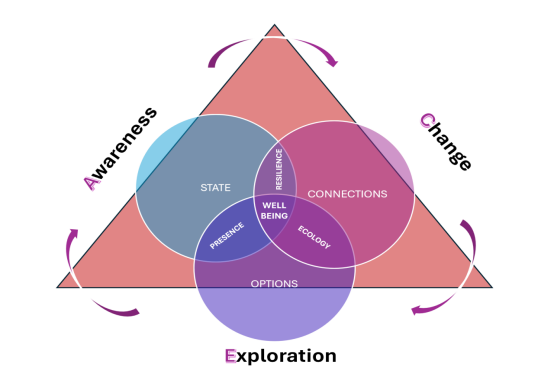
Figure 1
Humane Intelligence correlation to A.C.E.
Note. The diagram illustrates how wellbeing literacy activates humane intelligence in educational contexts through the ACE capacities of the EMBR.ACE framework: Awareness (recognising one’s internal state), Change (shaping relational connections through language and interpretation), and Exploration (generating constructive options for action). Adapted from Oades et al. (2021) on wellbeing literacy and integrated with the EMBR.ACE framework (Kyrikaki, 2026).
When wellbeing literacy reaches the wider community
The influence of teacher wellbeing literacy rarely stops at the classroom door. When students learn emotional awareness and regulation, these skills often travel into families and communities, as is clearly demonstrated by the following accounts from NeuroLearningPower institutions.
A teacher once received an unexpected phone call from a mother asking what exactly was being taught in class. The teacher was initially taken aback. The mother then explained that earlier that evening she had been crying in the kitchen. When her daughter saw her distress, she did not flaunt. The girl recognised her emotions and calmly suggested trying a breathing exercise she had learned at her English school. She then guided her mother through the technique for emotional regulation. In that moment the learning that had taken place in the classroom had quietly reached into family life.
In another example, during a school trip to a museum, a student experienced a panic attack in a narrow underground corridor. Before teachers could intervene, another student stepped forward and used co-regulation strategies she had learned in her English class to help her classmate slow her breathing until the panic subsided.
Teachers themselves can also become disseminators of wellbeing practices. In one case, a participant in the NeuroLearningPower training programme shared her experience with her school principal. The principal later contacted the trainer requesting training for all 46 educators working in that institution – a school operating inside a prison.
Wellbeing literacy spreads through schools the way ripples spread across water — quietly, but far beyond the point where they begin.
Of course, here arises the factor of positive institutions, the systemic part of teacher wellbeing, as proposed by Selingman and explored by Mercer and Gregersen, who conclude that language educators “need institutions that consider their needs, acknowledging their multiplicity of roles and demands on their time (Mercer & Gregersen, 2026).
Reflections
Teaching has always been a deeply human profession. Teachers do not only transmit knowledge; they also shape how young people understand themselves and others.
When teachers develop wellbeing literacy, they gain tools for recognising emotional signals, supporting peers and students more effectively and sustaining their own professional wellbeing.
In this way, the language of wellbeing spreads outward - from school leadership to teachers, from teachers to students, from students to families and from families into the wider community.
Thriving is a radical act of courage, because thriving teachers don’t just survive the system—they transform it from the inside out.
References
Collie, R. J. (2021). COVID-19 and teachers’ somatic burden, stress, and emotional exhaustion: Examining the role of principal leadership and workplace buoyancy. AERA Open, 7. https://doi.org/10.1177/2332858420986187
European Commission. (2023). Teachers in Europe: Careers, development and wellbeing; Eurydice report. https://eurydice.eacea.ec.europa.eu/sites/default/files/teachers_in_europe_2020_chapter_6.pdf
Figley, C. R. (2013). Compassion fatigue: Coping with secondary traumatic stress disorder in those who treat the traumatized. Routledge.
Gregersen, T., MacIntyre, P. D., & Meza, M. (2016). 6 positive psychology exercises build social capital for language learners: Preliminary evidence. Positive Psychology in SLA, 147-167. https://doi.org/10.21832/9781783095360-007
International Task Force on Teachers for Education 2030, & UNESCO. (2024). Global report on teachers: Addressing teacher shortages and transforming the profession. UNESCO Publishing.
Kyrikaki, E. (2023). Emotional and professional support measures for ESOL educator flourishing. Advances in Higher Education and Professional Development, 215-247. https://doi.org/10.4018/978-1-6684-8380-0.ch009
Leiter, M. P., & Maslach, C. (2016). Latent burnout profiles: A new approach to understanding the burnout experience. Burnout Research, 3(4), 89-100. https://doi.org/10.1016/j.burn.2016.09.001
MacIntyre, P. D., Gregersen, T., & Mercer, S. (Eds.). (2016). Positive psychology in SLA. Multilingual Matters.
Mercer, S., & Gregersen, T. (2020). Teacher wellbeing. Oxford University Press.
Mercer, S., & Gregersen, T. (2026). The role of institutions in language teacher educator well‐being: Unpacking the third pillar of positive psychology. The Modern Language Journal. https://doi.org/10.1111/modl.70058
Oades, L. G., Jarden, A., Hou, H., Ozturk, C., Williams, P., R. Slemp, G., & Huang, L. (2021). Wellbeing literacy: A capability model for wellbeing science and practice. International Journal of Environmental Research and Public Health, 18(2), 719. https://doi.org/10.3390/ijerph18020719
OECD. (2020). TALIS 2018 results (Volume II) teachers and school leaders as valued professionals: Teachers and school leaders as valued professionals. OECD Publishing.
UNESCO, & International Task Force on Teachers for Education 2030. (2024). Global report on teachers: Addressing teacher shortages and transforming the profession. UNESCO Publishing.
Please check the Pilgrims in Segovia Teacher Training courses 2026 at Pilgrims website.
Wellbeing Literacy: The Missing Language of Teaching in ELT (and not only)
Effie Kyrikaki, Greece