- Home
- The Creativity Group
- Telling Their Stories to the World – Showing Support and Expressing Admiration for the Children of Gaza
Telling Their Stories to the World – Showing Support and Expressing Admiration for the Children of Gaza
Editorial
This article was first published in the summer 2025 edition of Melta News and is republished with kind permission
Haneen Khaled Jadallah is an English language teacher, teacher trainer and remote theatre specialist. A PhD student at the University of Warwick, she’s passionate about connecting young people in Palestine with their peers worldwide through intercultural linkups and online theatre as exemplified in her current British Council project Voices Across Worlds.
David Heathfield is a world storyteller, teacher trainer and writer from Exeter, UK. The author of two books – Storytelling with our Students and Spontaneous Speaking
(both DELTA) and numerous articles and book chapters, he provides creative and engaging storytelling for teachers (CrEST) courses for participants worldwide via Zoom.
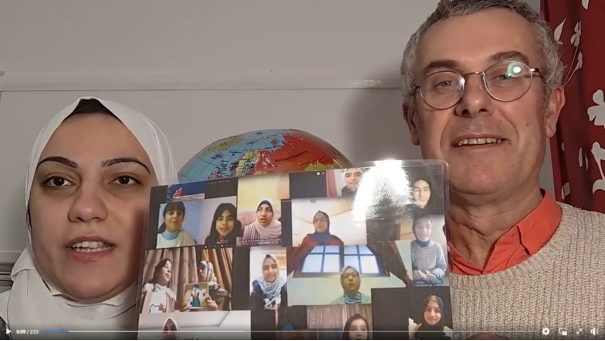
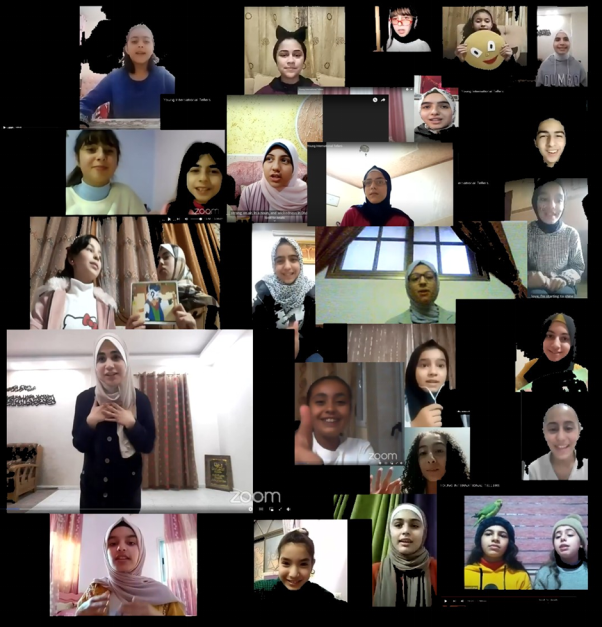
Young International Storytellers in Gaza telling stories at the World Storytelling Café
The project
From November 2023 to January 2024, a link was posted on Facebook every day to a video recording of a child from Gaza telling a story to the camera. Nearly all were from the archive of the World Storytelling Café shared on YouTube and Facebook between 2020 and 2023. Since then children in Gaza have continued to send us a surprising number of newly recorded stories in the midst of the suffering they are enduring and now there are over 130 videos and counting.
Starting on 1 January 2024, people around the world, many of them teachers and learners of English who love oral storytelling, have followed and retold the children’s tales, expressing admiration and support for the children and their teachers who continue to learn and teach in exceptionally difficult circumstances. There are so far over 330 videos of people retelling a tale in the name of the Palestinian child they learned it from.
The resulting project, Tell a Child in Gaza’s Tale, isn’t only an educational storytelling initiative; it’s a profoundly human act and an urgent documentation of the stories made, told and retold by Palestinian children since 2020. It’s a peaceful yet powerful way of awakening the world to the creativity of Palestinian children and their teachers, stories shared from their homes on Zoom since the pandemic and then returned to the world through Facebook, YouTube and other channels, ensuring the tales remain alive.
As we tell and retell these stories, it’s essential that we move away from framing the people of Gaza solely as victims. Instead, we must recognize them as creative-resilient people living under oppression who possess love for life and an incredible amount of creativity to offer the world. Our responsibility includes the importance of the ongoing listening to and retelling of the stories told by children who have survived as well as those children whose lives have been taken from them.
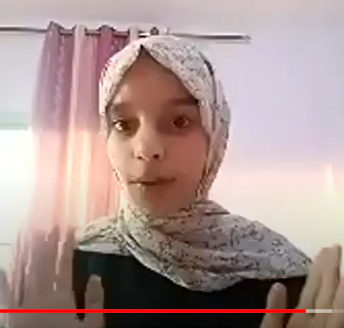
Tala storytelling at the World Storytelling Café
Tala’s story
Tala from Gaza is a wonderful young international storyteller. She shared a recording of herself telling the following heart-warming tale at the World Storytelling Café on June 1, 2021:
The Sick Girl and Her Friends
Once upon a time there was a little girl who became very sick. She had to spend all day in bed unable to move because other children were not allowed to come near her. She spent all day feeling sad and blue. While lying in bed, she looked out of the window, and as the day passed, she saw a strange shape outside: it was an enormous duck with a carrot in its hand! The duck squeezed through the window. “Good afternoon”, he said to the girl, and left again. The girl was very happy and she thought that she was imagining things. Well, when the little girl became better and went back to school, she told her friend about the strange duck that she had seen. While she was speaking, the girl noticed something strange in her friend's bag. She asked to see what was inside the bag. It was a duck costume with a big carrot: the girl’s friend had dressed up in the costume to try and cheer her up! Well, from that day on the little girl did her best to make sure nobody felt sad or alone.
Now over to you
One of the most important things for Palestinian children is to know that people around the world are talking about them and telling their stories. Here are three ways you and your learners can show your admiration and support.
Activity 1: Anticipate the story
Level: A2+
Time: 30 minutes
Aim: Improve listening comprehension
Materials: Pens or pencils, large pieces of paper, video recordings of “The Sick Girl and Her Friends” at https://youtu.be/wDrN-vPAXt8?si=cZoK8VDPH3g9doyj (told by Tala in Gaza) and https://youtu.be/Lt3QX_Z4GFk?si=sS8iJBqEUqnFuFu1 (told by Vera Cabrera Duarte in Brazil)
Note: The recording of Tala is unclear at times due to the internet connection.
Procedure:
- Ask learners to draw a large duck with a carrot in its hand – yes, in its HAND!
- Tell them that the story is about a girl who’s too ill to go to school and that it includes the duck they’ve drawn.
- Invite learners to ask questions to find out what happens in the story and answer their questions so that they get a rough idea of the story without telling them every detail. Give them a 3-minute time limit to keep up the energy
- Ask the learners in pairs / groups to tell the story they expect to hear based on your answers.
- Tell the story yourself (avoid reading aloud) and/or play one or both of the video recordings.
- Ask learners to compare your version / the video versions with their predictions and to talk about what the story means to them.
Activity 2: Follow-up
Level: A2+
Time: 30 – 40 minutes
Aim: Foster listening and oral storytelling skills
Materials: None
Procedure:
- Show your learners a simple picture you’ve drawn to illustrate a true story about a time someone cheered you up when you needed it. Tell your learners your story.
- Ask them to think of a time someone cheered them up when they needed it and give them a few minutes to draw a simple picture and get ready to tell their story.
- Divide the class into small groups, mixing learners who can’t think of a story with others who can.
- Ask the learners to tell their stories to the other learners in their groups and to learn and retell each other’s stories.
- Ask the listeners to retell one of the stories they’ve been told to different learners from the other groups.
Option: Invite learners to discuss what they can do to show their concern for the children of Palestinian and make their lives better. Activity 3 below would be a great thing to do.
Activity 3: Retell the story
Level: A2+
Time: 30 – 40 minutes
Aim: Communicate with children in Gaza
Materials: Video camera, materials for making puppets, pictures and/or masks
Procedure:
- Ask the class to retell “The Sick Girl and Her Friends” to a camera in person or using puppets, through pictures, with masks, etc.)
- Make an mp4 video recording of the result and send it to us at davidheathfield@hotmail.co.uk, so we can share it with children in Gaza and around the world.
Join the project
For us, as educators in Palestine and around the world, it’s a moral responsibility to preserve, share and continue using stories like Tala’s. They stand as living proof of the deeply humanistic educational system that once flourished in Gaza, a system that has been utterly destroyed since 2023.
We’ll always remember one young storyteller, Deema (now 17), who, after surviving and leaving Gaza, watched Jackie Ross (a Scottish storyteller) retell The White Elephant, a story she herself had told at the age of 13 on Zoom for the World Storytelling Café in 2020. With tears in her eyes, she said: “I thought I had been abandoned by the world and that everyone had forgotten me/us. But now I know that people still care.”
We welcome all your comments and suggestions and invite you and everybody you know to choose a child’s tale, retell it and share it around the world in order to return the hospitality shown from their homes in Gaza by wonderful young storytellers. Here are the tales told by young Palestinians: https://drive.google.com/file/d/1BKu7JPXmONEB6y5cbeGlUW6zWi3SmRAP/view
We’ll add your storytelling videos to our ever-growing YouTube playlist “Tell a Child in Gaza’s Tale” at: https://youtube.com/playlist?list=PLj-mcWeMmSZw63V5abQ4fw3JIITI_S_kS&si=du47VczUOOkf3dQo
Please feel free to get in touch at davidheathfield@hotmail.co.uk if you'd like some help choosing which tale to tell.
Find out more
Further information about Tell a Child of Gaza’s Tale is available online in our contribution to the February 2025 issue of Humanising Language Teaching at https://www.hltmag.co.uk/feb24/tell-a-child-in-gazas-tale.
Please check the Pilgrims in Segovia Teacher Training courses 2026 at Pilgrims website
Know-Ask-Explore-Learn: Taking Advantage of Learner Curiosity
Chrysa Papalazarou, GreeceThe Teacher, the Poet and the Critic: Change Cannot be Postponable
Fernanda Felix Binati, ColombiaTelling Their Stories to the World – Showing Support and Expressing Admiration for the Children of Gaza
Haneen Khaled Jadallah Palestine and UK;David Heathfield, UKMore than Methods: Using Stories to Humanize CPD: An Interview with Alan Maley
Chang Liu, China and UK