The Teacher, the Poet and the Critic: Change Cannot be Postponable
Fernanda Felix Binati is an EFL teacher and an active contributor to Worlds into Words (the ‘C’ - Creativity - group). She has carried out ethnographic research in schools around the world, such as in India, Brazil and Colombia, with the aim of promoting literacy, inclusion and critical thinking in English language teaching. Currently, she is volunteering for the World Literacy Foundation in vulnerable areas in Colombia and also teaching at a plurilingual school. Email: ffelixbinati@gmail.com.
… My food I ate between battles
To sleep I lay down among murderers
Love I practised carelessly
And nature I looked at without patience.
So passed my time
Which had been given to me on earth…
All roads led into the mire in my time.
My tongue betrayed me to the butchers.
There was little I could do. But those in power
Sat safer without me: that was my hope.
So passed my time
Which had been given to me on earth…
II - To Those Born Later, Bertolt Brecht
Reflections from Writers’ Monthly Meeting
In May, some members of the creative writers’ group Worlds into Words (WiW) coordinated by Alan Maley gathered online to write poems and reflect on the question “Can art play any meaningful role in countering the recent direction of US politics?”, bringing other reflections about the role of art in sparkling change. More than just politics, even academia has been lacking a critical capacity for change, and this has made art in education so unsettling and unrelated.
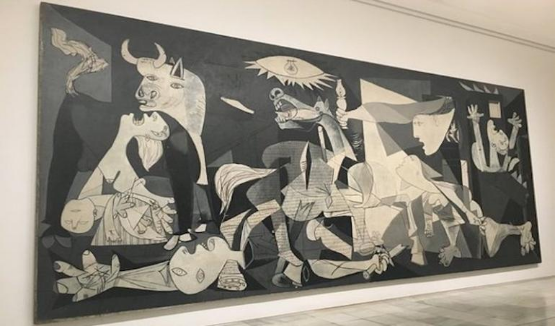
Guernica, by Pablo Picasso, picture in the public domain by Lacittafutura.
Ambiguity is a topic which has been highly avoided in today’s society, when societies demonise creativity but sanctify an academic culture of “perish or publish” and falling deeper into jingoistic ideas. By augmenting long speeches about ‘equal rights’ and ‘parts which don’t fit’ in the name of peace, where else would injustice be hidden?
Julianne Burgess mentioned the painting Guernica by Pablo Picasso that speaks volumes about what has been behind the deafening silence of real stories. Thus, in education, students are not just asked to learn the language, but also to “reimagine” that landscape of silenced stories as put it in the song written and shared by Dat Bao:
“Reimagine you and me
in this space called English
Try and repaint the picture
Try and rethink the speakers
in all these places called countries”
(Bao Dat, 31 May - WiW meeting)
It was also expressed that art can be a ‘catalyst for change’ (Dat Bao), and the role of art as ‘enabling future generations to survive’ (Charlie Hadfield).
Digging in Ideas
Before the meeting, we read the interview by The Guardian on Steve Reich ‘We all wish art could counter the direction of US politics. But it can’t, which I then transformed into Found Poems (Finding Poems by Alan Maley). When Dave Simpson asked Steve Reich about his job of “moving art around”, he replied:
“Yes and no. We moved things around, but it wasn’t art, it was big, smelly mattresses and couches up and down stairs (…).”.
Contrary to Steve’s opinion, I found the description of “smelly mattresses and couches up and down stairs” more often than not representative of the undefined and unpredictable side of teaching and writing. Haikus “Found Poems” can truly reveal the presence of ambiguity at times where everything is being labelled as ‘right and wrong’ rather than creative and continuous:
Artists play with life
Colours speak of ideas
Mind’s ambiguity
Feelings sparkle thoughts
Taking unforeseen paths
Never-ending art
(Binati, 31 May - WiW meeting)
Phrase: “We all wish art could counter the direction of US politics. But it can’t.”
If art counters hatred
Unravelling silenced stories
Capitalism dies
Artists are silenced
Politicians fail to speak
Hate and ignorance
Phrase: “I’m 88 years old. I use composition software, but don’t keep up with gadgets.”
Twenty-first era
Machines are outnumbered
Thoughts are redundant
(Binati, 31 May - WiW meeting)
Worlds into Words meeting, 2025
Creative Writing in Existential Conflict
On another account of the narrowing of human capacities, Al Jazeera English streamed the UN Security Council monthly briefing and consultations in the Middle East (UN Security Council holds meeting on the situation in the Middle East and Gaza) which instead of bringing change did not seem to make painful situations more practically meaningful for human survival. Sigrid Kaag, UN special coordinator for the Middle East said:
“Hamas and other armed groups must stop launching rockets towards Israel. Durable security cannot be achieved solely through force. It must be built on mutual recognition, justice and rights for all. A better path exists that resolves this conflict, deescalates regional tensions and achieves a shared vision for peace.” (28 May 2025, Al Jazeera English)
A Fictitious Dialogue with a UN World Leader
Here’s my interaction and reply to this existential conflict between human individuality against mainstream peace talks. This activity can be adapted based on a few ambiguous terms from speeches which can be expanded in more detail and better contextualised:
Kaag: “Thank you Mr. President. Members of the security council, (…) Hamas and other armed groups must stop launching rockets towards Israel.”
Fernanda: Excuse me ma’am, pardon my interruption, “must stop” means peace needs to be established by all means which implies the use or non-use of force.
Kaag: Exactly. “Durable security cannot be achieved solely through force.”
Fernanda: Ma’am has it occurred to you that we are living in a world where security is never guaranteed even when you are at the top of the food chain and speak a lot about peace? Is it realistic to desire “durable security” for a war that has been going on for over a century? Besides, while we are talking, there are people searching for food and shelter.
Kaag: Yes, but again dear members, “It must be built on mutual recognition, justice and rights for all.”
Fernanda: By “mutual recognition”, do you mean paying my taxes and depending on the West for food even after funds have been paid to repress my people out a sense of “durable security”?
Kaag: Actually… “A better path exists that resolves this conflict, deescalates regional tensions and achieves a shared vision for peace.”
Fernanda: Don’t you think that if such ‘a better path’ resolved the conflict, everyone would have been walking on it, including you and terrorists in mutual recognition?
This peace ‘speech’ sounds pedagogically redundant and the word ‘better’ has not had any effect on practicality yet. I would also like to ask you some further questions.
- At what point has peace been actually taken into account given the fact that both Israelis and Palestinians do not want to come to an agreement of a Western view of peace considering religion is a much more of a driving force in the Middle East?
- Peace, when not achieved through force and pressure, could it also - once and for all - not be moulded and framed by a simplistic sense of “durable security”?
Right now, I am taking a step back out from peace talks and calling out for real peace. Thank you, dear members of the council.
Narratives do Matter: There is Hope
At times where power structures are normalised in academia and politics, the very resource to produce relevant work gets reduced to a culture of intellectualism in which people discuss “durable security” and “mutual recognition” meanwhile real matters stay afloat. In another instance, the words “there is no hope” were also said by Sigrid in the UN session. The hopeful and symbolic world of art is being constantly supressed by a culture that mostly gains from what has been “scientifically proven” (i.e., leaders arguing whether what is happening in Gaza is genocide or not) or indoctrinated by tradition, and thus more students have come to believe and repeat the same “mantra” - ‘there is no hope’ instead of focussing on what’s actually at stake and what can be done. So, another follow-up activity would be asking learners to rewrite the narrative in a more hopeful manner and highlighting how people’s narratives do matter, and there is hope as long as we are the ones writing our own stories.
“We live in a society absolutely dependent on science and technology and yet have cleverly arranged things so that almost no one understands science and technology. That’s a clear prescription for disaster.”. (Carl Sagan, 1995)
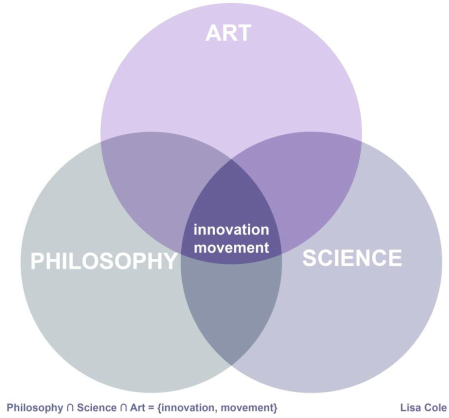
Interdisciplinary research for further reading:
Cole, L. (n.d.). Interdisciplinary collaboration as a catalyst for innovation. Lisa Cole. https://www.lisa-cole.co.uk/interdisciplinary-collaboration/
Bibliography
Al Jazeera English. UN Security Council holds meeting on the situation in the Middle East and Gaza. YouTube. https://www.youtube.com/watch?v=D9iRF_q2H5g
Brecht, B. (1930). To those born later (M. Hamburger, Trans.). Ronnow Poetry. https://www.ronnowpoetry.com/contents/brecht/ToThoseBorn.html
Cole, L. (n.d.). Interdisciplinary collaboration as a catalyst for innovation. Lisa Cole. https://www.lisa-cole.co.uk/interdisciplinary-collaboration/
La Città Futura. (2018). L’immagine artistica tra politica e società: Guernica. https://www.lacittafutura.it/cultura/l-immagine-artistica-tra-politica-e-societa-guernica
Lewis, T., Amini, F., & Lannon, R. (2001). A general theory of love. Vintage Books.
Maley, A. (2021, August). Finding poems. Humanising Language Teaching, 23(4). https://www.hltmag.co.uk/aug21/finding-poems
Popova, M. (2012, April 6). What is science? From Feynman to Sagan to Asimov to Curie, an omnibus of definitions. The Marginalian. https://www.themarginalian.org/2012/04/06/what-is-science/
Sagan, C. (1995). The demon-haunted world: Science as a candle in the dark. Random House.
Simpson, D. (2025, March 20). Steve Reich: 'We all wish art could counter the direction of US politics. But it can't'. The Guardian. https://www.theguardian.com/music/2025/mar/20/steve-reich-we-all-wish-art-could-counter-the-direction-of-us-politics-but-it-cant
Worlds into Words. (2025, May 31). 31 May meeting (C. Hadfield, J. Burgess, & D. Bao, Contributors).
Please check the Pilgrims in Segovia Teacher Training courses 2026 at Pilgrims website.
Know-Ask-Explore-Learn: Taking Advantage of Learner Curiosity
Chrysa Papalazarou, GreeceThe Teacher, the Poet and the Critic: Change Cannot be Postponable
Fernanda Felix Binati, ColombiaTelling Their Stories to the World – Showing Support and Expressing Admiration for the Children of Gaza
Haneen Khaled Jadallah Palestine and UK;David Heathfield, UKMore than Methods: Using Stories to Humanize CPD: An Interview with Alan Maley
Chang Liu, China and UK