- Home
- Various Articles - Tertiary/CLIL
- Code-Switching and its Impacts on Students’ Motivation of Practice in English Speaking at Van Lang University
Code-Switching and its Impacts on Students’ Motivation of Practice in English Speaking at Van Lang University
Ms. Ton Thien Quynh Tram is an English lecturer at the Faculty of Languages, Van Lang University. She has 29 years of experience teaching at university level. Her areas of teaching include English skills, linguistics, literature and social studies and translation and interpretation. Her research interests include translation of literary works, literary study, and fostering students' motivation in the speaking class. Affiliation: Faculty of Foreign Languages, Van Lang University, Vietnam. Email: tram.ton@vlu.edu.vn
Ms. Nguyen Bach Hue is a former student at Van Lang University, Ho Chi Minh City. Her research fields of interest are English speaking skills and Translation. Email: huenguyen5018@gmail.com
Abstract
This paper provides a perspective on how students majored in English at Van Lang University apply Code-switching (CS) and their motivation in practicing English-speaking. It also provides a perspective on Code-switching's impacts on English-speaking skills to evaluate whether code-switching can be a teaching approach and learning method for learners and educators. There were 215 English-majored students participating in a survey. The results illustrate the factors that influence the motivation of students to practice English-speaking skills: Vocabulary, Confidence, Pronunciation, Expression, Grammar, Background knowledge, Ideas, Fear of Public speaking, and Fear of making mistakes, listed in descending order of impact. The findings show that code-switching enables students to express their ideas effectively, provides students with the confidence to practice English-speaking skills, enrich vocabulary, and also helps them reduce the fear of making mistakes; students agree that they can learn new knowledge when they code switches. The result shows that code-switching is inevitable when learning and teaching English speaking.
Introduction
In a world where English plays an essential role in the communication of human society, the education systems of Asian countries are focusing on improving their students' speaking skills. According to Azlan and Narasuman (2013), English is a dominant language in communication, people tend to use Code-switching (CS) to express their opinions and solidarities in their mother tongue. This is a phenomenon that occurs in a multilingual or multicultural environment. In the English Language Teaching classes, it appears in both the educators' and learners' speech. Many educators do not have positive opinions about this phenomenon. For instance, Arega Temesgen and Eyasu Hailu (2022) states that Code-switching has always been a controversial aspect of teaching methodology due to its advantages and disadvantages. However, they agree with the benefits of Code-switching. Knowledge about Code-switching will provide teachers with the methodologies to use the advantages of Code-switching in teaching languages (Sert, 2005). Educators have to discover various methods to effectively develop students' language skills, especially students' fluency in the language is a prerequisite (Ho, 2018). In a study by Ngugi (2015), the result indicated that Code-switching is a method to communicate effectively between students and teachers, which can help them reduce difficulties in communication. In other words, Code-switching is a method to support the communication and learning process of teachers and students. Another research paper by Cahyani and peers emphasizes that teachers usually apply Code-switching to help their students gain new knowledge, manage students' behaviors, and improve the connection between learners and educators. Code-switching in classrooms is an intentional action to translate language in a bilingual class, which can engage students with the lessons (2018). The purpose of this study is to determine whether Code-switching's benefits can become an inevitable factor in teaching approaches in education.
Literature review
Code-switching (CS)
Code-switching is a common language phenomenon that occurs in the utterances of bilingual speakers. Sometimes, Code-switching, known as Code-mixing, is the act of multilingual alternately using two or more languages, dialects, or accents. In other words, when the speaker code-switches, they change the forms of a language and ways of pronouncing words in an utterance. When a person can speak equally well in more than one language, Code-switching is a natural phenomenon in an utterance (Palmer, 2009). According to Heredia and Altarriba, when there is more than one language in a conversation, a bilingual tends to change alternately between two languages. CS is not a random phenomenon. It follows a principle that may affected by contextual factors (2001). CS is alternately changing the clauses, words, and sentences in one language with another in an utterance. Utilizing CS is a method to study some difficulties of linguistics (Gort, 2012). Having a similar opinion to those researchers, Moghadam and others believe that CS is shifting occurs in a conversation where a whole or a part of a sentence is changed. This action is likewise known as normally appearing in conversations of everyone within or without reason (2012). Furthermore, in an utterance between multilingual people, 84% of single words, 10% of phrases, and 6% of clauses are switched among the languages in a conversation (Skiba, 1997).
Types of code-switching
On the one hand, the research of Moghadam in 2012 emphasized there are many types of CS. However, there are only two main types of CS, which consist of :
- Mechanical switching: This type of CS is also known as "Code-mixing ". This type occurs unconsciously in the conversation of multilingual speakers. In daily conversation, when a speaker cannot express their thoughts, somehow the speaker recalls them in other languages. This phenomenon naturally occurs, demonstrating the diversity in linguistics of the speakers.
- Code-changing: Another type of Code-switching, different from Code-mixing (mechanical switching), is when the speechmaker uses Code-changing, which means they intend to change their language to express effectively and influence. This type of CS appears depending on the contextual elements such as contextual meanings, stylistics, or intentions of the orators. Most of the time, Code-changing is between two languages in an utterance.
On the other hand, Janet Holmes divided CS into three main types in his research in 2013, which consisted of:
- Metaphorical switching: This type of CS is used to represent a collection of meanings, which is considered social value. It means people use the metaphor to convey the implied meaning. Or to a specific topic, the speechmakers may change their language to convey the meaning to their listeners effectively or enrich the utterance. Some people believe this type is called "Code-mixing.". However, to Holmes, Code-mixing may appear because of the lack of knowledge of the speakers. Metaphorical switching may be a skillful way to convey the implied meaning.
- Lexical borrowing: Mention lexical borrowing in a conversation, it is the result of the lack of vocabulary of the speakers. They do not know how to describe their thoughts in their primary language, so they replace it with appropriate words in another language. Lexical borrowing sometimes occurs when there are no available terms in the primary language to describe, in this situation, the speaker tends to use the term in the second language in their utterance.
- Linguistic constraints: Based on the matrix language frame, the speaker will grammatically change the words in their utterance. There are two kinds of languages: the primary language and the embedded language. The embedded language is determined to follow the frame of the primary language, like arranging the words in sentences following the grammar of the primary language.
Functions of code-switching
According to the illustration of Moghadam in his research in 2012, the functions of CS consist of checking knowledge, requesting clarification, problem-solving, translation, and communication. Another research has pointed out that the functions of CS are replacing the unavailable terms in primary languages, addressing a specific listener, and requesting (Hughes, Shaunessy, Brice, Ratliff, & McHatton, 2006). Similar to the research of Moghadam in 2012, there was research illustrated that the functions of CS consist of checking knowledge, requesting resolution, clarifying new knowledge, translation, communication, and one more new point is building up and maintaining the group membership (Hughes, Shaunessy, Brice, Ratliff, & McHatton, 2006). According to Holmes' research, CS enriches conversations, effectively conveys messages, and replaces unavailable terms or inappropriate words (2013). Even though there are a variety of functions of CS in that research, the similarities of them are that CS can help the speakers convey the meaning effectively and translate and clarify knowledge while learning language. In addition, CS can replace inappropriate terms in the primary language; therefore, the speechmakers can enrich their utterances.
Factors affecting code-switching
The research of Holmes in 2013 indicated that there are several factors affecting CS in an utterance of the multilingual. Nevertheless, he divided all the factors into two main factors:
- Participants, solidarity, and status: First of all, when a speaker makes a speech, he or she will consider and choose the language suitable for the addressee. Holmes believes that people tend to switch their Codes within the scope of a domain or social situation, when some things in the situation change obviously, like a new person's present. Secondly, CS also identifies the ethnicity between two cultures or shares the ethnicity between two languages. Finally, is status, which means people code-switch depending on the social roles of the participants such as doctors and patients or neighbors and friends.
- Topic: There are two elements in this part. The first one depends on the background knowledge of the speaker on a specific type of topic. For example, people who learn economics in English will hardly know the word "capital formation" in other languages. The second one is quoting someone. In this type, the speaker wants to emphasize the importance of the exact words and their intention when they code-switch.
Motivation in speaking skills
This research points out five main factors impacting the motivation of students which are teammates, teachers, methods, knowledge, and learning environment (Williams, 2011). According to Kafryawan, motivation is an element that belongs to psychology and affects speaking skills. The results of this research show that there is a huge correlation between motivation and speaking skills. That means the more motivation, the better performance in speaking (2019). Motivation is a pivotal element in the achievement of learning English, which can motivate students to work harder to improve their skills. Motivation refers to the mix of desire and effort with a positive attitude to learning progress to obtain the targets. In learning a second language, motivation is identified as the desire to learn and the satisfaction with that activity. It is considered to have a positive effect on the learning second language progress of the learners. Therefore, it plays an essential role in learning new knowledge and skills (Silalahi, 2018).
Menggo has revealed in his research that 05 ingredients belonging to instrumental motivation can affect language learners. Those ingredients consist of achievements, failures, challenges & competitions, assignment responsibilities, and benefits of learning English. Furthermore, the findings from the interview indicated that intrinsic motivation is derived from the inside of that person. It plays a pivotal role in the success of students' speaking performances. On the contrary, extrinsic motivation is more likely linked to outside elements. Teachers must be able to capture those elements to improve the speaking abilities of the students (2018). However, according to Wilona et al., the definitions of intrinsic and extrinsic motivations in the theory of foreign language learning are less complex. Intrinsic motivation is derived from the individuals, people aware of language's roles and benefits to themselves. They choose to learn for the sake of understanding. By contrast, the extrinsic motive is the outside forces such as family's demands, achievements, rewards, or preventing punishment (2010). Beyond the research of Wilona and Menggo, Wong in 2011 has indicated motivation in four dimensions:
- Intrinsic motivation: the individual learns without external reasons.
- Extrinsic motivation: He/she learns it for pleasurable results.
- Instrumental motivation: the individual doing with intention, such as high-paying jobs, social
status, etc.
- Integrative motivation: He/she learns with the demand of integration in the target language
community.
In the concept of language learning, there are four main kinds of motivation in practicing speaking skills: Intrinsic motivation, Extrinsic motivation, Instrumental motivation, and Integrative motivation. This study aims to specifically research two types: Intrinsic and extrinsic motivation of English-majored students at the Faculty of Foreign Languages at Van Lang University in Speaking 1.
Factors affecting students’ speaking skills
The research of Wilona et al. in 2010 also illustrated various factors that affect the students' speaking competence. Like motivation, factors affecting speaking skills are divided into two main types. The first group of factors is students' internal factors, such as lack of self-confidence and low motivation that lead to fear of speaking, fear of making mistakes, and lack of confidence in practicing speaking skills. The second one is external factors consisting of teachers, school support, teaching methods, teaching resources, etc. According to Arifin, low self-confidence, speaking anxiety, and low self-esteem are the top three common issues in speaking classes, appearing among teachers and their students. Students who are not confident usually hardly perform their speech effectively in public because of fear of others' thinking, losing self-belief, fear of making mistakes, etc. Students who have low confidence and esteem easily lose their performance during class, lacking problem-solving. All those factors have a negative effect on the speaking activities of the class (2017). Another research identified the difficulties that influence the speaking performance of students, comprising fear of mistakes, criticism, inability to come up with new ideas, and shyness. The four "lack" characteristics that mainly influence students’ performance are lack of knowledge, lack of preparation, lack of instruction, and lack of practice (Younes & Albalawi, 2016). From the above research, we can deduce three main factors affecting students' speaking competence in classes: lack of knowledge, low self-confidence, and anxiety.
Research questions
The research questions below are intended to be addressed in order to achieve the purpose of the study:
RQ1: How does using CS affect the motivation of practice in English-speaking skills of students of English major at the Faculty of Foreign Languages at Van Lang University?
RQ2: How does CS affect the factors that influence students' motivation?
Research method
Pedagogical setting & participants
The study was conducted among students at Van Lang University (VLU) in Ho Chi Minh City. The survey listed responses from a total of 215 participants, who were either male or female. These participants are English-majored students at the Faculty of Foreign Language, Van Lang University and have learned Speaking 1 at the Faculty of Foreign Language at Van Lang University. This research utilizes the online form of Google Form, which participants fill in with the 5-point Likert scale and interview questions.
Design of the study
This research utilizes the online form of Google Form, which participants fill in with the 5-point Likert scale and interview questions. The 5-point Likert scale is a popular research method in the field of education and society (Joshi et al., 2015). According to Johns, a 5-point Likert scale is a simple method to apply in surveying the opinions of participants. Moreover, a 5-point Likert scale is a method by which the researchers can easily evaluate a variety of features of an opinion. In other words, a 5-point Likert scale can measure attitudes and values in broader ways (2010). In this research, the researcher mainly designed the questionnaires following the 5-point Likert scale method: "Strongly disagree, disagree, neutral, agree, strongly agree" and " None, rarely, sometimes, often, always." This method provides the research with more detail in the degree of each opinion and more valuable and reliable outcomes.
The students who were invited accessed the form through a link. Participants had unlimited time to read and consider the answers to questions of the research during the survey process. The survey form was available for one month from March 11, 2024. So that the participants had to complete the form before April 11, 2024. Even though there was no limited time during the filling process, the questionnaires may have taken participants from 10 to 20 minutes to complete the form and ensure the reliability of the answers. Each participant had one time to fill in the form to ensure the information's quality. Besides the group of participants who received the link, some participants accessed and filled in the form through the provided devices in the class. There were at least two devices per time, and after accepting the request, the participants received the device to complete the form. The whole process was under the supervision of the researcher.
This research focuses on how CS affects the motivation to practice Speaking skills, especially in Speaking 1, deducing the application of CS to the teaching and learning methods of both educators and learners. There are six parts in the form. First is the personal information, consisting of name, student mail, student ID, etc. The second part focuses on the attitudes of students toward practicing Speaking skills of English-major students at the Faculty of Foreign Languages at Van Lang University. Third the purpose of this part is to check out students' motivations in practicing Speaking skills. The fourth part is to figure out which factors can affect the motivations in practicing. The fifth one aims to strengthen the understanding of students about CS. Finally, this is the most essential part, which evaluates the degree of CS’s effects on the factors included in part 4. From that, the researcher can deduce how using CS affects the motivation of practice in Speaking 1 of freshman and sophomore English-major Students at the Faculty of Foreign Languages at Van Lang University. There is also a special part called a letter of consent, which is a letter to inform the participants all about the study, the objects, the reasons, the time, the harms, and the benefits when they participate in this research. Moreover, the letter commits that all the personal information will be private.
Data collection and analysis
To participate in the research, the volunteers had to meet some requirements. Firstly, this research focuses on a common phenomenon in linguistics, and the author focuses on English. So, to participate in the survey, the participants must use English as a fundamental tool in their lives. They must also have experience in using English to communicate. Finally, the participants also must be English second language learners. To collect data, the author chose students at Van Lang University as the central objective because of its convenience and familiarity with the researcher. As English is the participants' fundamental tool in their learning process, English-majored students at the Faculty of Foreign Language are the suitable object. Additionally, English-majored students also meet the ESL learner requirement. Furthermore, to guarantee the quality of data collection, the researcher chose students who have learned Speaking 1 due to 4 factors:
- They have experience communicating in English.
- They understand the learning process in Speaking 1.
- They have experience in CS.
- They have to practice English-speaking skills.
Deducing from the 4 factors, English-majored students can evaluate their motivation in practicing English-speaking skills, the factors affecting motivation, and how CS affects their motivation during the class. There are a total of seven parts in the research form. However, the first two parts are used for announcements and collecting personal information to ensure correctness. The five parts left are divided into 02 stages. The first group consists of part 1 to part 3, known as motivation in practicing English-speaking skills. This stage is focused on students' attitudes, motivation, and factors that affect motivation. The researcher utilized the data collected in this group for the next stage. The final stage is known as CS and its effect. This stage strengthens the understanding of CS of the participants. Then, they answered the questions of how CS affects their motivation in practicing English-speaking skills.
In the first stage, the researcher uses 5-point Likert scale questions, from strongly disagree to strongly agree, to collect the data on motivation and the degree of factors that affect participants' motivation in more detail than yes-no questions. In the final stage, the researcher also applied a 5-point Likert scale with the same objective. However, the author also combined interview questions to get more information about the effects of CS. Google Form is considered to be the most convenient instrument for the lowest budget and user-friendly interface. Beyond the two benefits mentioned, Google Forms has a pivotal feature within the scope of a study. Google Forms can do data aggregation, analysis, and charting by AI, which can reduce mistakes. Considering those benefits, the researcher used Google Forms as the main survey instrument in this study.
There are four steps to provide the outcome of Google Forms. First of all, participants were requested to fill in the form of Google. After that, the answers were recorded by the AI feature of Google Forms. Thirdly, AI automatically summarized and totalized the answers. Finally, the outcome was the charts, the rates, and the table of responses from the participants. All outcomes were used in the findings to discuss the results of this research. After collecting the date through Google Form, the author applied SPSS to calculate the average of the respondents of some important data.
Findings and discussion
There are 215 participants in total, consisting of 144 females, 62 males, and 09 people who do not mention their gender. This part mainly describes the data of the research. The answers to the questions follow the 5-point Likert scale method. There are 05 levels of the options equivalent to what extent participants agree or disagree with the mentioned statements. From the bottom to the top are Strongly Disagree, Disagree, Neutral, Agree, and Strongly Agree. This data has been separated into 04 groups: an overview of the practiced English-speaking skills of students, the factors that affect students’ English-speaking skills, to what extent students are familiar with CS, and how CS affects the motivation to practice English-Speaking Skills. An overview of the practiced English-Speaking Skills mainly focuses on the attitude of students about practicing English-Speaking Skills.
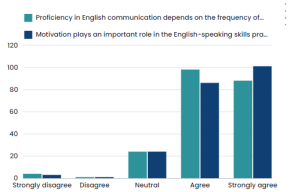
Figure 4.1.1: “Proficiency in English communication depends on the frequency of practice” and “Motivation plays an important role in the English-speaking skills practiced by student.”
There are two opinions in Figure 1: Proficiency in English communication depends on the frequency of practice, and Motivation plays an important role in the English-speaking skills practiced by students. Several people agree and strongly agree that Proficiency in English communication depends on the frequency of practice up to 98 and 88 participants. People who have a neutral attitude about this opinion are 24, and only five participants disagree and strongly disagree. Around 101 participants strongly agree, and 86 students agree that Motivation plays an important role in the English-speaking skills practiced by students. Only 04 students disagree and strongly disagree with this opinion. The number of people who have a neutral attitude toward the second opinion is 24.
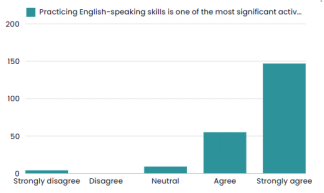
Figure 4.1.2: Practicing English-speaking skills is one of the most significant activities of English-majored students.
Figure 2 is Practicing English-speaking skills is one of the most significant activities of English-majored students. While the total of people who agree and strongly agree with this opinion is 202 participants, only 04 students strongly disagree, and 09 students have neutral ideas about this opinion.
This figure respectively consists of 9 factors: Grammar, Vocabulary, Background knowledge, Pronunciation, Expression, Idea, Confidence, Fear of Public speaking, and Fear of making mistakes, which are known as the factors that affect students’ English-speaking skills.
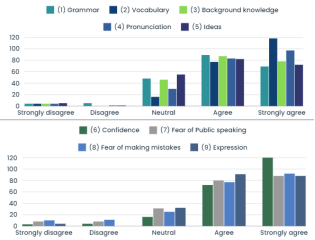
Figure 4.1.3: The factors that affect students’ motivation in practicing English-speaking skills
The first factor is Grammar, in which 04 participants (1.9%) strongly disagree, and 05 participants (2.3%) disagree. About 22.3% of participants (equivalent to 48 people) have neutral ideas about this factor. 89 and 69 participants (41.4% and 32.1%) agree and strongly agree. Vocabulary, Background knowledge, Pronunciation, and Expression are the factors that have 04 participants strongly disagree (1.9%). Except for the Pronunciation factor, the 03 other factors have no participants disagree with them. When the questions mention the Vocabulary factor, 118 people strongly agree (54.9%), 77 participants agree (35.8%), and 16 people take a neutral stance (7.4%). Background knowledge has 78 participants strongly agree (36.3%), 87 participants agree with this factor (40.4%), and 46 people have a neutral opinion (21.4%). According to the data on the Pronunciation factor, 97 students strongly agree (45%), 83 students agree (38.6%), 30 students stay neutral (14%), and only 01 students disagree with this factor (0.5%). Mentioning the Expression, 88 participants strongly agree (40.9%), 91 participants agree (42.3%), and 32 participants stay neutral (14.9%). When it comes to the Ideas factor, 72 participants strongly agree (33.5%), 82 participants agree (38.1%), 55 participants take a neutral stance (25.6%), 01 participant disagrees (0.5%), and 05 participants strongly disagree (2.3%). Regarding the Confidence factor, 120 people completely agree (55.8%), 72 people agree (33.5%), 16 people remain impartial (7.4%), 04 people disagree (1.9%), and 03 people strongly disagree with this factor (1.4%). Finally, regarding Fear of Public speaking and making mistakes, the number of students who respectively strongly agree with these two factors, 88 and 98 students (41% and 42.8%), 80 and 77 students agree (37.2% and 35.8%), 31 and 25 are unbiased (14.4% and 11.6%). Regarding the Fear of Public speaking, the number of participants who strongly disagree is equivalent to those who disagree, with 08 participants with each opinion (3.7%). In terms of Fear of making mistakes, 11 participants disagree (5.1%), and 10 participants strongly disagree (4.7%).
A table of descriptive statistics is a way to represent the participants' answers in numerical values. The table shows the average of the answers and the deviation, emphasizing to what extent the participants agree or disagree with the statements in the numerical values. There are four columns in the table. The first one shows the characteristics that the author researched, the second column (N) describes the number of objectives or participants, the third column (Mean) shows the average of the responses of each characteristic, and the final column (Std. Deviation) illustrates the deviation of the total answers per characteristics. The numbers in the third column (Mean) can be described as:
- 1.00 to 1.49: Strongly disagree
- 1.50 to 2.49: Disagree
- 2.50 to 3.49: Neutral
- 3.50 to 4.49: Agree
- 4.50 to 5.00: Strongly agree
|
|
N |
Mean |
Std. Deviation |
Valid N (listwise) |
215 215 215 215 215 215 215 215 215 215 |
4.00 4.42 4.09 4.25 4.00 4.40 4.08 4.06 4.20
|
.899 .786 .860 .848 .907 .820 1.018 1.090 .829
|
Table 4.1.1: Descriptive statistics of Figure 3
Table 4.1.1 is the descriptive statistics of Figure 3, the factors that affect students’ motivation in practicing English-speaking skills. Most of the participants agree with the 09 characteristics in the table. In terms of the highest rate is Vocabulary (2), up to 4.42. Confidence (6) is the second highest factor, up to 4.40. Pronunciation (4) is 4,25, and Expression (9) is 4.20. The rate of other characteristics such as Grammar (1), Background knowledge (3), Ideas (4), Fear of Public speaking (7), and Fear of making mistakes (8) are around 4.00 to 4.09. The values illustrate that all of the above factors, especially Vocabulary, Confidence, Pronunciation, and Expression, affect students’ motivation to practice English-speaking skills.
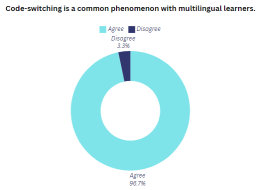
Figure 4.1.4: CS is a common phenomenon with multilingual learners.
The pie chart above shows participants' opinions about the statement: " CS is a common phenomenon with multilingual learners." The response rate was 96.7% agreed (208 students, blue), and 3.3% chose to disagree (07 students, red).
The following figure describes to what extent students agree with the statements related to how CS affects the motivation to practice English-speaking Skills and students' attitudes about the effects of CS on the motivation to practice English-speaking Skills. There are 09 statements: CS can improve Vocabulary (1), improve Grammar (2), approach new knowledge (3), have ideas to practice speaking (4), effectively express the ideas (5), improve Pronunciation (6), become more confident in practicing speaking (7), reduce the fear of public speaking (8) and fear of making mistakes (9).
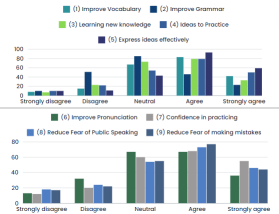
Figure 4.1.5: How CS afects the motivation to practice English-speaking skills
CS can improve Vocabulary (1) 08 participants strongly disagree with this statement (3.7%), 15 participants disagree (7%), 67 participants stay neutral (31.2%), 83 participants agree (38.6%), and 42 participants strongly agree with this statement (19.5%).
CS can improve Grammar (2) 10 students completely disagree (4.7%), 51 students disagree (23.7%), 85 students maintain neutrality (39.5%), 46 students agree, and 23 students strongly agree with this statement (21.4% and 10.7%).
CS can help students approach new knowledge (3) 07 participants strongly disagree with this opinion (3.3%), 23 participants disagree (10.7%), 73 participants take a neutral stance (34%), 79 participants agree, and 33 totally agree that CS can help students learn new knowledge (36.7% and 15.3%).
CS can provide students with ideas to practice (4) and effectively express their ideas (5) two opinions have the same number of participants who strongly disagree up to 10 (4.7%), 22 participants disagree with CS can provide students with ideas to practice (10.2%) and 11 participants disagree with CS can help learners effectively express their ideas (5.1%), the number of participants maintains their neutrality with the two statements respectively 54 (25.1%) and 43 (20%), 79 participants agree with CS can provide students with ideas to practice (36.7%) and 92 participants agree with CS can help learners effectively express their ideas, the number of strongly agree is 50 participants of CS can provide students with ideas to practice (23.3%)) and 59 participants of CS can help learners effectively express their ideas (27.4%).
In terms of CS can improve Pronunciation (6), 13 students completely disagree (6%), 32 students disagree (14.9%), 67 students stay neutral (31.2%), equivalent to the number of students who agree with this statement, 36 students strongly agree that CS can improve Pronunciation (16.7%).
CS provides students with confidence in practicing (7) 12 participants strongly disagree (5.6%), 20 participants disagree (9.3%), 60 take a neutral stance (27.9%), 68 participants agree (31.6%), and 55 participants strongly agree that CS provides students with confidence in practicing (25.6%).
CS can reduce the fear of public speaking (8) and the fear of making mistakes (9); in turn, 18 and 17 students (8.3% and 7.9%) strongly disagree that CS can reduce the fear of public speaking and the fear of making mistakes, 24 and 22 students disagree (11.3% and 10.2%), maintaining neutral is 54 and 55 students (25.1% and 25.6%), 73 and 77 students agree that CS can reduce the fear public speaking and the fear making mistakes (34% and 35.8%), 46 students strongly agree with CS can ease the fear of both public speaking (21.4%) and 44 students strongly agree with CS can reduce the fear of making mistakes (20.5%).
|
|
N |
Mean |
Std. Deviation |
|
(1) Improve Vocabulary (2) Improve Grammar (3) Learning new knowledge (4) Ideas to Practice (5) Express ideas effectively (6) Improve Pronunciation (7) Confidence in practicing (8) Reduce Fear of Public Speaking (9) Reduce Fear of making mistakes Valid N (listwise) |
215 215 215 215 215 215 215 215 215 215 |
3.63 3.09 3.50 3.40 3.83 3.39 3.64 3.49 3.51
|
.995 1.040 .985 .853 1.037 1.113 1.127 1.187 1.160
|
Table 4.1.2: Descriptive statistics of Figure 5
Table 4.1.2 is the descriptive statistic of Figure 5, how CS affects the motivation to practice English-speaking Skills. Two main groups represent two attitudes. The first group consists of Express ideas effectively (5) with a peak rate of 3.83, Confidence in practicing (9) up to 3.64, Improve Vocabulary (1) is 3.63, Reduce Fear of making mistakes (9) is 3.51, and Learning new knowledge (3) up to 3.50. The other group consists of Reduce Fear of Public Speaking (8) up to 3.49, Ideas to Practice (4) is 3.40, Improve Pronunciation (6) up to 3.39, and Improve Grammar (1) with a rate of 3.09.
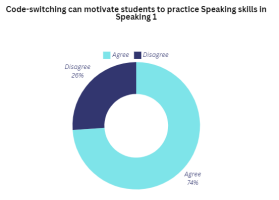
Figure 4.1.6: Code-switching can motivate students to practice Speaking skills in Speaking 1
The pie chart above shows the attitude of students about the statement: Code-switching can motivate students to practice Speaking skills in Speaking 1. 74% (light blue) of participants agree that Code-switching can motivate students to practice Speaking skills in Speaking 1. The rate of disagreement is up to 26% (dark blue).
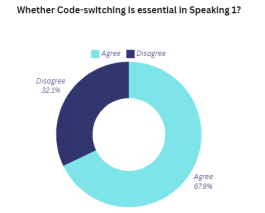
Figure 4.1.7: Whether CS is essential in Speaking 1?
This pie chart shows students' perceptions about whether CS is essential in Speaking 1. The number of students who agree that CS is essential in Speaking 1 is up to 67.9%. On the contrary, 32.1% of students do not agree with this statement.
An open-ended question: " How does CS affect your practice of English-speaking skills?" was added to the questionnaire to clarify the research question. According to the 105 responses, there are both advantages and disadvantages.
- The advantages:
+ Vocabulary: Practicing and using English frequently helps students understand, learn, and engage with vocabulary more easily and effectively. Some students believe that CS enables them to understand the context of the conversation because there are some untranslatable words.
+ Reflexes, creativity, and flexibility in multilingual communication: CS helps students get used to using multi-language, which improves their reflexes, creativity, and flexibility in communication. Some participants believe that CS helps them practice thinking in the target languages.
+ Expression: Some students believe that they can effectively express their ideas while practicing their English-speaking skills. CS motivates them to practice expressing their ideas in some languages, which helps them get familiar with expressing ideas in a specific language. In certain utterances, it is pivotal to describe some untranslatable words. Therefore, it allows students to effectively convey the ideas.
+ Confidence: CS provides learners with opportunities to practice their English-speaking skills. For weak students, it allows them to practice speaking in English and Vietnamese, making students used to speaking in both languages and confident in practice. In addition, CS helps students strengthen their vocabulary, making students more likely to practice confidently.
+ Knowledge: CS provides students with chances to access new knowledge during the conversation, which motivates students to learn and explore. It supports students in learning to understand the context of some words, which helps them develop their background knowledge.
- The disadvantages:
+ Uncomfortable for listeners: To some listeners, CS makes them have to spend time translating and thinking to understand the conversation, which makes listeners feel uncomfortable. Moreover, some people do not learn foreign languages; CS makes them feel uncomfortable.
+ Reliant on one language, forming habits, language disorder: Students believe that CS makes them depend on one language. In an utterance, they don't remember how to say that word in the target language, so they code-switch to another. In the long term, they tend to focus on one language more than others, leading to negative impacts on speaking skills in other languages. Long-term CS also makes them form a habit or language disorder, which can reduce their professionalism in some situations.
Discussion
This research focuses on how using CS affects the motivation of practice in English-speaking skills of students of English major at the Faculty of Foreign Language of Van Lang University. Regarding whether CS can become a teaching approach or a learning method, this research focuses on which factors can affect students' motivation to practice English-speaking skills and how CS can improve those factors. Based on the data in Table 1, it can be seen that the participants in this research believe that Grammar, Vocabulary, Background knowledge, Pronunciation, Ideas, Confidence, Fear of Public speaking, Fear of making mistakes, and Expression are the factors that affect students’ motivation to practice English-speaking skills. However, some factors have a greater impact on motivation than others, such as Vocabulary, Confidence, Pronunciation, and Expression, from 4.20 to 4.42. Derived from the values in Table 2 there are two main groups: In the first group, participants agreed that CS can help them feel more confident while practicing, express ideas effectively, improve Vocabulary, reduce the Fear of making mistakes, and learn new knowledge, from 3.50 to 3.83. The values of the second group illustrate that participants taking a neutral stance with Code-switching can reduce Fear of Public Speaking, come up with Ideas to Practice, improve Pronunciation, and improve Grammar. The research also illustrates some advantages and disadvantages of CS in students' practice. The advantages are learning and engaging with vocabulary, developing reflexes, creativity, and flexibility in multilingual communication, effectively expressing and describing, confidence in students' practicing, the opportunity to practice their English-speaking skills, and motivating students to learn about culture and knowledge. The disadvantages are that CS can make listeners feel uncomfortable during utterances, CS may lead to students being more likely to depend on one language, causing students to form bad habits, and CS leads to miscommunication with people who do not study foreign languages.
Concerning the expression factor, there are some untranslatable words that are only effectively expressed in their language, so CS is unavoidable. In addition, for students who are limited in their knowledge, CS provides them the opportunity to use and practice the language frequently; the more opportunities to practice they have, the more motivation to practice English-speaking skills. Additionally, using CS can help with information related to the culture of higher knowledge level. It will motivate students to research and learn about that point of knowledge. Not only does it develop students' knowledge but also supports students in learning and strengthening their vocabulary. Knowledge, vocabulary, and expression are the main factors in speaking skills. Therefore, when students code-switch, they can improve those factors, which makes them more confident and more likely to engage in practicing their English-speaking skills.
When students become more confident in practicing, the fear of making mistakes will be reduced. CS is a good method for students who want to improve the 05 critical factors: Expression, Confidence, Vocabulary, Fear of making mistakes and learning new knowledge. However, CS does not have a significant effect on the Fear of Public Speaking, Ideas to Practice, Pronunciation, and Grammar. Furthermore, there are some disadvantages of CS, such as being uncomfortable for listeners, reliance on one language, forming habits, and miscommunication with people who do not learn foreign languages. Therefore, CS can be utilized as a learning approach for students to reinforce their knowledge, vocabulary, and confidence in practice, but students should be more careful in applying CS to improve their pronunciation and grammar along with selective usage to avoid making the listeners feel uncomfortable, reliance on one language, forming habits, and miscommunication with people who do not learn foreign languages. Moreover, depending on the results, CS is pivotal in teaching some special knowledge. It is shown that CS is inevitable, and lecturers can apply it as a pedagogically useful communication resource in their classes.
Regarding the scope of the participants, the author does the research among English-majored students at the Faculty of Foreign Languages of Van Lang University. Therefore, the outcomes are most applicable to the Faculty of Foreign Languages at Van Lang University. To other multilingual learners and universities, this paper could be a reference to evaluate Code-switching. In addition, this study lacks perspectives from educators and interviews of learners from other institutions. In general, " CS " is more likely to be an academic linguistic term that is not familiar to students. This limitation leads to a longer time to finish the research. Because the findings of this research rely on self-reported data, it can be biased. Moreover, the study mainly focuses on practicing speaking skills, consequently, the findings cannot apply to other skills, such as reading, writing, and listening.
Although certain people may disagree that CS should be used as a teaching method, itis inevitable in many aspects, especially in teaching and learning English-speaking skills for educators and students. This study provides the educators as well as the learners with a comprehensive perspective on the impact of CS on students' motivation to practice English-speaking skills. Derived from the findings, educators and English learners can find the most appropriate ways to utilize Code-switching.
Regarding the use of CS in teaching speaking skill at beginner’s level (Speaking 1), the teacher should understand that CS, despite its disadvantages, is very common and can facilitate students’ learning process at this early level as it can be used in several ways:
- Supporting students’ comprehension of unfamiliar or untranslatable information
- Reducing the anxiety of using English in weaker students while their language knowledge is still limited, causing fear to speak English.
- Scaffolding ideas for students’ speeches or conversations with the teacher’s input in vocabulary or grammar when needed.
- Enhancing interaction between the teacher and students and among students as students do not feel the pressure to use English all the time.
The teacher should learn how and when to use CS strategically and purposefully, together with setting clear expectations and encouraging students to limit use of their native language as they progress.
Conclusion
With the intention of analyzing how using CS affects the motivation of practice in English-speaking skills, this paper conducted research among 215 English-majored students at the Faculty of Foreign Language of Van Lang University. The results illustrate 05 factors that affect the motivation of students, consisting of Grammar, Background knowledge, Ideas, Fear of Public speaking, and Fear of making mistakes. Certain factors exert more influence than those 05 factors: Vocabulary is the peak factor, the following factor is Confidence, the third is Pronunciation, and the final one is Expression. Those factors are more likely to have a greater impact on the motivation to practice English-speaking skills of students. Even though there is no significant effect of CS on students' motivation, according to the values, CS has a positive effect on some specific factors that affect the motivation to practice English-speaking skills.
These are the factors that the participants believe that CS will help them improve: (1) CS enables students to express their ideas effectively, (2) CS provides students with the confidence to practice English-speaking skills, (3) CS can enrich participants' vocabulary, (4) CS also helps students reduce the fear of making mistakes while practicing, and (5) Students agree that they can learn new knowledge when they code-switch. Derived from the result of the study, CS can become a pedagogically useful resource during class. Although it cannot become a teaching approach, CS can become a beneficial method for students to learn new knowledge, enrich vocabulary, express ideas effectively, become more confident, and reduce the fear of making mistakes so that they can motivate themselves while practicing English-speaking skills.
It is recommended that educators leverage the use of CS in the classroom in order to enhance students’ engagement and performance. This could be used as a pedagogic tool to encourage students to explore difficult subjects in their own language before using English. It can also help foster students’ confidence through positive enforcement in an environment where the teacher is supportive and understanding and students’ making mistakes is viewed as a natural process. CS can also be utilized as an opportunity for students to look at the two languages from a cross-cultural viewpoint, which enriches their linguistic knowledge and makes language learning more meaningful and engaging.
Acknowledgement
The author of this article acknowledged the support of Van Lang University at 69/68 Dang Thuy Tram St., Binh Loi Trung Ward, Ho Chi Minh City, Vietnam.
References
Arifin, W. L. (2017). Psychological Problems and Challenge in EFL Speaking Classroom. Register Journal/Register, 10 (1), 29. https://doi.org/10.18326/rgt.v10i1.29-47
Azlan, N. M. N. I., & Narasuman, S. (2013). The role of code-switching as a communicative tool in an ESL teacher education classroom. Procedia: Social & Behavioral Sciences, 90, 458–467. https://doi.org/10.1016/j.sbspro.2013.07.115
Bahrani, T., & Soltani, R. (2012). How to teach speaking skill? Journal of Education and Practice, 3(2), 25–29. https://www.iiste.org/Journals/index.php/JEP/article/view/1147/1068
Cahyani, H., De Courcy, M., & Barnett, J. (2016). Teachers’ code-switching in bilingual classrooms: exploring pedagogical and sociocultural functions. International Journal of Bilingual Education and Bilingualism, 21(4), 465–479. https://doi.org/10.1080/13670050.2016.1189509
Gort, M. (2012). Code-Switching Patterns in the Writing-Related Talk of Young Emergent Bilinguals. Journal of Literacy Research, 44(1), 45–75. https://doi.org/10.1177/1086296x11431626
Haden, P. (2019). Inferential statistics. The Cambridge Handbook of Computing Education Research, 133–172. https://books.google.com.vn/books?hl=vi&lr=&id=vmAwEAAAQBAJ&oi=fnd&pg=PA133&dq=30.%09Haden,+P.+(2019).+Inferential+statistics.+The+Cambridge+handbook+of+computing+education+research,+133-172.+&ots=1mrEEP6ZhE&sig=KPGWKq9aOIkErVWCmLYV_eRnvTk&redir_esc=y#v=onepage&q&f=false
Hamzehlou Moghadam, S., Abdul Samad, A., & Rahmani Shahraki, E. (2012). Code switching as a medium of instruction in an EFL classroom. Theory and Practice in Language Studies, 2(11), 2219–2225. https://doi.org/10.4304/tpls.2.11.2219-2225
Heredia, R. R., & Altarriba, J. (2001). Bilingual language mixing: Why do Bilinguals Code-Switch? Current Directions in Psychological Science, 10(5), 164–168. https://doi.org/10.1111/1467-8721.00140
Holmes, J. (2013). An Introduction to Sociolinguistics (4th ed.). Routledge. https://doi.org/10.4324/9781315833057
Hughes, C. E., Shaunessy, E. S., Brice, A. R., Anne Ratliff, M., & Alvarez McHatton, P. (2006). Code switching among bilingual and limited English proficient students: Possible indicators of giftedness. Journal for the Education of the Gifted, 30(1), 7–28. https://files.eric.ed.gov/fulltext/EJ750758.pdf
Ihsan, M. D. (2016). Students’ motivation in speaking English. JEES (Journal of English Educators Society), 1(1). https://doi.org/10.21070/jees.v1i1.147
Jamshidi, A., & Navehebrahim, M. (2013). Learners use of code switching in the English as a foreign language classroom. Australian Journal of Basic and Applied Sciences, 7(1), 186–190. https://www.researchgate.net/profile/Mahdieh-Navehebrahim/publication/343306958_Learners_Use_of_Code_Switching_in_the_English_as_a_Foreign_Language_Classroom_1/links/5f22a2d1a6fdcccc4399527e/Learners-Use-of-Code-Switching-in-the-English-as-a-Foreign-Language-Classroom-1.pdf
Johansson, S. (2014). Code-switching in the English classroom : What teachers do and what their students wish they did. DIVA. https://www.diva-portal.org/smash/record.jsf?pid=diva2%3A691914&dswid=5970
Johns, R. (2010). Linkert Items and Scales. Survey Question Bank: Methods Fact Sheet 1. https://dam.ukdataservice.ac.uk/media/262829/discover_likertfactsheet.pdf
Joshi, A., Kale, S., Chandel, S., & Pal, D. (n.d.). Likert Scale: Explored and Explained. British Journal of Applied Science and Technology, 7(4), 396–403. https://doi.org/10.9734/bjast/2015/14975
Kafryawan, W. (2019). The influence of motivation on EFL learners’ speaking skills. ELS Journal on Interdisciplinary Studies in Humanities, 2(4), 612–619. https://doi.org/10.34050/els-jish.v2i4.8846
Menggo, S. (2018). English Learning Motivation and Speaking Ability. JPAI (Journal of Psychology and Instruction), 2(2), 70. https://doi.org/10.23887/jpai.v2i2.15979
Ngugi, G. N. (2015). Code-switching as a Communication Strategy in Secondary Schools: a Case Study of St.francis Girls’ High School, Mang’u. http://erepository.uonbi.ac.ke/handle/11295/95001
Palmer, D . (2007). What is the best way to motivate students in science?. Teaching Science, 53(1), 38–42. https://www.proquest.com/openview/3451a221fd928ec93a7a0ee3f655b1e2/1?pq-origsite=gscholar&cbl=29558
Palmer, D. K. (2009). Code-Switching and symbolic power in a Second-Grade Two-Way classroom: A teacher’s motivation system gone awry. Bilingual Research Journal, 32(1), 42–59. https://doi.org/10.1080/15235880902965854
Sert, O. (2005, July 1). The functions of Code-Switching in ELT classrooms. https://eric.ed.gov/?id=ED496119
Silalahi, D. E. (2018, November 9). Correlation between Students’ Learning Motivation and speaking Competence at SFL FKIP University HKBP Nomensen. https://ijels.com/detail/correlation-between-students-learning-motivation-and-speaking-competence-at-sfl-fkip-university-hkbp-nomensen/
Skiba, R. (1997). Code switching as a countenance of language interference. The Internet TESL Journal, 3(10). http://iteslj.org/Articles/Skiba-CodeSwitching.html
Temesgen, A., Hailu, E. (2022, September 20). Teachers’ codeswitching in EFL classrooms: Functions and motivations. Cogent Education, Vol. 9. https://www.tandfonline.com/doi/full/10.1080/2331186X.2022.2124039#abstract
Vetter, T. R. (2017). Descriptive statistics: Reporting the answers to the 5 basic questions of who, what, why, when, where, And a sixth, So what? Anesthesia and Analgesia/Anesthesia & Analgesia, 125(5), 1797–1802. https://doi.org/10.1213/ane.0000000000002471
Vu Phi Ho, P. (2018). Fluency as Successful Communication. In 1st National Conference on English Language Teaching Upgrade: A Focus on Fluency, 15–24. https://www.researchgate.net/profile/International-Journal-Of-Tesol-Education/publication/329584415_FLUENCY_AS_SUCCESSFUL_COMMUNICATION/links/5c108fd892851c39ebe6b781/FLUENCY-AS-SUCCESSFUL-COMMUNICATION.pdf
Williams, K. C., & Williams, C. C. (2011). Five key ingredients for improving Student motivation. Research in Higher Education Journal.
Wilona, A., Ngadiman, A., & Palupi, R. (2010). The correlation between intrinsic motivation and speaking proficiency of the English Department students. Magister Scientiae, 27, 45–56. http://journal.wima.ac.id/index.php/Magister_Scientiae/article/viewFile/645/617
Younes, Z. B., & Albalawi, F. (2016). Investigating the factors leading to speaking difficulties: both perspectives of EFL Saudi learners and their teachers. Social Science Research Network. https://doi.org/10.2139/ssrn.2814824
The Cambridge Handbook of Computing Education Research. (n.d.). Google Books. https://books.google.com.vn/books?hl=en&lr=&id=vmAwEAAAQBAJ&oi=fnd&pg=PA133&dq=inferential+statistics+definitions&ots=1mrxLV3R9E&sig=Q4SWPzP2tKbE4vo0tr8NHcdO-z8&redir_esc=y#v=onepage&q=inferential%20statistics%20definitions&f=false
Please check the Pilgrims in Segovia Teacher Training courses 2026 at Pilgrims website
Study Program for English for Information Technology Specialists in the Air Navigation Sector
C. Dora M. Troitiño Díaz, CubaPerceptions of Students in Using ChatGPT in Translation Subjects at Van Lang University
Le Bao Chau, Vietnam;Pham Que Anh, VietnamSmall Words Big Impact - Three Barriers to Level 2 Success in the STANAG 6001 Writing Exam: Tenses, Auxiliaries, and Text Complexity
Robert Helán, Czech Republic;Radomira Bednářová, Czech RepublicCode-Switching and its Impacts on Students’ Motivation of Practice in English Speaking at Van Lang University
Ton Thien Quynh Tram, Vietnam; Nguyen Bach Hue, Vietnam