- Home
- Various Articles - Tertiary/CLIL
- Perceptions of Students in Using ChatGPT in Translation Subjects at Van Lang University
Perceptions of Students in Using ChatGPT in Translation Subjects at Van Lang University
Le Bao Chau is a graduate of Van Lang University, Ho Chi Minh City. Her research interests include the application of artificial intelligence in language learning, translation studies, and technology-enhanced English education.
Pham Que Anh is an English lecturer at the Faculty of Languages, Van Lang University. She often teaches English skills and English major subjects like Phonetics, IT application in language learning, Morphology and Syntax, and Translation. Her research interests include language teaching methodology, fostering students' motivation, and applying CALL in EFL teaching at tertiary levels.
Abstract
The research employed mixed-method approach to investigate students’ perspectives and challenges on utilizing ChatGPT in translation subjects. A questionnaire with 17 items based on the Technology Acceptance Model (TAM) was sent to 132 juniors and seniors in English major at Van Lang University to collect data. The data revealed that students identify ChatGPT as a useful tool to help them learn translation subjects effectively. Moreover, ten students were chosen randomly to join semi-structured interviews with the aim of delving deeper into their challenges. It can be seen that there are three risks including cognitive, linguistic and technical that students encounter. This research recommends that students should use ChatGPT as a supportive tool and use it responsibly to avoid these risks.
Introduction
Background of the study
According to Hamarashid et al. (2023), integrating ChatGPT into education is an important contribution in shaping the model of teaching and learning. The integration of ChatGPT can bring some benefits to students while using it in translating languages such as receiving high- quality outputs (Klimova et al., 2024), finding and correcting errors (Paton, 2024). While the advantages of ChatGPT are recognized, the influence has not been deeply explored, suggesting that it is critical to investigate the students’ perceptions and challenges when using this tool in translation subjects. Depending on the perceptions of students, experts can optimize translation teaching methods to improve learning outcomes.
Objectives of the study
The study aims to discover the perceptions of students while utilizing ChatGPT in translation subjects. Through examining students' experiences and attitudes, this research highlights the positive and negative aspects of ChatGPT in translation subjects. Also, from the two factors, the challenges of students will be revealed to help educators and students have an overall perspective about using ChatGPT in translation subjects.
Research questions
The intention of using ChatGPT was to investigate perceptions and challenges faced by students through two essential research questions:
R.Q.1: How do students perceive the use of ChatGPT in Translation subjects?
R.Q.2: What are students’ challenges while using ChatGPT?
This research holds practical implications for educational institutions, especially those aiming to incorporate AI tools into translation instruction. This study may encourage more thoughtful and strategic use of ChatGPT. Furthermore, the research can help both students and educators develop a more critical and informed perspective on the tool’s capabilities and limitations. As a result, it can seek to bridge the gap between AI innovation and pedagogical effectiveness and help students to enhance digital literacy and critical thinking skills in using technology for translation.
Scope of the study
This study concentrates on exploring the utilization of students and their obstacles by using ChatGPT in translation subjects at Van Lang University. The study also examines how 132 junior and senior English major students apply ChatGPT in general text translation tasks as part of their coursework. Data was gathered in three weeks through mixed methods, which included quantitative and qualitative. This study is limited to one university and does not attempt to evaluate the accuracy of ChatGPT’s translations in professional or literary contexts. Instead, it concentrates on the student experience and educational implications within a classroom setting.
Literature review
The use of ChatGPT in translation education
ChatGPT, known as ChatGPT Playground or Chat Generative Pre-Trained Transformer (Halaweh, 2023), is recognized as a supportive tool in translating activities, such as identifying and correcting grammatical errors, making it a valuable tool for enhancing language proficiency (Atlas, 2023). Hamdan (2024) pointed out that ChatGPT could translate idioms from English to Arabic accurately and create different versions of translations. As can be seen from the above studies, students can access ChatGPT and utilize it easily; however, in the research of Ren (2025), the author stated that students in China had trouble accessing ChatGPT due to the internet regulations. Despite the difficulties, the participants included undergraduate and postgraduate students from English major recognized ChatGPT as a valuable tool for learning and practicing translation assignments, as it could help them enhance their grades and expand their career paths. This study aligns with the above studies, highlighting the features of ChatGPT in enhancing language proficiency, but it fails to help students access ChatGPT directly.
Students’ perception of using ChatGPT in translation
Hatibu (2024) examined the perception of students in the first semester regarding the utilization of Google Translate and ChatGPT in learning. The results indicated that students preferred to use Google Translate over ChatGPT in translating words and phrases. However, this research is just limited to examining 50 students so the result is quite subjective. Unlike Hatibu (2024), Almhasees et al. (2024) conducted research to explore the perceptions and utilization of students in using ChatGPT to translate English-Arabic tasks. The results indicated that in the efficiency aspect, the speed of ChatGPT was highly evaluated but there were some mistakes that needed to be corrected in the accuracy. Also, in the ease of use aspect, it received positive feedback due to the friendly interface and reliability of this tool. Lastly, in the final theme – overall preference, it showed that participants were highly satisfied with the performance of ChatGPT and had the intention to introduce this tool to others. Through a deep examination of participants, it revealed that ChatGPT was highly evaluated in academic context. This aligns with the focus of the study, which investigates the perception of students while using ChatGPT in translation subjects through Google form.
Students’ challenges of using ChatGPT in translation
Errors expression is one of the challenges that students encounter while using ChatGPT in translation learning. Through the research of Abidah et al. (2024), the results indicated that ChatGPT had difficulties in translating complicated words with specific themes, such as education, tourism, and literature. The study of Abidah (2024) highlighted that ChatGPT had difficulties with complicated texts in literature, scientific research, medical reports, and legal documents. Errors expression in the current research is the use of words that are not appropriate for the technical context, this makes students misunderstand the content or producing translations that lack the necessary accuracy.
Furthermore, the research of Wang et al. (2023) pointed out that ChatGPT has difficulty in handling contextual and cultural factors, leading to inaccurate translations. The present study aligns with the research of Smith and Specia (2016), highlighted that this tool often process text sentence by sentence, ignoring the connecting elements between sentences, resulting in a translation that lacks coherence and fails to maintain the logic of the original text. Using this tool also poses many challenges, especially for inexperienced students.
Theoretical framework
According to Davis (1989), TAM stands for Technology Acceptance Model, including two factors that impact the intention of users in using a new technology: perceived usefulness (PU), a specific system can enhance their work effectiveness and perceived ease of use (PEU), using a specific system will be free from effort. Venkatesh and Davis (2000) claimed that two main factors affect attitude towards using (ATT), represent users’ positive or negative perception and behavioral intentions to use (BI), which is the level of people's intention to perform a certain behavior.
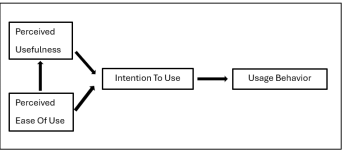
Figure 2.7.1
Extension of Technology Acceptance Model
Note. From Venkatesh and Davis (2000, p. 188)
To expand the use of TAM in translation, X. Li et al. (2024) conducted a study to test TAM including the effectiveness of computer and perceived enjoyment of students in using translation technologies. The results indicated a positive outcome of perceived ease of use and enjoyment from computer self-efficacy. Perceived enjoyment boosted perceived ease of use and attitude. This paper emphasizes the benefits while using TAM, highlighting that TAM is a simple theoretical model and it can be used easily in translation education. Through the survey, researchers can make recommendations for designing translation education that integrates ChatGPT more effectively. The results from the survey can help lecturers comprehend how students approach and use ChatGPT in translation subjects
Gaps in existing literature
Many studies have been conducted to explore the use of Artificial Intelligence tools such as Google Translate. Tumbal et al. (2022) found that students responded positively that this tool could help them translate sentences from English to Indonesian easily, but it was ineffective for paragraphs. The authors concluded that using Google Translate in translation was useful for students; however, it was suggested that students should not over-rely on this tool. This research aligns with the concerns of Alammar & AbdelReheem Amin (2023) that using AI can lead to a dependence on AI tools heavily.
These studies just focused on traditional translation tools and have not explored deeply in using advanced language models such as ChatGPT. Karpinska and Iyyer (2023) claimed that in translating paragraph ChatGPT has fewer incorrect translations stylistic inconsistencies in comparison to Google Translate. Moreover, ChatGPT can provide both translation and explanations of the reasons for specific word choices or sentence structures; however, these aspects have not been analyzed deeply. In addition, there has rarely been research focused on students’ perceptions and challenges of ChatGPT in translation subjects, especially in integrating ChatGPT in Vietnamese higher education contexts. This research will focus on investigating the students’ perceptions and challenges while using ChatGPT in translation subjects.
Method and procedure
Pedagogical setting and participants
The present study was conducted at the Faculty of English at Van Lang University, a private institution in Vietnam. The institution provides a variety of modules related to language courses such as Translation 1&2, which help students enhance their skills to translate effectively between English and Vietnamese, Vietnamese and English. Students are allowed to use ChatGPT in translation subjects but it is not officially integrated into the curriculum. The study encompassed 132 students included juniors and seniors, who learned Translation 1&2 in the English faculty at a private university in Vietnam. Furthermore, ten participants were chosen randomly to attend the interview to comprehend the challenges of students. To ensure the confidentiality of participants, pseudonyms were used in the process of analyzing the interview transcript. This pedagogical setting will contribute to discussions on the role of ChatGPT in translation and provide information to integrate it into program education.
Design of the study
A mixed-method approach was employed in the current research. The participants in English language faculty received a questionnaire form and 10 students were selected randomly to join the interview. There were 17 questions in the survey with a 5-point Likert scale ranging from “strongly disagreed” to “strongly agreed”.
The survey was designed based on TAM model to examine the perception of students while using ChatGPT in translation, which included 4 factors: Perceived Usefulness (PU)- 6 items, Perceived Ease of Use (PEU)- 4 items, Attitude towards Using (ATT)-5 items; and Behavioral Intention to Use (BI)- 3 items. These items were adapted from various sources (Al-Azawei et al., 2016; Andriani et al., 2023; Gao et al., 2024; Dianati et al., 2022).
The questions based on a 5-point Likert scale were evaluated highly regarding reliability and validity, as stated by Kusmaryono et al. (2022). Also, the reliability was evaluated according to Cronbach’s Alpha (Jain & Angural, 2017) with a total score of 0.766, as calculated by SPSS version 26.
There were at least 132 students who participated in the survey with a 95% confidence level and a 5% margin of error. Further, ten students were chosen randomly to participate in the semi-structured interview. The interview lasted from 15 to 20 minutes, students answered 17 yes- no questions based on the questionnaire and there had some additional questions to clarify the challenges of students. Their responses were interpreted into these steps, as stated by Braun and Clarke (2006):
Step 1: Read and noted down the ideas that were relevant to qualitative data.
Step 2: Coded data in systematically, each code represented to special features.
Step 3: Grouped the similar themes.
Step 4: Checked relation of themes and generated a thematic map.
Step 5: Analyzed the features of themes and named themes.
Step 6: Analyzed the chosen sections, linked it to the research question, literature and produced a report.
Results and discussion
Findings
To answer two research questions, the questionnaires and the interview were used to explore the perception of students and their challenges while using ChatGPT in translation subjects.
Research question 1: How do students perceive the use of ChatGPT in Translation subjects?
Table 1
Students’ perceived usefulness of ChatGPT in Translation subjects
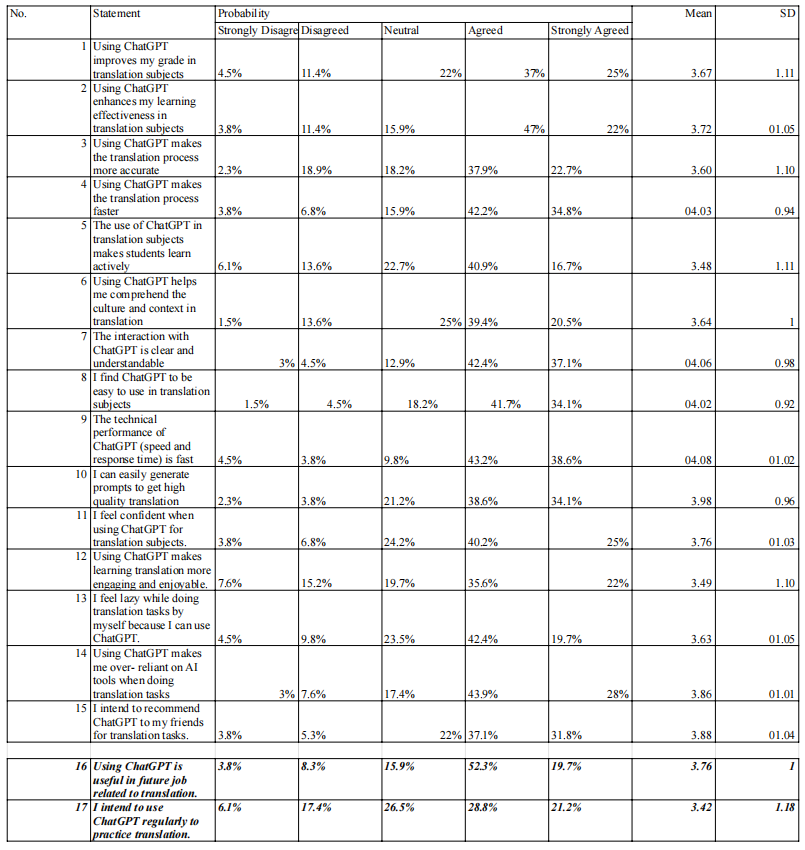
Regarding perceived usefulness (Items 1–6), most participants agreed that ChatGPT was a valuable tool for translation subjects, particularly in translation speed, accuracy, and learning effectiveness. About 77% and 69% of respondents agreed and strongly agreed that ChatGPT was an effective tool for increasing translation speed and improving learning effectiveness.
In terms of perceived ease of use (Items 7–10), most of the participants (82%) agreed that the performance of ChatGPT was fast and the interaction of ChatGPT was clear and understandable (nearly 80%). Moreover, there were 75,8% and 72.7% students who had intention to use because it was easy to create effective prompts to enhance the quality of translation.
However, when examining attitude toward using ChatGPT (Items 11–14), the results revealed the drawbacks, as 62.1% and 71.9% of participants had an intention to feel lazy and over reliant on AI tools in case of utilizing ChatGPT for translation assignments. This indicates that while students recognize the benefits of ChatGPT, they also acknowledge the risks of dependence on AI-generated translations.
Finally, the findings related to behavioral intention to use (Items 15–17), there was 72% and 68.9% of participants who tended to agree that ChatGPT would be beneficial in their translation careers and they would recommend ChatGPT to their friends for translation tasks, indicating widespread utilization of its effectiveness. However, the percentage of item 13 was the lowest, with 6.1% strongly disagreed and 17.4% disagreed. Although it is a valuable tool in translation, students do not integrate it into their regular study routines.
Research question 2: What are students’ challenges while using ChatGPT in translation subjects?
The interview questions were designed based on a questionnaire to investigate the challenges of students while using ChatGPT in translation. These difficulties were divided into three main groups: Cognitive risks, linguistic risks, and technical risks. Each group is analyzed based on the answers from participants.
Cognitive risks
At the beginning, some students used ChatGPT as a supportive tool in translation courses and they used it all the time to complete translation assignments. This reduced the ability to learn independently, as students were no longer actively involved in the translation process. This change not only affected learning outcomes, but also had a long-term influence on the development of learners’ language skills. Furthermore, it made students lose initiative in learning. Some students admitted that their level of dependence:
“Now I depend on ChatGPT about 50%. Initially, I translated assignments completely on my own. But after 2-3 exercises, I started using AI tool. Finally, I would just review ChatGPT's translations and only edit translations when mistakes were found.” (P7)
In addition, deadline is a big problem that leads to overreliance. Participant 6 shared:
“Sometimes, I feel dependent on ChatGPT, especially when using it to meet urgent deadlines. It's become a solution for last-minute assignments."
Speed and efficiency are key factors in academic context, from that students easily choose the optimal solution – using AI tools instead of developing their own assignments. However, this will make them lose their learning ability without the help of ChatGPT.
Some students admitted that the utilization of ChatGPT reduced their motivation, memory and creativity:
“The use of ChatGPT limits creativity, I just think about using it and I do not want to learn new vocabularies.” (P5)
Linguistic risks
1 Grammatical errors: While ChatGPT generates text rapidly and with accuracy at a basic level, it often has grammatical errors when applied to academic settings. Some students revealed that they had to adjust grammar and structure to meet assignment requirements while utilizing ChatGPT in translation:
“ChatGPT can translate quickly, but I have to correct grammatical errors.” ( P8)
“While translating from Vietnamese to English, I need to correct grammatical errors.” (P4)
Students without a grammatical foundation had to face this challenge, as they struggled to identify and correct errors. Over-reliance on ChatGPT translations without the necessary grammatical skills could lead to a reduction of effectiveness in developing translation skills.
2 Accuracy: Students reported that the translations generated by ChatGPT were not close to the original meaning and it was not coherent:
“ChatGPT is effective in speed but not completely accurate, I have to double or triple check the translations.” (P1)
“Using AI too much will lead to unnatural sentences or follow its structure.” (P7)
Particularly, in assignments requiring creativity such as literary translation or news, students found that ChatGPT failed to fully convey the emotion and meaning.
3 Technical risks: Cultural and contextual inappropriacy. In translation, especially when translating documents with cultural elements, understanding the context is extremely important. However, ChatGPT just produced general answers without detailed context information:
“ChatGPT does not support culture and context, I have to consult different sources.” (P1)
The lack of deep context and culture affected translation quality and caused serious misunderstandings when translating cultural or historical documents. This forced learners to consult additional books, lectures or other trusted sources to understand and revise the translation.
4 Challenges in prompt engineering and output accuracy: Many students revealed that if prompts were not clear, the output translation would not meet the requirements:
“ChatGPT does not provide the expected output if the prompt is unclear.” (P8)
This limitation forced students to learn how to generate the prompt in a detailed and structured way. In addition, students also had to try many times to adjust the command to make output usable, which was time-consuming and easily frustrating when they did not get the expected results.
5 Overtranslation: Some students found that ChatGPT added information which was not relevant to the original text:
“Sometimes, ChatGPT adds some irrelevant information when translating the paragraph.”(P10)
This led to the reduction of accuracy and students had difficulties in finding and correcting mistakes because they could not identify the original meaning and added information.
Discussion
Students’ perceptions of utilizing ChatGPT in translation subjects
Overall, based on the results of the study, it is obvious that most students have explored ChatGPT helps them complete translation tasks faster and improve their learning effectiveness according to the TAM model. This is in line with the study of Almhasees et al. (2024) which showed the opinions of students that ChatGPT could enhance learning effectively and produced accurate translations. Especially, in the case of having fully background information and research context, ChatGPT proves the ability to translate complex context, which is more excellent than traditional machine translation.
Data from the study suggested that the perceived ease of use of ChatGPT impacts on the participants’ intention to utilize the tool. This is in line with the research of Alshurideh et al. (2024), who stated that the necessary of improving and designing AI tools with user-friendly and accessible interfaces to promote their widespread adoption and use in academic settings. Many students, who participated in this research believed that ChatGPT was a useful tool, this view is completely consistent with the above authors, who stated that students used it as a reliable resource in academic settings.
Students’ challenges while using ChatGPT in translation subjects
The answers of the participants showed there were agreements that using ChatGPT led to concerns and could be categorized into three major types of risks: cognitive, linguistic, and technical.
The over-reliance on ChatGPT has raised concerns regarding its bad influence on human cognition, particularly in critical thinking and memory. According to Zhang et al. (2024), using AI for a long time could reduce critical thinking skills of students, cause they tended to accept all the answers of AI. The authors also claimed that students who used ChatGPT for exam preparation had lower grades than those who studied traditional methods. This suggests that when students frequently use ChatGPT to find out information instead of recalling it, their memory is weakened day by day.
Beyond cognitive concerns, linguistic risks are another serious issue that needs to be considered in the use of ChatGPT for translation. Many students who participated in the study admitted that they no longer attempted to improve their language skills because they used ChatGPT in translation. This mindset led to a degradation in their linguistic proficiency. If these problems are not addressed clearly, the language skills of students may become weakened.
Although ChatGPT can provide fast translations, it still has many technical limitations, especially in structure and context. Stap and Araabi (2023) highlighted that ChatGPT was an unreliable tool in translation because it could not translate complex or unfamiliar language structures due to a lack of data. Sometimes, the translations of ChatGPT cannot reflect the author’s intention or lack precision in technical terminology.
Implications for teaching & learning
The use of ChatGPT in translation courses should not be viewed simply as the introduction of a new technological tool. From a pedagogical perspective, it offers meaningful opportunities to support students in developing analytical and critical thinking skills in translation. Based on students’ perspectives, ChatGPT is not only seen as a tool for producing translations but also as a resource that allows them to compare different versions and reflect on language choices. This indicates that when guided appropriately, ChatGPT can play a supportive role in translation learning rather than replacing students’ own effort.
According to Jurenka et al. (2024), the rapid advancement of artificial intelligence requires translation curricula to be updated on a regular basis so that students can keep pace with current learning trends and professional practices. Incorporating AI-related content into translation courses helps ensure that students are exposed to tools that are increasingly used in the translation industry. From the students’ point of view, learning how to work with tools such as ChatGPT enhances their readiness for the job market, which is more technology-driven compared to the past.
However, students also raised concerns about the potential drawbacks of using ChatGPT too frequently, particularly the risk of becoming overly dependent on AI and engaging less deeply with translation tasks. To address this issue, BlackDuke and Akosubo (2024) suggest a teaching approach in which students first complete translation tasks in class without the assistance of ChatGPT, and then redo the same tasks at home using the tool. The two versions are subsequently compared and discussed in class to highlight the advantages and limitations of both human and AI-assisted translations. This approach aligns well with students’ learning experiences, as it encourages them to actively evaluate ChatGPT’s output instead of accepting it without reflection. Through guided comparison, students become more aware of linguistic accuracy and contextual suitability—areas where AI-generated translations may still lack. More importantly, this teaching strategy helps reduce the negative impact of ChatGPT use while maximizing its value as a learning aid.
In addition, ChatGPT can work well as a scaffolding tool for less confident students, helping them notice linguistic patterns they might otherwise miss. But lecturers must treat it as a starting point rather than a final answer. Students need specific training to catch the robotic or inaccurate outputs that AI often generates. Besides, because AI is so accessible, traditional take-home assignments need a makeover. Moving toward in-class tasks or asking students to critique AI output is a much better way to see their progress. It is also vital to build AI ethics directly into the curriculum. Educators should be aware of students' professional responsibilities. If AI is implemented through structured, critical activities, students can grow without sacrificing academic integrity.
In summary, the findings suggest that the effectiveness of ChatGPT in translation education depends largely on how it is implemented. Rather than allowing unrestricted use, lecturers should design structured activities that promote critical comparison and reflective learning. In this way, ChatGPT can be integrated into translation courses in a manner that supports students’ skill development while preserving learner autonomy and academic integrity.
Conclusions and recommendations
With the development of technology, the application of ChatGPT in education is no longer restricted, particularly in translation subjects. Through this study, it can be seen that students have a positive attitude toward the utilization of ChatGPT in translation, especially in improving speed, quality of translation and learning effectiveness. However, it is also important to recognize three types of risks while using ChatGPT.
Several limitations of this study should be acknowledged. The sample size is limited in terms of academic level and population, and the study does not explore the challenges and solutions in depth, highlighting gaps in understanding the difficulties and solutions of students when using ChatGPT in translation subjects. Despite these limitations, the current study provides valuable insights into perceptions of students in using ChatGPT in translation subjects at Van Lang university.
Although this study provides useful information, there are some suggestions for further research that the utilization of ChatGPT in translation subjects should be expanded to clarify the role of it and in- depth perceptions of students in translation learning. The future studies can expand the sample size in educational institutions, academic levels, and translation programs to have a comprehensive view of students’ perceptions in using ChatGPT in translation learning. In conclusion, it is necessary to have more studies about integrating AI translation tools into academic settings.
References
Abidah, N. K. K., Hikmawati, R., & Erawanto, V. (2024). ChatGPT in Indonesia-Arabic Translation: A quality analysis. Abidah | Al-Arabi: Jurnal Bahasa Arab Dan Pengajarannya = Al-Arabi: Journal of Teaching Arabic as a Foreign Language. https://doi.org/10.17977/um056v8i1p33-52
Alammar, A., & Abdel-Reheem Amin, E. (2023). EFL Students’ Perception of Using AI Paraphrasing Tools in English Language Research Projects. Arab World English Journal, 14(3), 166–181. https://doi.org/10.24093/awej/vol14no3.11
Almhasees, Z., Rayyash, H. A., Olimat, S., & Mahadin, D. (2024). An Analytical study on student perceptions of using CHATGPT in Language translation. Language Value. https://doi.org/10.6035/languagev.7925
Alshurideh, M., Jdaitawi, A., Sukkari, L., Al-Gasaymeh, A., Alzoubi, H. M., Damra, Y., Yasin, S., Kurdi, B. A., & Alshurideh, H. (2024). Factors affecting ChatGPT use in education employing TAM: A Jordanian universities’ perspective. International Journal of Data and Network Science, 8(3), 1599–1606. https://doi.org/10.5267/j.ijdns.2024.3.007
Atlas, S. (2023). ChatGPT for higher education: Opportunities and challenges [Report]. College of Business, University of Illinois.
BlackDuke, S. E., & Akosubo, D. S. (2024). The Challenges of AI in the Translation Class: What Do the Learners Lose? Port Harcourt Journal Of History & Diplomatic Studies. https://phjhds.com/wp-content/uploads/2024/12/12.-The-Challenges-of-AI- in-the-Translation-Class.pdf
Braun, V., & Clarke, V. (2006). Using thematic analysis in psychology. Qualitative
Research in Psychology, 3(2), 77–101. https://doi.org/10.1191/1478088706qp063oa
Cochran, W. G. (1977). Sampling techniques (3rd ed.). New York: John Wiley & Sons
Davis, F. D. (1989). Perceived usefulness, perceived ease of use, and user acceptance of information technology. MIS Quarterly, 13(3), 319. https://doi.org/10.2307/249008
Wang, R., & Hou, F. (2024). How to Design Translation Prompts for ChatGPT: An Empirical Study. In Proceedings of the 6th ACM International Conference on Multimedia in Asia Workshops (pp. 1-7). https://doi.org/10.1145/3700410.3702123
Halaweh, M. (2023). ChatGPT in education: Strategies for responsible implementation.
Contemporary Educational Technology, 15(2), ep421. https://doi.org/10.30935/cedtech/13036
Hamarashid, H., Karim, L., & Muhammed, D. (2023). ChatGPT and Large Language Models: Unraveling Multifaceted Applications, Hallucinations, and Knowledge Extraction. Indonesian Journal of Curriculum and Educational Technology Studies, 11(2), 60-70. https://doi.org/10.15294/ijcets.v11i2.
Hamdan, S. (2024). Exploring the Efficiency of ChatGPT vs. Google Translate in Translating Idioms and Idiomatic Expressions: “The Catcher in the Rye” as a Case Study. http://hdl.handle.net/20.500.14131/1795
Hatibu, H. (2024). Students perceptions on the utilization of ChatGPT and Google Translate in English language learning. Journal of Innovation Research and Knowledge, 4(7), 4611-4616. https://bajangjournal.com/index.php/JIRK/article/view/9047
Jain, S., & Angural, V. (2017). Use of Cronbach's alpha in dental research. Medico Research Chronicles, 4(03), 285-291. https://medrech.com/index.php/medrech/article/view/242
Jurenka, I., Kunesch, M., McKee, K. R., Gillick, D., Zhu, S., Wiltberger, S., Phal, S. M., Hermann, K., Kasenberg, D., Bhoopchand, A., Anand, A., Pîslar, M., Chan, S., Wang, L., She, J., Mahmoudieh, P., Rysbek, A., Ko, W., Huber, A., Ibrahim, L.
(2024). Towards Responsible Development of Generative AI for Education: An Evaluation-Driven Approach. arXiv.org. https://arxiv.org/abs/2407.1268
Karpinska, M., & Iyyer, M. (2023). Large language models effectively leverage document- level context for literary translation, but critical errors persist. Cornell University. https://doi.org/10.48550/arxiv.2304.03245
Klimova, B., Pikhart, M., & Al-Obaydi, L. H. (2024). Exploring the potential of ChatGPT for foreign language education at the university level. Frontiers in Psychology, 15. https://doi.org/10.3389/fpsyg.2024.1269319
Paton, B. (2024). Will ChatGPT change the game for language translation? Localize. https://localizejs.com/articles/chatgpt-for-translation
Ren, X. (2025). We want but we can’t: measuring EFL translation majors’ intention to use ChatGPT in their translation practice. Humanities and Social Sciences Communications, 12(1). https://doi.org/10.1057/s41599-025-04604-6
Tumbal, S., Liando, N. V., & Olii, S. T. (2022). Students’ perceptions toward the use of Google Translate in translating. Kompetensi, 1(02), 313–320. https://doi.org/10.53682/kompetensi.v1i02.1853
Venkatesh, V., & Davis, F. D. (2000). A theoretical extension of the technology acceptance model: four longitudinal field studies. Management Science, 46(2), 186–204. https://doi.org/10.1287/mnsc.46.2.186.11926
Zhang, S., Zhao, X., Zhou, T., & Kim, J. H. (2024). Do you have AI dependency? The roles of academic self-efficacy, academic stress, and performance expectations on problematic AI usage behavior. International Journal of Educational Technology in Higher Education, 21(1). https://doi.org/10.1186/s41239-024-00467-0
Please check the Pilgrims in Segovia Teacher Training courses 2026 at Pilgrims website.
Study Program for English for Information Technology Specialists in the Air Navigation Sector
C. Dora M. Troitiño Díaz, CubaPerceptions of Students in Using ChatGPT in Translation Subjects at Van Lang University
Le Bao Chau, Vietnam;Pham Que Anh, VietnamSmall Words Big Impact - Three Barriers to Level 2 Success in the STANAG 6001 Writing Exam: Tenses, Auxiliaries, and Text Complexity
Robert Helán, Czech Republic;Radomira Bednářová, Czech RepublicCode-Switching and its Impacts on Students’ Motivation of Practice in English Speaking at Van Lang University
Ton Thien Quynh Tram, Vietnam; Nguyen Bach Hue, Vietnam