- Home
- Various Articles - Tertiary/CLIL
- Small Words Big Impact - Three Barriers to Level 2 Success in the STANAG 6001 Writing Exam: Tenses, Auxiliaries, and Text Complexity
Small Words Big Impact - Three Barriers to Level 2 Success in the STANAG 6001 Writing Exam: Tenses, Auxiliaries, and Text Complexity
Robert Helán works in Testing Department at University of Defence Language Center, where he specializes in English language assessment based on STANAG 6001 levels 1-3. His responsibilities include developing tests for these proficiency levels. His research interests center on learner corpora, corpus tools, and data-driven learning. Additionally, he serves as the principal investigator for the Language Center’s project, "Long-Term Development Plan of the Organization" (DZRO in Czech).
Radomíra Bednářová is a member of Testing Department at University of Defence Language Center, focusing on English language evaluation aligned with STANAG 6001 proficiency levels. Currently, she is engaged in designing testing items as well as administering the exams. Earlier on, she taught medical English to both undergraduate and postgraduate students, as well as to healthcare professionals. Throughout her career, she has engaged in numerous initiatives, broadening her expertise in language education and assessment.
Introduction
Within any military environment, regardless of geographical territory, there is a strong need for collaboration. The English language has long been serving as the lingua franca of international military communication and instruction within NATO structures, alongside the French language (see Review of NATO International Policy, 2011). The policy covers the entire spectrum of positions within the military, ranging from the top commanding ones to the lowest-ranking settings. The NATO Standardization Agreement 6001 (ie STANAG 6001) represents a standardized framework for assessing operational readiness in language proficiency across varied military environments in any member country.
Generally, for military personnel, it is obligatory to have their language proficiency levels recognized and evaluated in a structured way. This happens in four key areas: listening, speaking, reading, and writing. The assessment scale ranges from Level 0, which indicates no functional ability in the target language, to Level 5, which reflects the proficiency of a highly articulate native speaker. These standardized levels are essential for ensuring that military personnel possess the necessary linguistic competencies to communicate effectively in multinational and operational settings (Green & Wall, 2005; Monaghan, 2012).
Within this structure, level 2 holds particular significance as the level of “Functional Proficiency” (Written Examination: Level 2 Criteria of Assessment), representing the point at which individuals are expected to carry out their duties without direct supervision or language support. Reaching this level suggests that a person can manage both everyday communication in the target language, along with more complex interactions, that may occur simply when at work or during their deployments or operational tasks elsewhere. It also defines the military staff´s eligibility for international courses (Crossey, 2005).
For military students across NATO countries, achieving level 2 in the STANAG 6001 English language exam is not merely an academic requirement—it is a milestone with direct implications for graduation, operational deployment, and professional advancement. Military personnel must be able to communicate effectively in English with individuals from diverse cultural and linguistic backgrounds, particularly in high-stakes situations (Siegel et al., 2024). At University of Defence in Brno, Czech Republic, English language training is a compulsory and integral part of students’ study programmes. Yet, despite targeted preparation and formal instruction, many students repeatedly fail to reach level 2 in the writing component.
Despite quite a number of training programs and available institutional support, many military students find the writing component of level 2 STANAG 6001 exams particularly daunting. While the shift from level 0 to 1+ is often managed successfully, progression beyond that is frequently hindered. Although shortcomings in general language proficiency are commonly identified as the cause of failure, closer examination reveals a more precise explanation: many candidates fail to progress owing to persistent, systematic weaknesses in their written English—weaknesses which, though relatively subtle, exert a disproportionately strong effect on assessment outcomes.
This article draws on corpus-based research involving 240 written responses by 120 students at STANAG levels 1, 1+, and 2, and focuses on three critical and often underestimated barriers that repeatedly hinder students from passing level 2: (1) incorrect tense marking through suffix errors, (2) wrong use of auxiliary verbs, and (3) underdeveloped syntactic complexity. Rather than addressing every possible error type in the corpus, we offer a focused examination of these three features because they consistently correlate with failure at level 2 and can be meaningfully addressed in classroom practice.
Research findings ˗ Barrier 1: Tense errors through suffix misuse
It is incorrect marking of tense through suffixes which belongs among the most persistent obstacles observed. These errors, while seemingly minor, often result in the student being rated at level 1+ or below:
What does this look like? Consider the difference between the following:
· “I report the incident yesterday.”
· “I reported the incident yesterday.”
While the intended message is clear in both, the absence of the past tense marker “-ed” in the first example indicates a grammatical gap that STANAG raters cannot overlook—especially at level 2, where candidates are expected to accurately report past events.
Corpus analysis of 240 texts revealed that suffix-related errors accounted for over 27% of all morphosyntactic issues, and were particularly concentrated at level 1, where over half of such errors occurred.
We observed patterns in which students at this level often either:
· omit a suffix entirely (“He walk to the office”),
· add an extra suffix (“He is lookings angry”), or
· use a wrong suffix (“They goed back yesterday”).
These are not slips—they are systematic errors showing that the student has not yet internalized how English uses suffixes and needs to anchor verbs temporally. The STANAG descriptor for this level explicitly requires candidates to “narrate current, past, and future activities in complete, but simple paragraphs.” (STANAG 6001, A-8). This demands not just vocabulary or idea development, but grammatical accuracy in verb forms. Inability to clearly mark past/future tense is crucial, as Level 2 requires narrating past events or making future-oriented recommendations.
Pedagogical implications: the persistent confusion with tense suffixes indicates gaps in learners' morphological awareness, especially under test conditions that demand fluency and accuracy at the same time. Teachers can navigate exam candidates through practices based on corpus research, such as
- narrative drilling with time anchoring when we regularly assign timed “incident report” tasks with focus on time adverbs (yesterday, last week, tomorrow) and require correct tense marking; later during practice, we may pair these with suffix-focused feedback
- visual tense timelines and form charts when we reinforce suffix use not just as grammar, but through communicative activity; linking suffixes to “when it happened” solidifies their functional purpose
Targeted drills focusing on tense formation through suffix usage—particularly within narrative and report-writing tasks—can be highly effective. Similarly, combining focused form drills with delayed peer correction activities, in which students identify and correct verb errors in anonymized excerpts from peer texts, is seen as equally beneficial.
Research findings ˗ Barrier 2: Auxiliary verb misuse
One of the most problematic grammatical issues observed in level 1+ and borderline level 2 writing is the misuse or absence of auxiliary verbs. These small grammatical words—be, do, have, and modal auxiliaries—are critical for accurate tense formation, active or passive voice, question structure, and negation. Yet they are often treated with less care than needed. Auxiliary-related mistakes accounted for nearly 15% of morphosyntactic errors in the corpus, with the highest concentration in level 1 texts. Misuse of auxiliaries with modal verbs (e.g., "should", "might", "must") was especially common, suggesting that students often struggle with understanding how auxiliary verbs interact with main verbs to signal mood, aspect, and tense. These errors frequently affect the accuracy of negative forms, interrogatives, and conditional sentences—structures that are integral to the types of writing tasks featured in the STANAG 6001 exam.
We observed patterns among which the following was happening:
Omission:
We going there next week. → We are going there next week.
Overuse or incorrect addition:
He did went home. → He went home.
Confusion of forms:
They was invited by the officer. → They were invited by the officer.
These errors interfere with clause-level grammatical cohesion and obscure intended time frames or relationships. At level 2, a candidate must be able to produce grammatically accurate and structurally complete messages across basic tenses and sentence types. Misuse of auxiliaries compromises this clarity and may place the writing below the assessment threshold of what is required for a level 2 rating. As one of the descriptor items says, candidates ideally “Can describe events and explain facts clearly using past and present tense structures.”
Pedagogical implications: auxiliary verbs are often treated as assumed knowledge, yet some of the presented error patterns are deeply rooted errors revealing a need for a stronger focus. Given their high frequency and function, auxiliaries deserve targeted practice—even at more advanced levels. Teachers can navigate exam candidates through some of the following practices, again based on the corpus:
- transformation exercises when learners regularly practice switching between affirmative, negative, and interrogative sentence forms; teachers may encourage oral rehearsal followed by writing to solidify verb pattern awareness
He goes to the briefing. → Does he go? / He doesn’t go.
- tense chain drills when learners are engaged in activities that scaffold auxiliaries across the range of tenses
I go → I went → I have gone → I will go
- error-spotting tasks when we may use anonymized class-generated examples to raise awareness and engage students in peer correction
Research findings ˗ Barrier 3: Lack of syntactic density
Alongside grammatical accuracy, level 2 performance is also shaped by the density and structure of the text itself. Successful candidates tend to produce texts with longer, more syntactically complex sentences, rich in modifiers, embedded clauses, and transitional phrases. This is reflected in the Flesch-Kincaid readability test (Kincaid et al., 1975), which utilized the scores from our corpus analysis: level 2 texts consistently registered lower scores (i.e., higher syntactic complexity), averaging 15.17 words per sentence compared to 12.9 at level 1.
We observed the following in the student writing:
- over-reliance on short, independent clauses:
I was in the army. I worked there. I liked it. - lack of subordination:
The mission failed. It was dark. They didn’t see anything. - poor lexical cohesion and missing connectives:
He didn’t go. The truck broke. The officer told him to stay.
Such writing lacks coherence and does not sufficiently demonstrate the writer’s ability to connect ideas logically and hierarchically—both of which are essential at level 2. Level 2 descriptors require the ability to “write structured and coherent messages that express relationships between ideas.” (Descriptor level 2 STANAG 6001). This level of discourse coherence is only achievable when learners can manipulate clause structure and link ideas through a range of cohesive devices.
Pedagogical implications: students stuck at level 1+ typically produce simple sequences of short sentences with minimal subordination. Apparently, teachers might want to consider several classroom techniques such as reinforcing activities, exploring sentence-combining and clause-expansion, i.e. exercises to cultivate syntactic feeling in language users. For example, have students rewrite isolated affirmative sequences (“I went to the base. I met the commander.”) into complex sentences that show time, cause, or contrast (“When I arrived at the base, I met the commander, who was waiting.”). Also, students must be exposed to a spectrum of activities that teach and model how to combine, expand, and connect ideas, rather than assume this skill will develop passively.
In-class techniques may involve such activities as sentence-combining tasks when we present students with sets of simple clauses and ask them to create compound and complex structures.
The mission failed. It was raining. They had no equipment.
→ The mission failed because it was raining, and the team had no equipment.
In expansion drills, we may ask students to rewrite short sentences using modifiers, relative clauses, or participial phrases.
The officer gave an order.
→ The officer got new information and gave a clear order to move.
In connective practice, we may teach signalling language for contrast, cause, sequence, and addition through using linkers such as however, as a result, in addition, although, and due to.
In text skeleton building, we may provide students with a logical idea map and have them generate a well-connected paragraph from prompts.
Practical suggestions for the classroom
Moving students from Level 1+ to 2 involves more than just error correction—it requires informed support that bridges grammatical form with communicative function. Some of the useful strategies involve:
- corpus-informed feedback, when we provide learners with authentic examples of peer errors and their improvements, we may opt to use an anonymized corpus excerpts to foster peer analysis and collaborative revision
- using grammar with purpose when we, instead of isolated drills, tie grammar instruction to communicative functions, for instance, use suffix instruction in the context of incident reports or mission plans
- employing sentence scaffolding, practice of which begins with model paragraphs, and gradual enhancement of sentence complexity through guided rewriting tasks, progressing from simple structures to compound and/or complex constructions
- repetitive drafting when we encourage multiple drafts to be produced, with each repetition targeting specific goals—first for clarity, then for lexical variety, and finally for syntactic complexity
Conclusion
The three identified barriers—tense suffix errors, auxiliary wrong use, and limited text complexity—may appear linguistically minor at first glance. However, their cumulative impact is considerable, frequently leading to performance outcomes that fall below level 2. For classroom practice, the significance is clear: instructional strategies must be precise, pattern-sensitive, and contextually informed. By systematically addressing these challenges, we can enhance learners’ prospects for success—not only in examinations but also in the operational demands of the standardized communication within NATO frameworks.
Please check the Pilgrims in Segovia Teacher Training courses 2026 at Pilgrims website.
Appendix
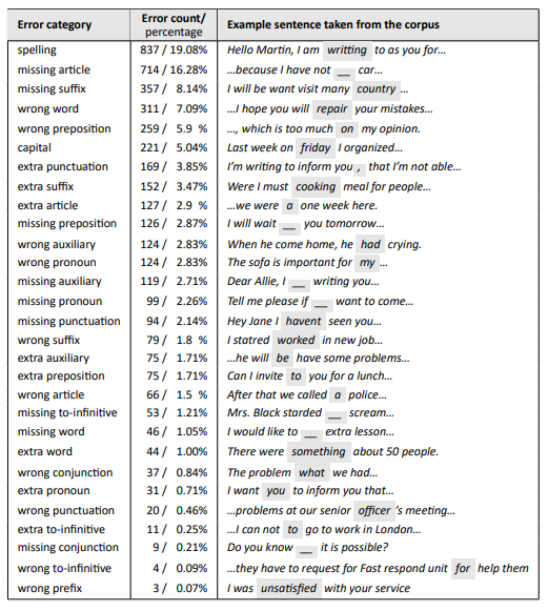
The following is a table of all the error types dealt with, with example sentences using James’s (2013, 37) classification framework for error types (i.e. omission, addition, and misformation) where appropriate – errors have been highlighted.
All error categories with error counts/percentages and example sentences (Helán, Bednářová, 2025, 100):
For teachers to check:
- Can students narrate clearly in present, past and future tenses?
- Do errors in auxiliary verbs occur rarely and not affect comprehension?
- Are modal verbs used in the different temporal forms accurately?
- Are sentences varied, connected through a range of conjunctions and connecting devices?
- Can the users of language combine and link sentences into a paragraph-length discourse?
- Is cohesion within paragraphs evident?
References
Review of the Language Policy for the International Staff of NATO https://www.nato.int/structur/recruit/info-doc/ON(2011)0026-ImplementingDirLanguagePolicyIS.pdf Retrieved on 20 May, 2025
BILC. (n.d.) STANAG 6001. Retrieved on 15 July, 2025 from https://www.natobilc.org/en/products/stanag-60011142_stanag-6001/.
BILC. (n.d.) Advanced Testing Booklet - writing proficiency descriptor overview for base and plus levels (2024). Testing Seminar Materials
BILC. Written Examination: Level 2 Criteria of Assessment. STANAG 6001. Presentation from Instructional Manual (2023) Microsoft Word file.
Crossey, Mark (2005)“Improving Linguistic Interoperability.” NATO Review, no 2. Retrieved 10 July, 2025
Green, R., Wall, D. (2005) Language Testing in the Military: Problems, Politics, and Progress. Language Testing, vol 22, no. 3, pp. 379-398
Helán, R., Bednářová, R. (2025). Error analysis and frequency in the writing section of the STANAG 6001 English examination among military students: A corpus-based study of proficiency level variations. CASALC Review, 14(2), 79–101. https://doi.org/10.5817/CASALC2024-2-4
James, C. (2013). Errors in Language Learning and Use: Exploring Error Analysis. Routledge.
Kincaid, J. P., Fishburne, R. P. Jr., Rogers, R. L., & Chissom, B. S. (1975). Derivation of new readability formulas (automated readability index, fog count and Flesch reading ease formula) for Navy enlisted personnel (Research Branch Report 8–75). Chief of Naval Technical Training, Naval Air Station Memphis. (APA)
Monaghan, R. (2012). Language and interoperability in NATO. The Bureau for International Language Co-ordination (BILC). Canadian Military Journal, 13(1), 23–32.
Siegel, A., Vance, M., & Nilsson, D. (2024). Military English language education: a scoping review of 30 years of research. Innovation in Language Learning and Teaching, 1–19. https://doi.org/10.1080/17501229.2024.2370986
Please check the Pilgrims in Segovia Teacher Training courses 2026 at Pilgrims website.
Study Program for English for Information Technology Specialists in the Air Navigation Sector
C. Dora M. Troitiño Díaz, CubaPerceptions of Students in Using ChatGPT in Translation Subjects at Van Lang University
Le Bao Chau, Vietnam;Pham Que Anh, VietnamSmall Words Big Impact - Three Barriers to Level 2 Success in the STANAG 6001 Writing Exam: Tenses, Auxiliaries, and Text Complexity
Robert Helán, Czech Republic;Radomira Bednářová, Czech RepublicCode-Switching and its Impacts on Students’ Motivation of Practice in English Speaking at Van Lang University
Ton Thien Quynh Tram, Vietnam; Nguyen Bach Hue, Vietnam